Quick Take
- Narration: Gary Furlong handles the ensemble cast with clarity, keeping the overlapping timelines and multiple POVs legible without flattening the suspense.
- Themes: Social rot beneath old friendships, the weight of secrets, class and nostalgia
- Mood: Wintry and claustrophobic, slow-burning dread
- Verdict: If you want a closed-circle mystery with authentic emotional stakes and real atmosphere, this one delivers on both counts.
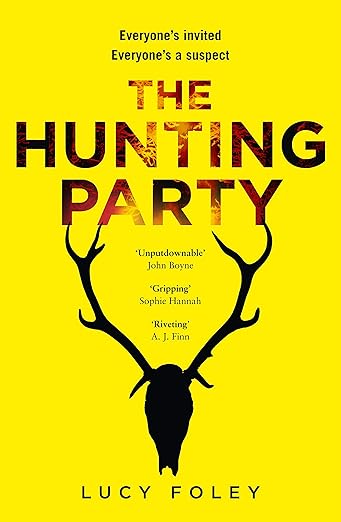
I started this one on a long evening in January, sleet tapping at the window, and I am not sure I could have chosen a better book for the conditions. The Hunting Party drops you straight into a Scottish Highlands estate sealed off by a historic blizzard, a group of Oxford friends gathered for New Year, and the knowledge that before midnight someone will be dead. Lucy Foley sets her mood early and never lets go of it.
What pulls the story apart from the average locked-room setup is the way Foley uses the gathering itself as a social autopsy. These are people who have been performing friendship for a decade, who chose the Highlands estate precisely for its isolation, and whose choice turns out to be less about celebration than avoidance. By the time the body appears, the question of who did it is almost secondary to the question of why any of them still show up for each other at all.
Our Take on The Hunting Party
Foley structures the novel in a dual timeline, cutting between the days leading up to New Year and the investigation after the death, with an additional perspective from the lodge gamekeeper and his assistant. It is a technique that could feel mechanical but here earns its keep. Each chapter resets the reader’s suspicion, and the reveals around the secret resentments feel genuinely earned rather than arbitrarily withheld. One reviewer described it as a traditional country house mystery in a contemporary setting and blazed through it in a couple of days. That captures the experience accurately: the book is propulsive in a way that Agatha Christie-adjacent fiction often fails to be because the characters feel like actual people rather than suspects with name tags. The boisterous revelry of New Year’s Eve, the champagne in front of the crackling fire, the weight of a decade of accumulated resentment underneath the surface nostalgia, Foley builds all of it with patience and precision.
Why Listen to The Hunting Party
The audiobook format works particularly well here because Gary Furlong keeps the vocal register consistent across what is a demanding cast of characters. He does not attempt to differentiate each voice theatrically, which would have been a mistake given how many overlapping perspectives the novel carries. Instead he reads with a controlled tension that matches the material. Listeners who come to audiobooks specifically for immersive genre fiction will find the experience satisfying. At just over ten hours, it is exactly the right length for a single weekend listen. The dual timeline structure that could disorient in print stays navigable in audio because Furlong manages the tonal shifts between past and present with enough care that you always know where you are in the story.
What to Watch For in The Hunting Party
The book is sometimes criticized for thin characterization on the male characters, and that critique has some validity. Foley is clearly more interested in her female characters, and the men tend to recede into type at certain moments. The villain, when revealed, may feel inevitable to readers who have spent time with classic country house fiction. If you come to this hoping for a genuinely surprising twist you may find the final reveal familiar. What you get instead is something that I would argue is more satisfying: a story about how friendships calcify into obligation, how old resentments get carried forward year after year until someone breaks, and what happens to a group when the cord holding them together finally snaps. The synopsis’s phrase about secret resentments growing too heavy for tenuous nostalgia is not just marketing copy. It is the actual architecture of the book, and Foley builds it with care.
Who Should Listen to The Hunting Party
Pick this up if you are a fan of Ruth Ware, Tana French, or the slower-burn end of psychological suspense. It rewards listeners who want character work alongside their mystery plotting. Skip it if you require breakneck pacing from page one, or if you have already read so much closed-circle fiction that the form’s mechanics are entirely transparent to you. Listeners new to Lucy Foley should know she followed this with The Guest List and The Paris Apartment, both of which riff on similar territory. The Hunting Party remains a strong entry point to her work.
Frequently Asked Questions
Do I need to have read other Lucy Foley novels before listening to The Hunting Party?
No. This is a standalone novel with no connection to her other books. It was her debut in this format, so it is a natural starting point for new readers of her work.
How well does Gary Furlong handle the multiple POV structure?
Furlong manages the ensemble cast competently without resorting to exaggerated character voices. The dual timeline, cutting between the days before the death and the aftermath, stays clear throughout, which is the main technical challenge of the performance.
Is the mystery solvable before the reveal?
Experienced mystery readers will likely narrow the field significantly by the midpoint. Foley plants fair clues, so the reveal is logical rather than shocking, but the emotional payoff in the final act is what most listeners remember long after.
Is this more mystery or psychological drama?
It leans toward psychological drama. The whodunit mechanics are present and functional, but the book is primarily interested in what sustained proximity and shared history does to a group of people who have outgrown each other.