Quick Take
- Narration: Henry Leyva brings an urban authenticity to Shy’s voice that suits Matt de la Pena’s style, keeping the pace urgent without sacrificing emotional depth.
- Themes: Survival against systemic forces, class and race in post-disaster America, the burden of dangerous knowledge
- Mood: Tense and kinetic, with an underlying current of social awareness
- Verdict: A sequel that raises the stakes from the cruise ship disaster of The Living into California’s fractured landscape, rewarding readers who started from the beginning.
I had a teenager in my orbit who devoured The Living in forty-eight hours and then looked at me with the particular urgency of someone who needs the next book immediately. That is how I ended up listening to The Hunted on a long drive, navigating Matt de la Pena’s post-disaster California alongside a kid who kept asking whether we were close to the end. We were not. The book has real pull, and it earns that pull through character rather than through action set pieces alone.
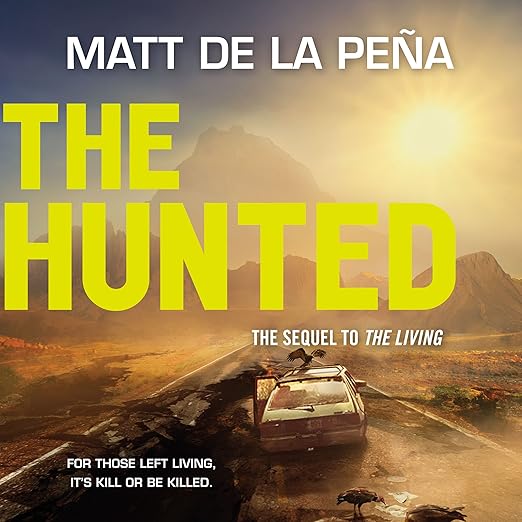
The setup follows directly from The Living: Shy has survived the wreck of the Paradise Cruise luxury liner, and he has emerged knowing something that powerful people would rather he did not know. Back in California, that knowledge makes him a moving target. Addie, the girl he connected with at sea, is somewhere out there, and finding her is bound up with surviving what is coming after him. De la Pena, who won the Newbery Medal for Last Stop on Market Street, is a writer who understands that YA adventure only works when the stakes feel real and the characters feel like people rather than plot functions.
Our Take on The Hunted
The California setting is one of the book’s strengths. De la Pena renders a post-disaster landscape that feels plausible rather than fantasized, and the class dynamics embedded in that landscape, who survived, who got resources, who is still being left behind, are consistent with his broader social concerns as a writer. The Entertainment Weekly comparison on the book’s cover, a plot-driven YA with characters worthy of a John Green novel, is useful shorthand: this is not the kind of YA that treats its characters as delivery mechanisms for plot. Shy carries the weight of what he has been through, and the book takes that weight seriously.
Why Listen to The Hunted
Henry Leyva’s narration is a strong match for this material. He brings an urban register to Shy’s voice that grounds the character’s perspective without caricature, and the urgency he maintains through the action sequences keeps the audio format from losing tension. De la Pena is cited by reviewers as someone who can bring a voice to urban youth and make it entertaining, and Leyva serves that voice faithfully. At just under eight and a half hours, the pacing rarely lets up: one reviewer read the physical book in a single day because of how it kept them hooked, and the audio version creates a comparable pull for a commute or road trip.
What to Watch For in The Hunted
This is explicitly a sequel, and the book assumes familiarity with the events and relationships established in The Living. Beginning with The Hunted without that context will mean arriving mid-story with missing emotional background for the character dynamics that matter most. The sci-fi element one reviewer mentioned, describing it as a bit of mystery mixed with sci-fi fantasy, is present but secondary to the survival thriller structure; listeners expecting hard science fiction should calibrate accordingly. The book also represents de la Pena operating at the more accessible end of his range: the social commentary is present but woven into the action rather than foregrounded as explicitly as in some of his other work.
Who Should Listen to The Hunted
The obvious audience is listeners who have already completed The Living and need to know what happens to Shy. For that audience, this delivers without reservation. YA readers who appreciate action-forward narratives with class and race awareness embedded in the plot will find de la Pena’s approach refreshing compared to the more domestic focus of much contemporary YA. Adults who read YA seriously, rather than apologetically, will find the Entertainment Weekly assessment accurate: the characters are worth caring about, which is the precondition for any adventure to work. De la Pena’s reputation as a Newbery Medal winner is not incidental here; his commitment to authentic character voice is present in every chapter. New readers should start with The Living.
Frequently Asked Questions
Do I need to read The Living before listening to The Hunted?
Yes. The Hunted is a direct sequel and begins where The Living ended. The character relationships, the secret Shy carries, and the disaster context are all established in the first book. Beginning with The Hunted without that context would significantly diminish the experience.
What age range is The Hunted appropriate for, and does the content require parental guidance for younger teens?
The book is generally appropriate for readers twelve and up. The survival thriller content includes violence and moments of genuine peril but is not graphic. The social commentary about class, race, and systemic failure is substantive enough to generate meaningful conversation for older teens.
Is The Hunted a standalone sequel, or does it end on another cliffhanger like The Living?
The series has multiple entries, and the Living Series arc continues beyond The Hunted. The book provides more resolution than The Living but does leave narrative threads open for the next installment. Listeners who want complete closure within a single audiobook should know the story continues.
How does Henry Leyva’s narration compare to other YA audiobook performers in terms of character differentiation?
Leyva is praised for the authenticity he brings to Shy’s voice and perspective. His character differentiation is competent rather than exceptional, with Shy’s voice being the standout performance. For a thriller with this pacing, his strength lies in maintaining tension rather than in ensemble character work.