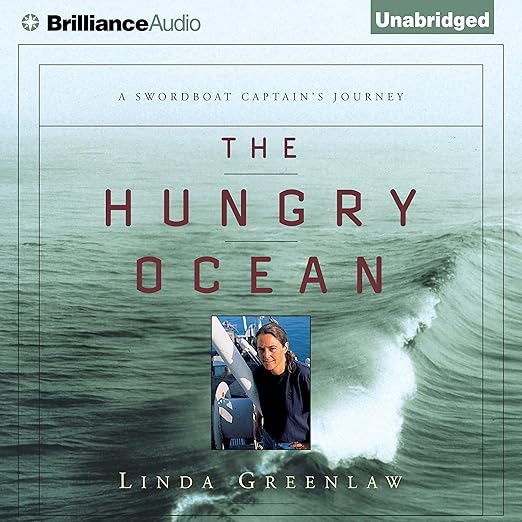
Linda Greenlaw's The Hungry Ocean is one of those audiobooks that benefits from an almost accidental endorsement: Sebastian Junger described her in The Perfect Storm as "one of the best sea captains, period, on the East Coast," and that assessment from a writer who spent serious time in the world of Grand Banks swordfishing opens this memoir with a credibility most authors cannot manufacture. Greenlaw narrates her own account, running six hours and three minutes, covering a thirty-day swordfishing voyage aboard one of the best-equipped boats on the East Coast. The excitement, she notes, starts before they leave the dock. That is not a figure of speech: the book's opening pages establish that the kind of decision-making governing a long-line swordfishing operation begins at the pier and does not stop until the last fish is aboard.
Commercial fishing memoirs occupy a crowded shelf, and what separates the best from the rest is the writer's ability to convey technical reality without losing the narrative thread, to make the reader understand how the work actually functions without turning the book into an instructional manual. Greenlaw does this as well as anyone in the genre. She is a working captain, and the operational details she provides, including how a swordfishing long-liner deploys gear, how weather and equipment failure interact under conditions of genuine physical pressure, and what constitutes "treachery aboard ship" in the specific culture of offshore fishing, are not researched approximations but lived knowledge. One reviewer who has read extensively in the genre and written their own commercial fishing book called The Hungry Ocean "one of the best," noting that from the first pages they felt as if they were "one of the crew heading out for a month-long trip to the Banks."
The Moby Dick comparison made in the synopsis is accurate in one specific sense: Greenlaw's crew are as distinct and colorful as any literary shipboard company. She renders each of her five crew members with the precision of someone who has spent thirty consecutive days in close quarters with them under physical pressure, which is the only condition under which you truly learn what someone is made of. The characters that emerge are not composites or archetypes but specific people with specific strengths and specific difficulties, rendered without sentimentality and without cruelty.
The Strengths
Greenlaw narrating herself is not incidental to the audiobook's quality. It is the central reason to choose audio over print. Her voice carries the dryness and authority of someone who has been at sea long enough to find its dangers unremarkable and its pleasures specific and hard-earned. The "true fisherman's gift for storytelling" the synopsis identifies is real and audible: she knows which detail to linger on and which to dispatch quickly, and those editorial instincts are present in the rhythm of her reading as much as in the writing itself. The thirty-day voyage structure provides a natural narrative arc, including departure, the first set of gear, the weather systems, the mechanical failures, and the personalities that surface under physical pressure, and Greenlaw's pacing through that arc is confident and unhurried.
Listeners who encountered Greenlaw through The Perfect Storm will find this account a significant enrichment of that earlier portrait. Junger's book gave her a cameo; here she is the captain, the center of the action, and the one making the decisions that keep the boat, the crew, and the operation functioning. One reviewer described the account as offering "a glimpse of life fishing for large catches of swordfish, battling weather and managing a team to accomplish a real goal," which is accurate as a description and understates how fully Greenlaw inhabits each element of that summary.
What to Watch For in The Hungry Ocean
The book is organized around the voyage itself but moves freely between operational description and character portrait. Greenlaw's leadership is a recurring subject without being a stated theme. The questions of how a woman in her mid-thirties commands a boat in an industry with specific cultural norms around authority are present in the text but not foregrounded as a feminist argument. She is interested in the work, and the authority she carries comes from the evidence of the work rather than from assertion. That restraint is both a strength and a distinction. The nasty weather sequences are handled with the controlled understatement of someone to whom nasty weather is an operational condition rather than a dramatic occasion. The equipment failure passages are similarly grounded: these are problems to be solved, logged, and moved past, not occasions for extended reflection.
The danger is constant but not sensationalized. Greenlaw's method is to describe the specific conditions, including sea state, equipment status, crew fatigue, and fish location, and let the accumulated specificity do the emotional work rather than reaching for language designed to make the reader feel the danger. The result is more frightening than sensationalized accounts of offshore fishing because the ordinariness of the risk is what makes it real. One reviewer who described wanting "a fascinating look at a job I don't want" captures the response: you understand, at the end of six hours, exactly what the job requires and exactly why Greenlaw is good at it.
Who Will Get the Most From It
This audiobook belongs to anyone who responds to the literature of dangerous physical labor. Readers of Sebastian Junger, Joe Simpson, Jon Krakauer, or Robert Kurson will find a natural companion in Greenlaw's account. Listeners who encountered the genre through The Perfect Storm and wanted more context for the world Junger described will find this the most direct path in: Greenlaw was Junger's source for the industry's specifics, and her memoir demonstrates why he trusted her. Those looking for a personal journey of self-discovery will find something different and arguably more interesting, a professional doing her job with extraordinary competence and describing it plainly. Skip it if you need strong narrative invention or dramatic arc-building in your reading; Greenlaw's method is observation and operational precision, not dramatization. For listeners who find that kind of clarity in professional memoir the most compelling thing a book can offer, The Hungry Ocean delivers it without compromise or self-congratulation.
- Read by: Linda Greenlaw narrates her own book, and the authority this brings to a commercial fishing memoir is non-negotiable; when the captain of a swordfishing boat describes managing weather and crew in the North Atlantic, the voice doing the telling matters enormously.
- At its heart: Commercial fishing as labor, leadership under physical extremity, the North Atlantic's indifference
- Vibe: Propulsive, salt-sprayed, and grounded in hard realism
- Short version: The definitive first-person account of commercial swordfishing in the Grand Banks era; Greenlaw's combination of operational precision and storytelling instinct makes this one of the best professional memoirs in the outdoor writing genre.