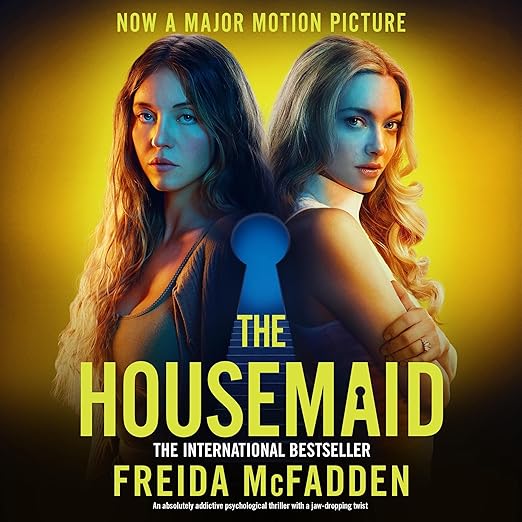
The Housemaid arrived in my listening queue at an interesting moment: I had just seen the trailer for the Sydney Sweeney and Amanda Seyfried film adaptation and found myself curious about whether the novel's considerable reputation could survive the weight of those casting expectations. Freida McFadden has sold over five million copies of this book, and domestic thrillers of its type tend to create a critical bifurcation between readers who find the plot architecture genuinely clever and readers who find it mechanical. I came away from Lauryn Allman's narration firmly in the first camp, with reservations that I want to be precise about.
The premise is deceptively simple: a young woman named Millie takes a job as housemaid for the Winchesters, a wealthy couple with a beautiful house and an expensive marble hallway and a marriage that is obviously, quietly, catastrophically wrong. McFadden builds the dread carefully through small escalations rather than dramatic confrontation, and the first half of the book is a sustained study in how domestic service creates conditions of radical vulnerability. Nina makes a mess just to watch Millie clean it up. She tells strange lies about her own daughter. The door to the attic bedroom locks from the outside. These touches work because they are banal enough to feel real before they feel menacing.
Millie and Nina's Power Struggle Reframes Everything
McFadden's reputation rests on her structural construction, and The Housemaid earns that reputation through a midpoint revelation that recontextualizes everything the reader has been told up to that point. Multiple reviewers describe being unable to predict the ending despite being trained readers of the genre who approach domestic thrillers with considerable suspicion. That is a meaningful achievement. The twist is not a cheap inversion but a structural move that forces a genuine reassessment of both the narrator's reliability and the moral framework the book has been building across its first half.
Reviewer Jennifer M. Outlaw's description of the book as full of suspense, tension, and twists that keep you turning pages captures the reading experience accurately but understates the slightly more interesting thing McFadden does with gender and class dynamics. The power struggle between Nina and Millie is not simply an antagonist-protagonist setup. It is a portrait of two women competing within a system that has given one of them property, a perfect marriage, and a walk-in closet, and the other none of those things, while giving both of them less freedom than the house's elegant surfaces suggest. That layer, however lightly applied, gives the thriller more substance than the genre average tends to deliver.
Lauryn Allman Paces the Dual-Perspective Twist
Lauryn Allman's narration is well-calibrated for the dual-perspective structure McFadden uses in the later portion of the book. When the narrative voice shifts, Allman changes register subtly enough to signal the transition without dramatic announcement or obvious theatrical effect. This is harder than it sounds in the audio format. Domestic thrillers with unreliable narrators can collapse into genuine confusion when the narration does not carry the structural work that typography and chapter headings do in print. Allman keeps it clear and clean throughout without ever making the perspectival distinctions feel mechanical.
The pace of her delivery suits the novel's rhythm precisely: brisk through the escalating tension of the early sections, more deliberate as the consequences of the midpoint revelation unfold and the reader recalibrates their understanding of what they were told. Several reviewers note finishing the book in a single sitting, and the narration is substantially responsible for that quality. At 9 hours and 46 minutes, The Housemaid is designed for exactly this kind of absorbed, committed listening.
Gone Girl Comparisons Set the Right Expectations
McFadden is frequently compared to Gillian Flynn and Paula Hawkins, and the comparison is not wrong on the structural level. If Gone Girl or The Girl on the Train asked too much of your willing suspension of disbelief, The Housemaid will not convert you. McFadden's prose is functional rather than literary: it does its job without ornamentation. She prioritizes mechanism over psychological depth in ways that some readers find unsatisfying once the twist has resolved and the book is over, leaving not much to think about afterward.
For the listener who wants a domestic thriller that delivers on its structural promises, The Housemaid is a thoroughly reliable choice. It earns its bestseller status honestly, through craft rather than marketing circumstance. Reviewer Megan's note that she came to McFadden through this book and then read the sequels to equally strong effect is worth taking seriously as a recommendation for what the series delivers consistently. The upcoming film will bring a new audience to the novel, and the book repays being read before being watched, because the architecture of the midpoint twist is the novel's central achievement, and an adaptation will inevitably externalize what the novel delivers through interior narration.
Plot Mechanics Matter More than Elegant Prose
McFadden is one of the most commercially successful practitioners of a subgenre that has been under genuine critical pressure since Gone Girl changed reader expectations in 2012. The domestic thriller format, unreliable female narrator, enclosed household setting, power dynamics expressed through domestic labor and social performance, has been accused of formulaic repetition, and some of that criticism is fair. What McFadden does well within the formula is construct plots that have genuine structural integrity rather than just the appearance of complexity.
Reviewer Marla's note that the book is not the most elegant writing but earned five stars for its plot twists is an honest account of what McFadden delivers and what she does not. This is genre fiction executing its genre commitments at a high level rather than literary fiction pursuing something beyond them. Listeners who understand that distinction going in will find The Housemaid consistently delivers what it promises, and Allman's narration makes those promises easier to keep.
- Performance: Lauryn Allman handles the dual unreliable-narrator structure with enough vocal distinction to keep the perspectives clear without overplaying the thriller mechanics.
- What it covers: Class and domestic servitude, female power and powerlessness within a wealthy household, the house as a space of surveillance and subtle coercion
- Feel: Propulsive and claustrophobic, built for a single absorbed sitting rather than extended breaks
- Our call: Freida McFadden's most structurally accomplished domestic thriller, earning its bestseller status through genuine architectural cleverness rather than surface-level shock value.
Does The Housemaid work better as an audiobook than in print, or is the format neutral?
The audiobook format works very well. Lauryn Allman's narration handles the dual perspectives and the escalating dread effectively. The format suits McFadden's propulsive pacing, and the way Allman manages the perspectival shifts in the second half of the book is a genuine production asset.
How structurally surprising is The Housemaid compared to other domestic thrillers in the same vein?
More surprising than average, with a midpoint inversion that genuinely recontextualizes the first half rather than adding a plot turn at the end. Readers familiar with the genre's conventions still consistently report not predicting the resolution, which is an achievement in a category that has trained its audience to be suspicious of everything.
Is The Housemaid the first book in a series, and are the sequels worth continuing?
Yes, it is the first in a series, and McFadden has continued Millie's story in subsequent volumes. Reviewer Megan reports the sequels as comparably strong entertainment. The first entry is generally considered the most architecturally impressive, but the series maintains its thriller mechanics across the follow-up books.
Should I read the book before seeing the Sydney Sweeney and Amanda Seyfried film adaptation?
Reading the book first is the better experience if you want the structural surprise to land as intended. The film adaptation will necessarily externalize information that the novel delivers through interior narration, changing the dynamic of the midpoint revelation. The book's particular pleasure is dependent on not knowing what is coming.