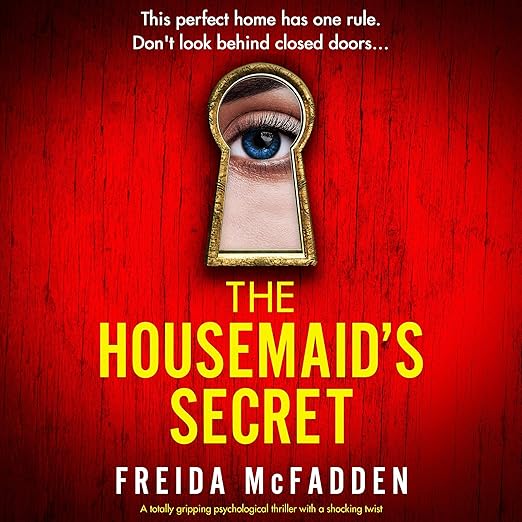
I finished The Housemaid's Secret on a Wednesday evening after spending most of the day treating it as background listening while working, and then suddenly, sometime around hour seven, stopping whatever I was doing and sitting down to listen properly. Freida McFadden has a particular skill with pacing that I have come to recognize across her work: the first act makes you slightly impatient, and then the second act makes you understand why the first act had to be that slow. The Housemaid's Secret follows this pattern with enough craft that the impatience feels, in retrospect, like something McFadden built deliberately rather than a flaw she did not notice.
This is the second book in The Housemaid series, and McFadden has designed it to function as a standalone, providing enough context from the first novel that new listeners will not be lost. What you need to know is that Millie, the protagonist, is a woman with a past that most employers would find disqualifying. She spent a decade in prison for a murder she technically committed but that the law's binary framework failed to classify correctly. The man she killed was threatening another woman's life, and the jury did not find self-defense sufficient. Millie carries that history into every job she takes, which is why she thanks her lucky stars when the Garricks offer her a position cleaning their penthouse without asking too many questions.
Allman's Calibrated Suspense in the Guest Bedroom
The opening hook is one of McFadden's best. Douglas Garrick's instruction not to go into the guest bedroom, delivered with a particular expression and a particular excuse, is the kind of detail that thriller writers spend careers trying to calibrate. Too heavy-handed and the mystery collapses immediately. Too subtle and the reader does not register the wrongness. McFadden gets it right. The spots of blood on the nightgowns. The sounds of crying behind the door. The moment when the door swings open and what Millie sees inside changes everything: these are managed with the economy of someone who has thought carefully about how much to show and when.
Lauryn Allman's narration is well-suited to material that requires calibrated suspense. Her Millie is warmer than McFadden's prose sometimes suggests, which is not a misreading but a reasonable interpretation of a character who cares more than she lets on. The pacing of the audiobook benefits from Allman's instinct for where tension should accumulate and where it can briefly release. At just under ten hours, the audiobook does not overstay its welcome, and the final act delivers the jaw-dropping quality that one reviewer described experiencing at the epilogue.
Predictable First Half, Jaw-Dropping Second
Several reviewers have noted that the first part of the book is predictable. This is accurate. The setup involves a wealthy abusive husband, a vulnerable wife, and a protagonist with a protective instinct and the skills to act on it. The genre beats are familiar and McFadden does not attempt to disguise them. What she is doing instead is something that requires the familiarity: she is building reader investment in Millie and Mrs. Garrick before the second part destabilizes everything you thought you understood about the situation. The gamble pays off, but only if you stay through the first half.
One reviewer described the first part as painfully predictable and the last part and epilogue as jaw-droppers. That split is an accurate description of the book's structure and its gamble. Listeners who find the setup too transparent too early may not give the book the time it needs to complicate itself, and that would be a genuine loss. The complication is worth the patience.
Atonement and Survival Drive Millie's Secrets
What makes Millie more interesting than the average domestic thriller lead is the genuine complexity of her moral position. She is a person who has done serious violence for reasons that were justified and also shaped by circumstances she has not fully reckoned with. She protects people as a form of atonement, and she keeps secrets as a form of survival, and those two drives do not always point in the same direction. McFadden gives her enough interiority that her choices feel comprehensible even when they are not entirely defensible. That is a harder thing to achieve than the surface-level thriller mechanics would suggest.
Allman Keeps Millie's Interiority Present Without Overplaying It
The Housemaid's Secret rewards listeners who enjoyed the first book and want to spend more time with Millie. New listeners can start here, though reading the first book first will deepen the experience. This free audiobook through membership platforms makes it a low-stakes way to evaluate whether McFadden's approach suits you before committing to the full series. Listeners who require sustained momentum from the first chapter, or who find the familiar domestic suspense setup impossible to engage with on its own terms, may struggle with the first half. If you have patience for a slow build that earns its ending, this delivers on everything it promises. McFadden has a talent for writing female protagonists whose intelligence is not the kind that announces itself with exposition. Millie is smart in practical, situational ways, and the book shows rather than tells that intelligence through her observations and her choices. That quality is present in the first book as well, but in the second installment, with more backstory established, it has more room to operate. The audiobook format serves this well because Allman's narration keeps Millie's interiority present without over-dramatizing it.
Key Details
- Voice: Lauryn Allman handles the pacing and reveals with confident calibration, keeping the thriller's suspense intact rather than letting the slow build flatten under uneven vocal delivery.
- Big ideas: Domestic power and its abuse, women protecting each other across class lines, the moral weight of secrets kept for survival
- Atmosphere: Tense and propulsive in the second half, with a deliberately slow build that divides readers
- Worth it?: A worthy follow-up to The Housemaid that improves on the original's formula in its final act even if the first half moves carefully.