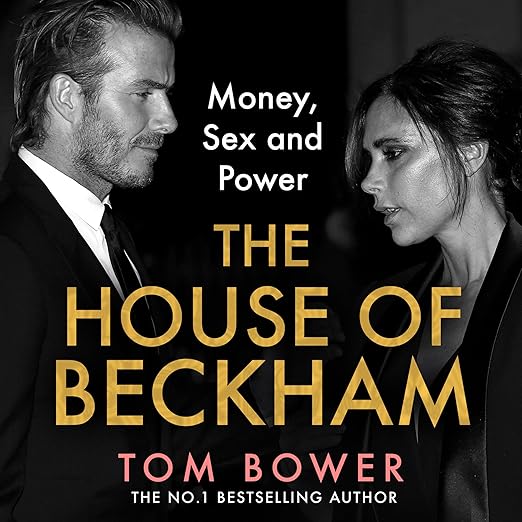
Quick Take
- Narration: Ciaran Saward delivers a composed, measured performance well-suited to investigative biography, neither sensationalizing the revelations nor deflating their weight.
- Themes: Celebrity image management, wealth and tax strategy, the architecture of personal branding
- Mood: Forensic and at times relentless, occasionally dense with financial detail
- Verdict: A serious piece of investigative journalism that will satisfy readers who want to understand how Brand Beckham was built, though those seeking a balanced portrait should know Bower’s skepticism is pervasive.
I started The House of Beckham on a long flight, which turned out to be the right environment for it. Tom Bower’s investigative biographies reward sustained attention, and at fourteen hours this one requires it. I went in knowing the broad outlines: David Beckham the footballer, Victoria as Posh Spice, the Netflix documentary that raised more questions than it answered. What I did not know was the extent to which the book would function less as a celebrity portrait and more as a detailed study of how fame gets converted into financial and cultural capital, and what that conversion actually costs in terms of authenticity.
Bower is Britain’s most prominent investigative biographer, known for subjects including Richard Branson and Boris Johnson, and he applies the same methodology here. Extensive sourcing, insider interviews, and a willingness to follow financial trails where they lead. The result is a book that the Beckhams clearly did not cooperate with and would presumably prefer did not exist. Whether that independence produces a reliable portrait or a one-sided attack is genuinely a matter of reader perspective, and the reviews reflect that split honestly.
The Netflix Documentary as Provocation
Bower frames a significant portion of his inquiry as a response to the 2023 Netflix documentary that the Beckhams produced themselves. His argument, developed across the early chapters, is that the documentary raised questions precisely because it was so tightly controlled. The image management visible in that production, he suggests, is not incidental to the Beckham story but central to it. The House of Beckham is in many ways Bower’s attempt to supply the context the documentary withheld, to answer the questions that the Beckhams’ own self-narration was structured to avoid.
One reviewer who described themselves as firmly Team Beckham noted that the book made for uncomfortable reading and acknowledged that, despite the author’s evident lack of sympathy for his subjects, much of what Bower reports rings true. That combination of discomfort and recognition is probably the most honest response the book can produce from readers who arrive with existing affection for its subjects. Those who were already skeptical of the Netflix documentary’s promotional quality will find Bower’s account specifically satisfying.
The Financial Detail Problem
The most consistent complaint across reviews involves the extended treatment of tax strategy and financial structures. One reviewer put it plainly: way too much emphasis on taxes and money. Bower spends considerable time tracing the corporate arrangements through which the Beckhams have managed their wealth, including the use of legal structures that minimize tax liability. His argument is that these arrangements reveal something about character and values, not just financial planning. That argument is defensible but the execution is long. Listeners who are primarily interested in the human story, the marriage, the football career, the Miami chapter, may find the financial passages a genuine test of patience.
Ciaran Saward’s narration handles this material professionally. He does not inject artificial drama into sections that are essentially accounting, which is the right call. But the writing itself slows when Bower enters balance sheet territory, and the audio format does not help because you cannot skim forward the way you might with a physical book.
A Portrait of Brand Architecture
What saves the book from being simply an exposé is Bower’s evident fascination with the mechanism of celebrity brand-building as a project. One American reviewer who knew little about the Beckhams before reading described the book as fascinating and praised the depth of research going back decades. That response captures something real about the value here. Whatever you think of Bower’s editorial stance, the account of how two individuals constructed a multi-billion-dollar brand from a combination of football skill, pop celebrity, strategic media management, and relentless self-promotion is genuinely interesting as a case study in contemporary fame economics.
The Miami chapter, covering the Beckhams’ move to set up Inter Miami CF, receives substantial attention in the final section of the book. Bower treats the Inter Miami project as a continuation of the brand-building pattern he has traced throughout, and the sourcing in this section is particularly current. Listeners who followed the David Beckham Netflix documentary and wanted more critical examination of the Miami venture will find it here.
A Biography That Requires a Stance
Unlike biographies that attempt neutrality and end up saying nothing, The House of Beckham requires the reader to do interpretive work. Bower’s conclusions are pointed and his sympathy for his subjects is minimal. Reading this alongside the Netflix documentary, as one reviewer effectively suggests by noting the contrast between the two texts, produces a more complete picture than either alone provides. Available as a free audiobook through Audible membership, this is a good choice for listeners interested in celebrity biography with genuine investigative depth. Approach with awareness of Bower’s critical orientation, which is consistent with his other work but which some readers will find more limiting than others.
Frequently Asked Questions
Is Tom Bower’s account balanced, or does his critical stance undermine the biography’s credibility?
Bower is openly skeptical of his subjects, consistent with his work on other high-profile figures. Some reviewers find this invalidating; others find his willingness to follow uncomfortable evidence a sign of journalistic integrity. The sourcing appears rigorous even where the conclusions are pointed.
How does The House of Beckham relate to the 2023 Netflix documentary?
Bower explicitly frames the book as a corrective to the self-produced documentary. His argument is that the documentary’s tight image management is itself evidence of the pattern he is investigating, making the two texts interesting to consider together.
Is Ciaran Saward’s narration a good match for investigative biography material?
Yes. Saward reads with measured authority that suits the material’s forensic tone. He does not sensationalize the revelations, which lets the evidence carry the weight rather than the performance.
Does the book address David Beckham’s football career substantially, or is it primarily about brand and finances?
Both are covered, though the football career is treated as context for the brand-building story rather than the primary subject. Listeners expecting deep football analysis will find less of it than those interested in the commercial and personal dimensions of the Beckham story.