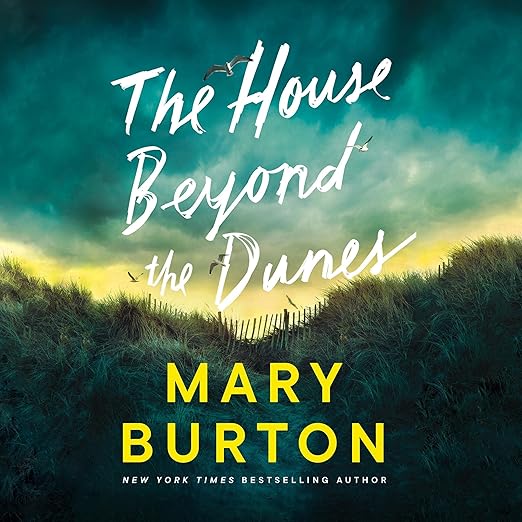
Quick Take
- Narration: Erin Bennett is a reliable thriller narrator and her work here maintains the psychological pressure the story requires.
- Themes: Buried memory and self-deception, the danger of misplaced trust, isolation as a device of control
- Mood: Tightly wound and claustrophobic, with a coastal setting that does atmospheric heavy lifting
- Verdict: Mary Burton constructs a psychologically credible suspense scenario around an unreliable survivor, and Erin Bennett’s narration keeps the pressure on throughout.
I started The House Beyond the Dunes late on a Sunday night when I wanted something compact and propulsive. The setup delivered immediately: Lane McCord wakes up in a hospital having survived a fall at a North Carolina beach cottage, and her boyfriend Kyle did not. The amnesia hook could easily be a structural cliche, but Mary Burton uses it structurally rather than decoratively. The question of what Lane actually does and does not remember becomes the engine of the plot rather than simply a convenient excuse for withheld information.
The North Carolina Outer Banks setting is more than atmosphere. The isolation of the beach cottage, the rainstorm that traps Lane after she returns to collect her belongings, the specific coastal geography that limits options and sight lines: Burton uses these elements to tighten the circumstances around her protagonist methodically and without apparent strain. A concerned neighbor arrives out of the storm claiming he heard a violent argument before the accident. A detective is tracking a missing woman whose diary starts to complicate what everyone thought they understood about Kyle. The net tightens in ways that feel earned rather than engineered, which is the harder achievement in this genre.
Our Take on The House Beyond the Dunes
Burton is a New York Times bestselling author with a long backlist in the thriller genre, and the craft of this novel shows that experience clearly. The pacing is disciplined without feeling rushed. The red herrings, praised by at least one reviewer as genuinely well-constructed, largely work because they are rooted in plausible character behavior rather than pure authorial manipulation. One reader described the framing of the story as really cool, which is vague but points at something real: the structural approach here is more ambitious than a standard domestic thriller, involving multiple timelines and perspectives that function as competing accounts of the same event. The question throughout is whose version of events is closest to reality, and the answer arrives at exactly the right moment.
Why Listen to The House Beyond the Dunes
Erin Bennett brings exactly what this material requires: a consistent urgency without tipping into melodrama. She handles Lane’s confusion and dread credibly across the full runtime, and the passages involving the detective Stevie are differentiated clearly from Lane’s more subjective, unreliable narration. Listeners who have enjoyed Burton’s previous standalone thrillers will find this consistent with her strongest work. At just over ten hours it is a complete, satisfying listen that does not ask for a series commitment, which is increasingly rare in the thriller audiobook space.
What to Watch For in The House Beyond the Dunes
The psychological reveal at the end divides readers in ways that are worth knowing about in advance. One reviewer described it as a bit old-school, and another was more direct, saying the dissociative element did not sit well with them as a narrative resolution. This is a fair flag: the specific psychological concept Burton settles on carries some narrative baggage in the thriller genre, and listeners who read widely in this space may find it familiar rather than surprising. The multiple-perspective structure also requires patient attention early in the book before the organizing pattern becomes clear enough to provide orientation.
Who Should Listen to The House Beyond the Dunes
This is a well-crafted psychological thriller for readers who enjoy atmospheric, setting-driven suspense with a strong female protagonist at the center. If you are a fan of Harlan Coben’s one-book-at-a-time domestic suspense, or the kind of thriller where the house itself functions as an antagonist, Burton delivers those pleasures reliably across her catalog. Skip it if you have strong reservations about dissociative psychology as a narrative device, or if you need your central twist to be something you have not encountered before in the genre. For readers who simply want a well-paced, professionally executed thriller set on a genuinely atmospheric stretch of coastline, Burton delivers that reliably and Erin Bennett’s narration keeps the ten hours feeling purposeful throughout.
Frequently Asked Questions
Is The House Beyond the Dunes part of a series, or does it stand alone?
It is a standalone novel. Mary Burton has written series fiction, but this title does not require any prior familiarity with her other books. The story is complete in itself and the ending resolves the central questions the plot has raised.
How does Erin Bennett handle the dual narrative between Lane and the detective Stevie?
Bennett differentiates the two voices sufficiently that the perspective shifts register clearly. Lane’s chapters carry a quality of confusion and vulnerability that contrasts with Stevie’s more observational, professional manner. The narration supports the structural complexity without overplaying the distinction.
Is the amnesia premise handled believably, or is it used as a convenient plot device?
More the former than the latter. Burton grounds the memory gaps in a specific psychological framework that becomes clearer as the story progresses. The unreliability is structural rather than decorative: the question of what Lane suppressed and why is the actual engine of the plot, not a shortcut around an inconvenient scene.
The ending has divided some readers. How significant is the twist, and is it satisfying?
The central revelation draws on a psychological concept that genre readers may recognize from other thrillers. Some reviewers found the execution strong and well-handled; others felt it was familiar territory. It resolves the narrative cleanly, and the final chapters have been praised even by readers who found the central reveal itself predictable.