Quick Take
- Narration: Joe Hempel is a reliable workhorse for Pacific Northwest crime fiction, keeping pace with the locked-island tension without overplaying the horror elements.
- Themes: Locked-room mystery, depravity and motive, the limits of witness testimony
- Mood: Compact and propulsive, unsettling in its final reveals
- Verdict: A tight, inventive mystery that uses its Bainbridge Island setting and blind-witness hook to deliver genuine surprises in under six hours.
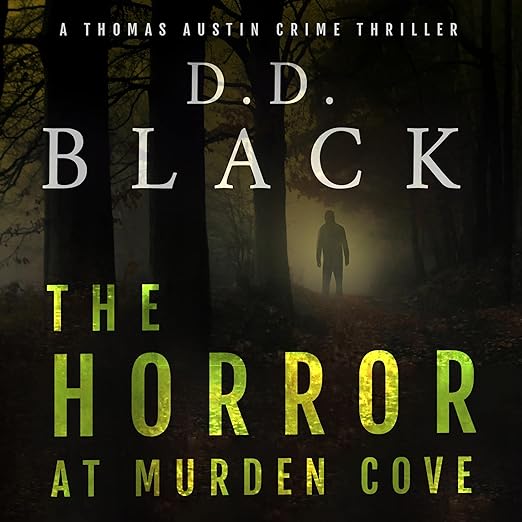
I have a weakness for mysteries that confine their detective to a specific geography and then dare you to figure out the exit. The Horror at Murden Cove does exactly that. A summer storm closes the bridges and ferry routes to Bainbridge Island, stranding private investigator Thomas Austin with a triple homicide, one surviving witness, and a suspect pool of exactly five people. I listened to this on a Tuesday morning when I had a backlog of shorter audiobooks to clear, and I cleared nothing else that day.
D.D. Black writes the Thomas Austin series with a clear understanding of what readers come to Pacific Northwest crime fiction for: specific place, controlled atmosphere, and puzzles that feel genuinely constructed rather than arbitrarily revealed. Murden Cove is the fourth entry, and it can function as a standalone. The premise arrived via synopsis with a detail that I found immediately arresting: the sole survivor of the massacre is blind from birth. She saw nothing. She heard everything. The killer took his time, and she listened to all of it.
Our Take on the Blind Witness as a Narrative Device
This is the kind of hook that either pays off completely or collapses under its own cleverness. Black earns it. The survivor is not a device used once for exposition and then set aside. Her testimony, and the problem of interpreting auditory memory under extreme trauma, threads through the entire investigation. Austin must understand not just what she heard, but how to translate sound into evidence in a system built almost entirely around visual witness accounts. One reviewer noted the novel builds to a philosophy in its final chapters that brings a degree of peace as well as optimism. That observation surprised me when I read it, but having finished the book, I understand what they mean. Black does something quietly thoughtful here about perception, truth, and what we owe the people we cannot protect in time.
Why Listen to the Thomas Austin Series on Audio
Joe Hempel has narrated across the crime fiction genre long enough to understand pacing. In a 5-hour-52-minute window, there is no room for indulgence, and Hempel does not waste any. His Austin is competent without being flashy, which is exactly right for a PI whose defining quality is persistence rather than brilliance. The Bainbridge Island setting comes through clearly in audio, with Black’s descriptions of the storm-battered landscape creating a sensory backdrop that Hempel’s delivery supports without overemphasizing. For listeners new to the series, Austin’s introduction as someone capable of connecting with this particular witness creates instant investment without requiring backstory from earlier volumes.
What to Watch For in the Motive Reveal
The synopsis warns that the killer’s motive is so deranged you will need to listen twice to believe it. That is promotional language, and I say this having been surprised anyway. The suspect pool of five people, all of whom the witness was dating, creates a premise that sounds like dark comedy and functions as something considerably more disturbing. One reviewer described the ending as a little melancholy, which is accurate. This is not the kind of thriller that wraps neatly with moral restoration. Austin solves the case, but the solution raises questions about the people we trust and the systems we rely on that linger after the final chapter. That residual unease, handled with more restraint than the word horror in the title might suggest, is Black’s best writing in the series.
Who Should Listen to The Horror at Murden Cove
Readers who enjoy Michael Connelly’s later Lincoln Lawyer novels or early Tana French will find Black’s approach to the crime puzzle familiar and satisfying. Listeners specifically drawn to Pacific Northwest settings, and there is a robust readership for that particular regional fiction, will appreciate the geographic specificity. The horror of the title is real but not graphic in the conventional sense. This is psychological unease rather than splatter, which suits the audio format particularly well. At under six hours, it is an ideal candidate for a single-session listen on a long commute or a quiet weekend afternoon.
Frequently Asked Questions
Is The Horror at Murden Cove the right starting point for the Thomas Austin series, or should I begin with book one?
The series is designed so each book can stand alone, and Murden Cove is frequently cited as a strong entry point. The synopsis confirms this. Beginning with The Bones at Point No Point adds backstory but is not required.
How graphic is the violence in this audiobook given the horror elements in the title?
The violence is present and disturbing in implication rather than graphic description. The horror derives more from the psychological nature of the murders and the motive than from explicit gore. Reviewers describe it as dark and tense without being gratuitously brutal.
Does the blind witness character feel authentic, or does the premise strain credibility?
Multiple reviewers found the device credible and thoughtfully developed rather than gimmicky. Black uses the auditory witness angle to explore memory and trauma in ways that feel grounded rather than sensationalized.
At under six hours, does The Horror at Murden Cove feel complete, or does it read like a shorter, rushed installment?
Consistently praised for tight plotting rather than rushed pacing. The shorter runtime reflects the locked-island premise and single-case structure, not shortcuts in characterization or resolution.