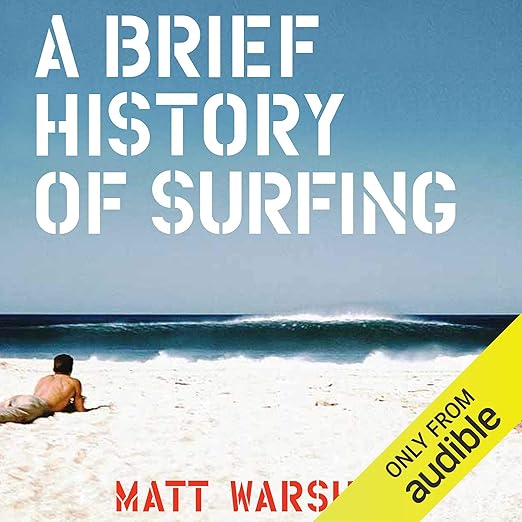
Matt Warshaw has devoted most of his adult life to documenting surfing in more depth than any other writer alive. His Encyclopedia of Surfing runs to over 400,000 words. His History of Surfing in its unabridged print form is a 512-page monument with images. So when Warshaw honed that material down into the abridged audiobook edition narrated by James Patrick Cronin, the question was not whether the content was authoritative. It was whether the compression would gut what made the original essential. The answer, across just over three hours, is that it survives the trimming with the central argument intact and the prose qualities that distinguish Warshaw's writing from sports journalism still fully present.
Cronin's delivery is confident and engaged, appropriate for material that moves from Hawaiian antiquity to the modern professional circuit, from the invention of the fin to the rise of Kelly Slater, from the social dynamics of localism to the economics of the global surf industry. His voice does not try to reproduce a breezy surfer affect; he treats the subject with the intellectual seriousness a genuine cultural history deserves, which is exactly the right call for material this carefully researched.
Our Take on The History of Surfing
The format is worth understanding before you listen. This abridged edition pairs micro essays with references to specific images from surf history, each entry functioning as a capsule covering a person, event, innovation, or cultural shift. On audio, the visual component is necessarily absent, which is the one structural limitation here. Warshaw accounts for this in the writing: each essay is self-sufficient as text rather than a caption for an image you are supposed to be looking at alongside. Reviewers who encountered the audio without the print edition report it stands on its own; those who owned the book first find the audio deepens their engagement with the arguments they had already read through, giving the analytical passages a different kind of presence.
The historical range is the book's greatest asset. Warshaw does not begin with the surf culture explosion of the 1960s or the shortboard revolution that followed. He goes back to ancient Hawaii, to the kapu system that governed who could ride which waves on which boards, to the near-extinction of surfing under missionary influence in the nineteenth century, and to the sport's deliberate revival by Hawaiian and part-Hawaiian watermen in the early twentieth century. That longue duree perspective separates Warshaw's work from almost all surf writing, which tends to treat post-war California as the origin point and compress everything before it into a paragraph of obligatory context.
Why Listen to The History of Surfing
At just over three hours, this audiobook rewards focused listening rather than background playback. Warshaw's writing is dense with specific names, dates, board dimensions, and events, and Cronin's pacing assumes you are paying attention. Listeners who engage actively will get considerably more from the experience than those who let it wash past them. One reviewer who described themselves as an aging surfer with extensive prior knowledge of the surf literature noted that even they found material they had not encountered elsewhere; Warshaw's research runs deep enough that specialists and general listeners encounter different layers of new information from the same text.
The treatment of competitive surfing is particularly strong on audio. Warshaw traces the development of the contest circuit, the rise of professional surfing as a structured industry, and the figures who defined different eras on the world tour with the kind of specificity that makes the names and events feel like more than a catalogue. Kelly Slater appears not as a celebrity cameo but as the culmination of a specific developmental arc in what high-performance surfing can be. The localism chapter, addressing the territorial culture and occasional violence that has characterized some surf spots for decades, is handled with the same analytic care and without the romanticization that mars most surf literature on the subject.
What to Watch For in The History of Surfing
Watch for the sections on board technology and how equipment changes drove performance changes that then drove cultural changes throughout the sport. Warshaw's account of the shortboard revolution of the late 1960s, when boards shrank from nine feet to under six feet in less than two years, is one of the more compelling instances in any sport of technology reshaping an entire subculture in near-real time. The transition was not merely technical; it changed who surfed, how they trained, what the culture valued, and how surfing positioned itself within the broader counterculture of that era. Cronin's delivery in these sections conveys the pace and momentum of the change.
Also listen for what Warshaw says about the relationship between surfing and commercial culture, the decades-long tension between the values that define surfing's core identity and the marketing apparatus that has monetized them at every level from local surf shops to global sportswear brands. By the time the audiobook reaches the contemporary period, this tension has not been resolved. It has simply become the permanent condition of the sport and a defining feature of what it means to call yourself a surfer in any era after the 1970s. Cronin's neutral delivery in these passages lets Warshaw's own ambivalence come through without editorializing.
Who Should Listen to The History of Surfing
Surfers of any generation who want broader context for the culture they inhabit will find this audiobook genuinely illuminating. The three-hour runtime makes it an accessible entry point for curious non-surfers who want to understand how a Hawaiian practice became a global industry with its own aesthetic codes, celebrity structure, and internal politics. Warshaw's authorial voice is wry and specific, far from the generic enthusiasm that characterizes most sports documentaries, and Cronin carries that voice faithfully across the full listening experience.
Skip it if you want personal stories or extended athlete profiles as your primary mode of engagement. This is history and cultural analysis, not memoir or biography. The abridged format also means some figures and episodes prominent in the full print edition are compressed or absent here. Completists will need the full version; listeners who want the essential argument in a manageable, well-narrated audiobook form will find exactly what they need.
In Brief
- Narrator: James Patrick Cronin delivers Warshaw's dense, analytic prose with engaged neutrality that suits the subject's sweep from Hawaiian antiquity to Kelly Slater.
- Subjects: Surfing as cultural history, technology and performance, the tension between core culture and commercialization
- Tone: Authoritative and wry, compact but substantive
- Bottom line: A rigorous, well-narrated audiobook survey of surfing history that earns its authority through Warshaw's incomparable depth of knowledge, even in abridged form.
Since this is an abridged audiobook, what gets cut from Warshaw's full History of Surfing?
Individual profiles and extended case studies are compressed most heavily. The essential historical arc, from ancient Hawaiian origins through the competitive modern era, remains intact. Warshaw designed the abridged edition as a standalone work rather than a cut-down version, so the audiobook reads as complete rather than truncated.
Does the audiobook work without being able to see the photographs and images referenced in the book?
Yes. Each micro essay in this audiobook is written to be self-sufficient as text, and James Patrick Cronin's narration carries the arguments clearly without requiring the accompanying images. Readers who own the print edition may find the audio deepens their engagement, but it stands alone.
Is The History of Surfing audiobook suitable for listeners with no surfing background?
Warshaw writes with enough context that non-surfers can follow the cultural and historical arguments fully. The technical sections on board design and competitive formats are clearly explained. Surf terminology is introduced in context, so no prior familiarity with the sport is assumed.
At just over three hours, is this audiobook long enough to be genuinely substantive?
Warshaw's dense, specific prose covers more ground per hour than most audiobooks in this category. The brevity reflects careful compression rather than shallow treatment. That said, listeners who want extended individual athlete profiles or deeper regional histories will need to seek out the full print edition or Warshaw's Encyclopedia of Surfing.