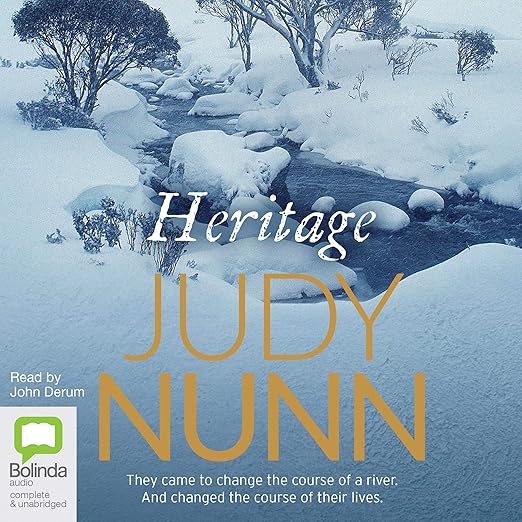
Quick Take
- Narration: John Derum brings gravity and warmth to a sprawling cast of European immigrants, with enough range to handle the novel’s emotional sweep across nearly nineteen hours.
- Themes: Post-WWII displacement and reinvention, the birth of Australian national identity, buried wartime secrets
- Mood: Sweeping and emotionally generous, with real historical weight
- Verdict: An absorbing piece of historical fiction centered on the Snowy Mountains Hydro-Electric Scheme that works both as adventure and as an exploration of what it costs to begin again.
I came to The Heritage having recently been deep in a run of European WWII histories, and I was ready for something that moved outward from the ruins of that conflict rather than dwelling in them. This novel does exactly that, it takes the wreckage of postwar Europe and follows the people who left it, who crossed the world to a continent they had never imagined calling home, and who built something there. The Snowy Mountains Hydro-Electric Scheme, one of Australia’s great engineering achievements, becomes the setting and the occasion for this crossing of paths.
The novel opens in the ruins of Berlin, in the mountains of Italy, in the early chaos of the new state of Israel, and then moves all of these stories toward the Australian high country, where refugees from more than seventy nations gathered to tunnel through a mountain range and redirect a river. As a premise, it is almost implausibly rich, and the execution is largely equal to it.
Our Take on The Heritage
The great strength of this novel is its insistence on the humanity of its enormous cast. A story about a mass engineering project involving tens of thousands of people from dozens of war-devastated nations could easily become epic to the point of abstraction. Instead, the narrative stays close to individual lives, their buried memories, their unimaginable losses, the deadly secrets they brought with them from the inferno they escaped. The Snowy Scheme becomes not just the backdrop but the redemptive mechanism: a place where people who had nothing in common except survival found themselves tunneling through the same mountain.
One reviewer who described themselves as a Snowy kid, someone who grew up in Cooma during the scheme’s construction years, found the novel’s rendering of life in the camps and the town genuinely accurate. That kind of testimonial from someone with direct family connection to the period suggests the historical research underlying the fiction is solid.
Why Listen to The Heritage
John Derum’s narration across nearly nineteen hours is a patient and committed performance. The novel’s cast moves between German, Italian, Jewish, and Australian characters, each carrying distinct emotional registers, and Derum manages the transitions without losing the listener’s orientation. He is particularly good with the quieter emotional moments, the scenes of grief, recollection, and reconciliation that give the novel its depth.
The audiobook format suits historical fiction of this scope especially well. The long runtime becomes immersive rather than daunting because each listening session drops you back into a world fully rendered enough to feel lived-in. One reviewer bought the book before a vacation to Australia’s Snowy Mountains, intending to use it as a kind of extended companion to the landscape, and the novel rewards that kind of engaged, context-aware listening.
What to Watch For in The Heritage
At nearly nineteen hours, The Heritage is a commitment. The novel’s approach is cumulative: it builds emotional investment across dozens of characters and multiple narrative threads, which means early episodes can feel disconnected before the Snowy setting pulls them together. Listeners who prefer tight, linear narratives may need patience in the first third before the connections begin to clarify.
The unexpected twists praised by multiple reviewers are real, and at least one major revelation requires that readers have absorbed a significant amount of earlier context to feel its full weight. This is not a novel that rewards half-attention, the details seeded early are the details that pay off late.
Who Should Listen to The Heritage
Listen if you have any interest in Australian history, in postwar European displacement narratives, or in the kind of generational historical fiction that uses a specific event or place to tell a much larger story about human resilience. The novel works for listeners who came to similar territory through books like Kristin Hannah’s The Nightingale or Anthony Doerr’s All the Light We Cannot See, though it operates on a more explicitly national-historical scale.
Skip it if you prefer compact, propulsive plots or if nineteen hours of multi-threaded historical fiction feels like too significant a time investment. This is a book for devoted historical fiction listeners rather than casual dippers.
Frequently Asked Questions
Do I need any prior knowledge of Australian history or the Snowy Mountains Scheme to follow the novel?
No prior knowledge is required. The novel provides the historical and geographical context readers need as part of the storytelling. Multiple reviewers note that they knew very little about the Snowy Scheme before listening and found the historical education embedded in the narrative a genuine asset rather than a distraction.
How does the novel handle the European wartime backstories, are they graphic?
The wartime histories of the characters are present and emotionally substantial, including experiences of the Holocaust and the devastation of postwar Berlin and Italy. The treatment is serious rather than gratuitous, focused on psychological aftermath and buried memory rather than explicit wartime violence. Sensitive listeners should be aware the emotional weight is real.
Is The Heritage part of a series, or does it stand alone?
It stands alone as a complete narrative. The novel resolves its central storylines and character arcs fully within its nearly nineteen-hour runtime. It is comparable to the standalone sweep of authors like Colleen McCullough rather than anything designed as a series opener.
How does John Derum handle the multilingual cast of European immigrant characters?
Derum differentiates the European characters through vocal quality and emotional register rather than heavy accent work, which is the right call for a nearly nineteen-hour listen. The approach keeps characters distinct without requiring sustained accent performance that can become fatiguing or caricature-like over a long runtime.