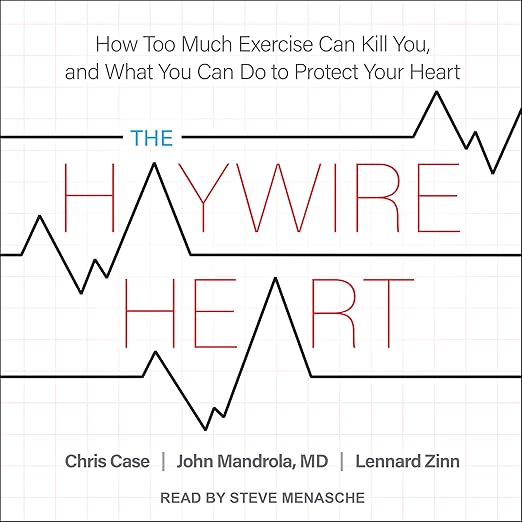
Quick Take
- Narration: Steve Menasche delivers a clean, authoritative performance that suits the book’s hybrid tone, part medical education, part athlete memoir. His pacing gives breathing room to the denser cardiac science without losing momentum.
- Themes: Athlete heart conditions, exercise addiction, the limits of endurance culture
- Mood: Sobering and educational, with flashes of genuine tension from the case studies
- Verdict: If you log serious training hours and have never thought carefully about what you’re doing to your heart, this book will change how you approach rest days.
I was about fifty minutes into my morning run when I started this one, which, in retrospect, was either perfect timing or a case of unfortunate irony. By the time Steve Menasche got to the opening case study about Lennard Zinn, the cyclist and co-author whose heart condition nearly killed him mid-ride, I had slowed to a walk. Not because I was tired. Because the book had already gotten under my skin.
The premise that too much exercise can damage your heart permanently is not exactly new territory in sports science circles, but The Haywire Heart by journalist Chris Case and cardiologist Dr. John Mandrola is the first book to address it comprehensively and specifically for the people who need it most: committed endurance athletes who have spent decades believing that more training equals better health.
Our Take on The Haywire Heart
What makes this audiobook earn its place is the combination of two very different voices, Case’s narrative storytelling and Mandrola’s clinical precision, woven together without feeling like a textbook interrupted by anecdotes. The case studies are vivid and uncomfortable in the best way. Athletes who developed atrial fibrillation, arrhythmia, and coronary calcification after years of what most people would consider aspirational fitness habits. The book doesn’t catastrophize, but it does not soft-pedal either. The chapter on exercise addiction, in particular, is one of the most honest treatments of a subject that the endurance community tends to dodge.
Mandrola is frank about the gaps in current research, which is either refreshing or frustrating depending on what you came for. If you want definitive thresholds (run this many miles per week and your heart is fine, go over this number and it isn’t), you won’t find them here. What you will find is a framework for paying attention: warning signs to recognize, conversations to have with your doctor, and practical guidance on how to modify training without abandoning the sports you love. One reviewer described it as “a very interesting book that will make you think more about your training,” and that sums it up well. It is not a book that tells you to stop. It is a book that tells you to think.
Why Listen to The Haywire Heart
This is primarily a book for masters athletes, the forty, fifty, and sixty-year-olds who compete in endurance events with the same intensity they brought to their twenties, often without adjusting for what happens to cardiovascular tissue over decades of hard effort. But it works equally well for anyone who has recently taken up endurance training and wants to understand the physiology they are putting under stress.
The audiobook format suits the material better than I expected. Menasche’s narration is measured without being dull, and the medical terminology lands clearly without requiring a pause-and-Google. One listener who described herself as a marathoner diagnosed with cardiomyopathy noted that the book explained the electrical architecture of the heart in layman’s terms without skipping substance, and that she appreciated how thoroughly it handled the diagnostic side of things, given that many doctors don’t recognize how different an athlete’s cardiac profile looks from a sedentary patient’s. That observation about physician misdiagnosis is one of the book’s more practically urgent contributions.
What to Watch For in The Haywire Heart
The book has real limits, and being upfront about them seems fair. The definition of “endurance athlete” is genuinely fuzzy throughout, the opening claim that “too much exercise can kill you” is a sensationalist hook that several reviewers pushed back on, and one acknowledged the headline was probably its worst editorial choice. The research base, while growing, is still incomplete enough that firm conclusions are hard to draw. Readers who come expecting clear-cut prescriptions will leave with more nuance than certainty, and depending on your personality, that can feel like the right answer or an unsatisfying one.
There is also a structural tension between the scientific rigor of Mandrola’s chapters and the narrative drive of Case’s storytelling. They mostly work well together, but occasionally the book feels like two different documents occupying the same space. Neither voice dominates long enough to set a single reading rhythm, which can interrupt immersion during the longer technical sections.
Who Should Listen to The Haywire Heart
Listen if: You are a serious endurance athlete, particularly a masters competitor; you have experienced unexplained heart palpitations, fatigue, or irregular rhythms during or after training; or you simply want to understand the cardiovascular science behind the sports you love at a level beyond what your running club discusses.
Consider skipping if: You are looking for a straightforward training manual with hard thresholds and protocol, or if the idea of spending eight-plus hours confronting the potential downsides of your athletic identity sounds more anxiety-inducing than useful. The book is not designed to alarm, but it will give some readers exactly that feeling regardless of authorial intent.
Frequently Asked Questions
Do I need to be a competitive athlete to get value from The Haywire Heart, or is it relevant for recreational runners and cyclists too?
The book is written primarily with serious endurance competitors in mind, particularly masters athletes who train at high volumes. That said, the foundational cardiac education and warning signs it covers are relevant to anyone who trains consistently and has never thought about the upper limits of exercise intensity. Recreational athletes will find the case studies instructive even if some of the high-end training context doesn’t apply directly.
Does the audiobook handle the medical terminology accessibly, or will listeners without a science background struggle?
Steve Menasche’s narration keeps things grounded, and the authors take care to explain conditions like atrial fibrillation, arrhythmia, and coronary calcification in plain terms before diving into specifics. Listeners who’ve read reviews of their own cardiac workups will feel comfortable; those without any medical background may want to keep a quick-reference handy for the denser chapters, but the book is not written for specialists.
The book mentions Lennard Zinn as a co-author, how much of the audiobook is his personal story versus the broader medical research?
Zinn’s near-fatal cardiac episode serves as the opening case study and a thread that runs through the narrative, but the book’s scope extends well beyond his individual experience. Dr. John Mandrola contributes the bulk of the clinical analysis, covering research on multiple athletes across different endurance disciplines. Zinn’s story grounds the science emotionally; it’s not a memoir.
Does The Haywire Heart offer concrete training modifications, or does it mostly raise concerns without practical guidance?
It does both, though the practical guidance is less prescriptive than some readers want. Dr. Mandrola covers training modifications, recovery protocols, supplements and medications relevant to cardiac health in athletes, and how to have more productive conversations with physicians who may not recognize athlete-specific cardiac presentations. What it doesn’t deliver is a simple formula for safe training volume, the research doesn’t yet support one.