Quick Take
- Narration: Jot Davies handles the multi-perspective structure with clean vocal differentiation; each of the five narrators registers as distinct, which is essential given how much the plot depends on reader disorientation.
- Themes: Buried secrets at social gatherings, performance versus reality in marriage, institutional cover-up of male violence
- Mood: Atmospheric and claustrophobic, with a slow build that rewards patience from the first chapter
- Verdict: A well-constructed psychological thriller that uses its Irish island setting and multi-narrator format to maximum effect; the Christie comparisons aren’t quite earned, but Foley’s own considerable strengths are real.
I was halfway through The Guest List before I realized I had forgotten to make dinner. That’s the particular kind of absorption Lucy Foley achieves here: not the white-knuckle urgency of a thriller that’s always accelerating, but the quieter compulsion of a book that keeps you inside a very enclosed space with people you increasingly don’t trust. I had it on at about six-thirty on a Friday evening and kept listening through dinner, through the dishes, into the kind of late night where you’re not really tired but you’re also not fully awake. It’s that sort of book, and it knows it.
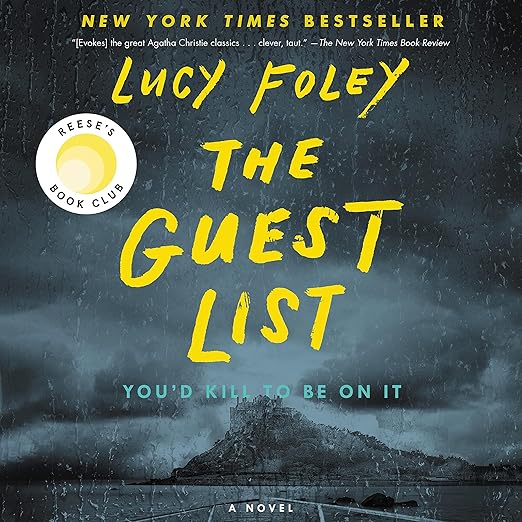
The setup is elegant in its simplicity. A glossy wedding on a remote island off the coast of Ireland, the cell service spotty, the Atlantic appropriately moody, the guests all carrying versions of themselves they’d prefer no one else examine too closely. The bride is Jules, a magazine publisher; the groom is Will, a television personality with a face made for screens and a past that the novel’s structure is very careful about revealing gradually. The book gives us five perspectives, rotating between the bride, the plus one, the best man, the wedding planner, and the bridesmaid, and it doesn’t tell you whose body turns up until you’re ninety percent through. That structural decision is either frustrating or ingenious depending on your tolerance for delayed revelation.
The Island That Does Real Atmospheric Work
Foley’s greatest asset is setting, and the island she creates here is impressively functional as narrative space. It is beautiful in the way that isolated places are beautiful: indifferently, without reference to the people in it. The cormorants that multiple reviewers mention, the way the water appears in descriptions, the venue’s particular combination of elegance and wildness: all of this creates an environment where the usual social escape routes are closed. You cannot leave. You are stuck with these people and their secrets on a small piece of land surrounded by cold Atlantic water, and Foley makes that constraint feel genuinely uncomfortable rather than merely convenient.
One reviewer invoked the “locked room mystery” tradition in describing this setup, and the comparison is apt. The island is the locked room, and Foley uses it the way the best locked-room stories do: as a pressure cooker that turns up the heat on social performance until something breaks. The geography is not backdrop; it is argument.
The Christie Comparison and What It Gets Right and Wrong
The promotional materials lean hard on an Agatha Christie comparison, and at least one reviewer pushed back on this with some justice. Christie’s genius is in puzzle architecture: the revelation that recontextualizes everything you thought you knew. Foley’s genius is atmospheric and psychological. She is better at maintaining sustained unease than at engineering the devastating reversal. The reveal here is satisfying rather than mind-altering, and the identity of the victim, withheld so long, produces a jolt that is more structural than emotional. This is a fine thing to be, but it is not Christie.
What Foley actually does well, and what the comparison undersells, is the exploration of how wedding celebrations concentrate social performance. Every guest is performing a version of themselves that fits the occasion. The resentments and jealousies that the synopsis mentions are rendered with real psychological accuracy: these aren’t cartoon villains, they’re recognizable people in recognizable situations, which makes the eventual violence feel like an outcome rather than a plot device.
How Jot Davies Holds the Structure Together
The book’s multi-perspective structure is ambitious in audio format, and Davies earns his fee. Five distinct voices, rotating across a nonlinear timeline, with different registers of class and education and emotional temperature: this is a significant narration challenge. Davies differentiates them consistently enough that you’re never disoriented about whose perspective is currently active, which is the minimum requirement, but he also brings individual vocal texture to each character beyond mere differentiation. The best man’s narration, in particular, has a quality of barely suppressed tension that pays off in retrospect when the full picture assembles itself.
At ten hours and twenty-two minutes, this is a comfortable listen across a weekend. Foley’s pacing builds methodically, and Davies’s narration respects that method without losing energy in the slower buildup sections.
Who Gets the Most From This Book
The Guest List is available as a free audiobook on Audible, and it is a reliable choice for listeners who enjoy psychological thrillers built on social dynamics rather than procedural investigation; who like settings that do real narrative work; and who are comfortable with a nonlinear structure that withholds information strategically. Listeners who want a thriller with relentless forward momentum may find the slow atmospheric build trying. Listeners looking for something to listen to on a foggy evening when you want to be absorbed somewhere else entirely will find this delivers exactly that experience. Foley has built a career on this kind of contained, atmospherically intense thriller, and The Guest List remains one of her strongest books in the genre. The island setting is specific enough that it stays with you: cold water, grey light, a beautiful venue that the weather keeps reminding you is also exposed and isolated. That combination of glamour and vulnerability is what the book is really about, and Foley earns it. If you have a taste for mystery that locates evil within social systems and secret histories rather than in random pathology, The Guest List will satisfy in ways that more conventional thrillers don’t. The characters are all credible in their compromises, and the book treats them with more moral complexity than the genre typically extends to its victims and suspects.
Frequently Asked Questions
Is the nonlinear timeline in The Guest List confusing to follow in audio format?
Less than you might expect. Foley uses the timeline strategically rather than chaotically, and Davies’s narration is clear enough about whose perspective is active that the back-and-forth between past and present is manageable. The structure creates suspense rather than confusion once you understand the game being played.
Is the Christie comparison accurate, or is this a different kind of mystery?
Different. The Christie comparison signals atmosphere and a contained-location puzzle setup, both of which apply. But Christie’s signature is architectural: the devastating reveal that restructures everything. Foley’s strengths are in sustained psychological unease and atmosphere. Both are good; they’re just not the same thing.
Is The Guest List a standalone novel, or does it connect to Lucy Foley’s other books?
Standalone. Foley’s other novels, including The Hunting Party and The Paris Apartment, use similar structural approaches, but The Guest List doesn’t share characters or plot with them. You can start here without any prior Foley context and lose nothing.
How dark does The Guest List get, and are there content warnings listeners should know about?
It touches on sexual violence and institutional cover-up in its backstory, which becomes significant to the plot’s resolution. The treatment is not gratuitous, but it is serious and may be distressing for some listeners. The overall atmospheric tone is sustained throughout; this is not a light mystery despite its wedding-party premise.