Quick Take
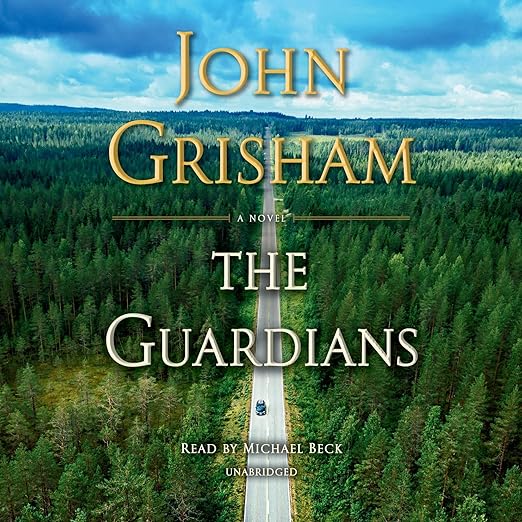
- Narration: Michael Beck gives Cullen Post a measured, principled voice that suits the material; the Southern setting and pacing come through clearly without ever tipping into affectation.
- Themes: Wrongful conviction, institutional corruption, faith and justice
- Mood: Deliberate and morally serious, with genuine tension in the final third
- Verdict: Grisham writing at his most purposeful, less interested in courtroom spectacle than in the grinding reality of innocence work.
John Grisham has written legal thrillers for decades, and the risk with any long-running genre novelist is that the machinery becomes more visible than the story. The Guardians is one of the books where the machinery recedes. It is a quieter novel than much of his catalog, closer in spirit to The Innocent Man than to The Firm, and the quietness is a choice that serves the subject. Wrongful conviction cases move slowly and grind against the people working them. A thriller paced like a car chase would be dishonest about what this kind of work actually costs.
I finished the last two hours on a Sunday evening drive, which is the kind of late-session listening that happens when a book has kept you honest. Michael Beck’s narration is steady and Southern in a way that never calls attention to itself, which is the right approach for a story that needs you inside the logic of the investigation rather than admiring the performance.
Cullen Post and the Economics of Innocence Work
The character of Cullen Post is one of Grisham’s more interesting inventions: a lawyer who is also an Episcopal minister, operating a small nonprofit called Guardian Ministries that takes on only a handful of cases at a time. The combination of professions is not accidental. Post is not motivated by money or professional advancement. He is motivated by something closer to religious obligation, and Grisham keeps that motivation clear without making it preachy or naive. Post knows the system and knows how hard it pushes back.
The organizational reality of Guardian Ministries is sketched with enough specificity to feel accurate to how innocence organizations actually function: perpetually underfunded, dependent on volunteer work and donated expertise, and able to accept only a fraction of the cases that come to them. Quincy Miller’s letter, after twenty-two years in prison maintaining his innocence, lands on Post’s desk precisely because no one else is listening. That isolation is what made the case possible to ignore, which is also what makes it possible to pursue without institutional interference.
Seabrook, Florida, and the Danger of Getting Close to Truth
The thriller mechanism in The Guardians is not a puzzle solved through cleverness. The people who murdered Keith Russo and allowed Quincy Miller to go to prison for it are dangerous in the present tense, and they are watching how close Post is getting. Grisham builds this pressure through accumulation rather than set-pieces: small escalations, warnings that could be coincidental, resources drying up in ways that might be explained by bad luck but probably are not.
The small-town Southern setting is handled with the specificity that Grisham has always done well. Seabrook has a particular social architecture, a particular history, and a particular set of power relationships that made an innocent conviction possible twenty-two years earlier and that make exposing it genuinely dangerous now. One reviewer flagged a geographic error about Kingsport, Tennessee, and another noted a factual issue about Morehouse College’s enrollment policies. Small details, but worth noting for a writer of Grisham’s experience, even if they do not affect the story’s larger logic.
What This Novel Owes to the Innocence Movement
The Guardians is clearly informed by the real innocence advocacy movement in the United States, and several reviewers have responded to it as more than entertainment. One describes the book’s themes as a truth the public should be more aware of; another says they intend to read the nonfiction companion to the story. Grisham has always been most effective when his legal knowledge and his moral indignation work in the same direction, and here they clearly do. The book is not a polemic. It trusts readers to draw the implications rather than spelling them out.
At nearly twelve hours, Michael Beck’s narration gives the investigation room to develop at its actual pace. Listeners who want tight procedural plotting will find the mid-section slower than they expect. Listeners who can stay with a story more interested in character and consequence than in surprise will find this one of the more satisfying entries in Grisham’s long catalog of legal fiction.
Frequently Asked Questions
Is The Guardians based on a real wrongful conviction case?
Grisham has acknowledged drawing on his knowledge of innocence advocacy work, and several reviewers mention a nonfiction companion. The novel is fictional, but the institutional dynamics it describes are well-documented in real innocence cases across the United States.
How does Michael Beck’s narration handle the Southern setting and the ensemble of characters?
Beck maintains a measured pace that suits the deliberate rhythm of the investigation. He gives Post a quiet moral authority without making him a saint, and the supporting cast is differentiated clearly enough to track through a twelve-hour listen.
Is this Grisham’s most politically engaged novel, or does it work purely as a thriller?
Both modes are present. The thriller mechanics are effective, particularly in the final third. But the book’s clear sympathy for innocence advocacy and its implicit critique of how wrongful convictions happen make it more politically engaged than much of his catalog.
Do I need to have read other Grisham novels before starting The Guardians?
No. It is a complete standalone with no connection to his recurring characters like Jake Brigance. The only prior context that enriches it is a general familiarity with how innocence organizations work, which the novel itself provides.