Quick Take
- Narration: Ana Osorio brings Marisol’s El Salvadoran voice to life with an authenticity that grounds the speculative premise. Her bilingual ease with the Spanish woven through the narrative is a significant asset.
- Themes: Immigration and asylum, queer identity under pressure, grief as a transferable burden
- Mood: Tender, politically urgent, and quietly devastating
- Verdict: A debut YA speculative novel that earns its emotional ambition through precision of character rather than plot mechanics, a rewarding listen that lingers.
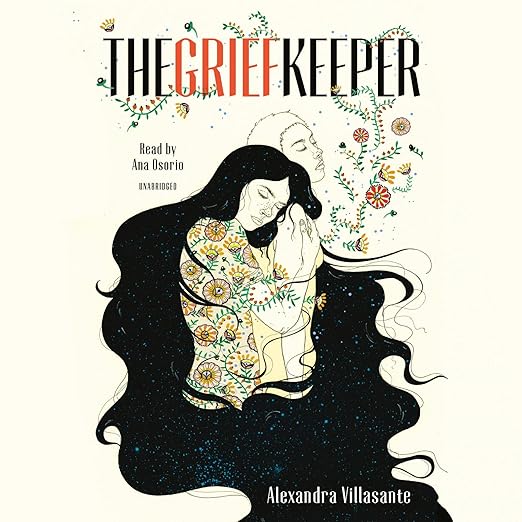
I came to The Grief Keeper expecting a YA speculative novel with immigration politics at the center, and that is what it is, but what I did not expect was how completely Alexandra Villasante would make me care about two sisters before the speculative premise even arrived. Marisol and Gabi are so specifically rendered in the opening chapters that by the time the experimental grief-keeping program appears as a plot device, it feels less like science fiction and more like a logical extension of what the asylum system already asks immigrants to absorb.
The setup is striking: Marisol, seventeen, flees El Salvador with her younger sister after her brother Pablo is murdered, a consequence, she believes, of her relationship with a girl named Liliana. Caught at the US border with their asylum claim likely to fail, Marisol accepts a place in a government experiment. She becomes a grief keeper: someone who physically absorbs another person’s grief into her own body, experiencing it as pain, in exchange for a chance to stay. The person whose grief she carries is Rey, the daughter of the program’s lead scientist. Marisol falls in love with Rey while literally hurting from the weight of her pain. That is a remarkable metaphor, and Villasante earns it.
Our Take on The Grief Keeper
The reviews across 167 listeners settle at 4.5, which reflects both the book’s genuine achievement and the absence of vocal detractors. One reviewer described it as one of the most beautiful, heartbreaking, creative, and underrated books they had ever read. Another noted being surprised by the ending repeatedly, in wonderful ways. What strikes me most is how Villasante handles the intersection of the political and the personal without letting either flatten the other. The immigration system’s cruelty is present as fact rather than lecture. Marisol’s queerness is simply part of who she is, shaped by threat but not defined by it. The grief-keeping metaphor carries both registers simultaneously.
Why Listen to The Grief Keeper
Ana Osorio’s narration is the right choice for this story. One reviewer specifically praised Villasante’s use of Spanish and the playful exploration of language that runs through the novel, and Osorio handles that bilingual texture with fluency that a less attuned narrator could easily miss. Marisol’s voice in the original text has a particular cadence, the trace of a second language shaping thought in a first, and Osorio preserves that quality without exaggerating it. At just under ten hours, the audiobook allows the story room to develop Marisol’s relationships with Gabi and Rey at the pace they deserve. The pacing is careful without being slow; the peaks and valleys, as one reviewer put it, feel earned.
What to Watch For in The Grief Keeper
The speculative element, the science of grief-keeping, is gestured at rather than fully developed. Listeners who want rigorous world-building or detailed mechanics for the experimental program will find Villasante more interested in the emotional logic of the premise than its technical plausibility. That is a deliberate choice: this is character-driven speculative fiction rather than science fiction in the engineering sense. The book also sits in a space between YA and adult fiction that may frustrate listeners firmly on one side of that line. The romantic relationship with Rey develops in the second half; readers who found the first half slow should be patient, as the emotional payoff is substantial.
Who Should Listen to The Grief Keeper
This suits YA readers and adults who enjoy character-led speculative fiction with queer protagonists and real political stakes. It is particularly recommended for listeners interested in immigration narratives that resist the traps of either sentimentality or polemic. Those who loved The House on Mango Street for its language or The Poet X for its emotional directness will find something compatible here. Skip it if you need a tightly plotted thriller; the emotional architecture is more important to Villasante than narrative propulsion.
Frequently Asked Questions
What is the grief-keeping premise in this novel and how does it work?
The grief-keeping program is a government experiment in which Marisol physically absorbs another person’s grief into her own body, experiencing it as pain. In exchange for participating, she and her sister are allowed to remain in the United States. The novel treats the mechanics impressionistically rather than with scientific rigor.
How does Ana Osorio handle the Spanish language elements in the narration?
Osorio navigates the bilingual texture of the novel with natural fluency, preserving the way Marisol’s El Salvadoran background shapes her voice in English. Reviewers specifically praised Villasante’s language play, and Osorio’s performance honors it.
Is this suitable for readers who do not typically read YA fiction?
Yes. Several adult readers described it as one of the best books they had encountered without qualification. The novel sits between YA and adult fiction in ways that make it accessible to readers across the divide, particularly those interested in immigration, queer identity, and speculative premises grounded in emotional realism.
Does The Grief Keeper require prior knowledge of the immigration system to be meaningful?
No. Villasante presents the system’s cruelty through Marisol’s experience rather than through exposition, which makes the political dimension accessible regardless of prior knowledge. The emotional stakes are clear from the first chapter.