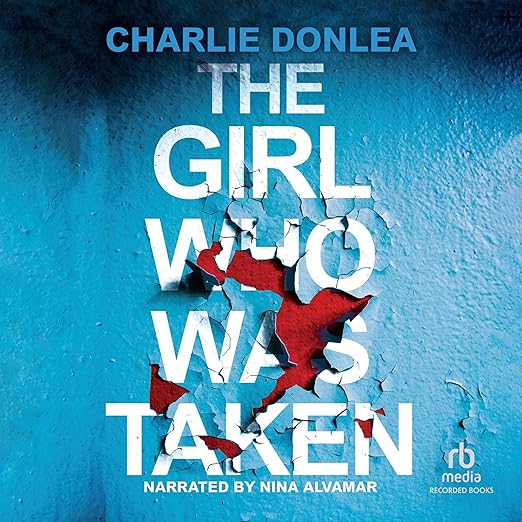
Quick Take
- Narration: Nina Alvamar handles the dual timeline structure competently, maintaining enough distinction between Megan and Livia’s storylines to keep the puzzle legible.
- Themes: Abduction survival and its aftermath, forensic investigation, hidden truth vs. public narrative
- Mood: Methodically tense, with a climax that lands harder than the setup suggests
- Verdict: Charlie Donlea constructs a dual-timeline thriller where what Megan has not said in her bestselling memoir matters more than what she has, and the forensic investigation that unravels it is carefully built.
I was halfway through an evening commute when The Girl Who Was Taken shifted on me. I had been listening with half my attention, tracking the dual timeline reasonably well, and then a detail landed that required me to back up and listen again. That is the particular pleasure Donlea is going for here: not shock for its own sake but the quiet, accumulated revelation of a story that was never what it appeared to be.
The setup is unusual in the genre. Most abduction thrillers begin with a missing person. Donlea begins with a return. Megan McDonald has escaped from a bunker in the woods, written a bestselling memoir about her ordeal, and become a national celebrity around her survival narrative. Her friend Nicole Cutty, taken the same night, is still missing. It is Nicole’s older sister Livia, a forensic pathology fellow, who gradually understands that Megan’s triumphant public account is incomplete, and that the gap between the memoir and the truth is where Nicole’s fate lies.
Our Take on The Girl Who Was Taken
Donlea structures the novel across two timelines: Megan’s account of captivity and the present-day investigation Livia is conducting through her work in the morgue. The technique is common in contemporary thriller but Donlea uses it with discipline. The reveals are sequenced carefully, and the structure serves the story’s logic rather than existing purely for narrative variety. One reviewer described the conclusion as something they never saw coming despite being an avid suspense reader, which is the genre’s highest practical compliment.
What distinguishes Donlea’s approach is the forensic pathology element. Livia’s profession is not decorative. The first clue to Nicole’s disappearance comes through an autopsy Livia performs on a young man connected to Nicole’s past. The morgue work is described with enough detail to feel authentic without becoming clinical, and it gives the investigation a procedural grounding that differentiates the book from purely psychological thriller territory. Reviewers describe the characters as flawed and believable, and Donlea’s strength, as one notes, is in creating characters whose circumstances naturally support the narrative rather than requiring the plot to be bent around them.
Why Listen to The Girl Who Was Taken
Nina Alvamar’s narration handles the structural complexity of the dual timeline without losing listeners in the transitions. The two central women, Megan navigating her incomplete recovery behind her public recovery narrative, and Livia investigating through grief and professional commitment, require distinct emotional registers, and Alvamar maintains those differences consistently. The short chapters that reviewers mention as contributing to the book’s pacing work particularly well in audio, providing natural breathing room between revelations without losing momentum.
Donlea is praised specifically for research and for creating characters whose flaws feel real rather than convenient. Megan is not simply a victim concealing truth for self-protection. Her psychology is more complex than that, and the memoir-within-the-novel device, a published account of her ordeal that is both true and incomplete, is a clever formal choice that the narrative earns.
What to Watch For in The Girl Who Was Taken
One reviewer found the book somewhat long on events after the abduction and shorter on the abduction itself than they wanted. This is a fair structural observation. The novel is less interested in captivity as horror and more interested in what survival costs and conceals. If you are primarily drawn to abduction thrillers for the tension of the crime itself, the book will feel somewhat indirect. The payoff lives in the revelation of what Megan has not said, which requires patience with the investigation.
The multiple missing girls subplot, the implication that Nicole’s disappearance is connected to a broader pattern, is less developed than the central investigation. Donlea introduces this dimension effectively enough to deepen the stakes but does not explore it as fully as some readers may expect. The novel stays closest to Livia and Megan, which is the right choice but leaves some threads somewhat loose by the end.
Who Should Listen to The Girl Who Was Taken
Thriller readers who want procedural grounding in their suspense, specifically forensic pathology rather than law enforcement, will find Donlea’s approach refreshing. Listeners who respond well to dual timeline structure, where the present investigation illuminates and is illuminated by past events, will find the construction satisfying. Readers who enjoyed Karin Slaughter’s Will Trent series or Patricia Cornwell’s Scarpetta books for the forensic dimension alongside the human investigation will find this in similar territory.
Listeners who want faster pacing and more time inside the captivity experience will find Donlea prioritizes aftermath and investigation over the abduction itself. The book earns its climax, but it takes a methodical route to get there, and that requires some patience in the middle sections.
Frequently Asked Questions
Is The Girl Who Was Taken a series or a standalone novel?
It is written as a standalone thriller. The central mystery of Nicole’s disappearance and what Megan’s memoir conceals resolves within this single volume. Charlie Donlea has written other standalone thrillers, but this story does not require or set up sequels.
Does the dual timeline structure work in audio format?
Yes, with some attentiveness. Nina Alvamar maintains distinct registers for the two timelines and the transitions are clearly signaled. Reviewers who describe themselves as avid suspense readers found the structure legible and the reveals well-sequenced. The short chapter format helps maintain orientation across the two time periods.
How graphic is the forensic content in the book?
The forensic pathology work is present throughout but handled with enough detail to feel authentic rather than gratuitous. Livia’s morgue work is central to the investigation and described specifically, but the book is not primarily interested in gore. Readers who are sensitive to autopsy content but can tolerate it in a functional investigative context will likely manage this without difficulty.
Is the ending satisfying for readers who invest in the mystery across the full runtime?
The majority of reviewers find it genuinely surprising and well-earned. One describes it as a conclusion they never saw coming despite being an experienced suspense reader, and another calls it a masterstroke. A smaller number of readers found the pacing in the middle sections too deliberate for the payoff. The ending is the book’s strongest element, and most listeners who reached it felt the investment was justified.