Quick Take
- Narration: Annalee Scott handles the split perspective structure and tonal range from suburban comedy to genuine menace with consistent skill.
- Themes: Suburban secrets and social facades, holiday horror, women’s friendship under pressure
- Mood: Fast-paced and darkly comic, with genuine chill beneath the Southern hospitality
- Verdict: The Fruitcake earns its Desperate Housewives comparisons by taking the cul-de-sac thriller format seriously enough to let it get properly dark before the credits roll.
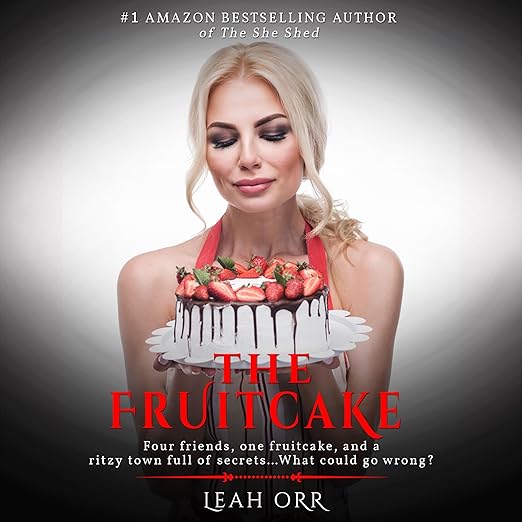
I started The Fruitcake on a Sunday in early December, which was either an accident or unconscious programming on my part, because the book is deeply and deliberately seasonal. The holiday fruitcake exchange as a vehicle for murder and mayhem is the kind of high-concept premise that either collapses into self-parody or commits to its own logic with enough energy to carry you through. Leah Orr commits. By the second chapter, someone has been kidnapped. By the time the fruitcake reaches the Hudson sisters on Christmas Eve four years later, you are not entirely sure what you are listening to, which is exactly where Orr wants you.
The setup plants Holly Kelly in Laguna Palms, a beachfront cul-de-sac community on Florida’s Hutchinson Island that has been engineered to look like a dream neighborhood and functions like something considerably darker. Holly arrives with her husband, her triplets, and an instinct for community that makes her immediately central to the neighborhood’s social life. The three friends she accumulates, Gina, Greta, and Chloe, are the core ensemble, and the book is smart about letting their different personalities create friction without making any of them villains. The actual menace in Laguna Palms comes from somewhere else entirely.
What the Fruitcake Tradition Conceals
The fruitcake exchange as a structural device is more clever than it initially appears. The tradition creates a recurring annual event that both bonds the community and marks the passage of time across the book’s four-year frame. Orr uses the non-linear timeline, jumping between the years when the deaths and disappearances occur and the Christmas Eve when Holly delivers to the Hudson sisters, to generate dread through dramatic irony. The reader knows something is wrong with Laguna Palms before Holly has assembled enough evidence to understand it, and the gap between what we suspect and what she knows creates sustained unease beneath the neighborly surface.
One reviewer described the tonal range as moving from a ladies’ workout group to humorous discussions about flatulence to murder with the reader never quite sure where the dialogue leads next, and that description is accurate. Orr is clearly enjoying herself at the tonal level, and the comedy does not undercut the horror. If anything, the humor makes the darker turns more effective because you have been lulled into a comfortable register before the temperature drops.
Split Narration and the Multiple Perspective Problem
The synopsis describes split narration spinning the tale from alternate perspectives, which is a structural choice that works better in some thriller premises than others. In The Fruitcake, the multiple perspectives serve the mystery: no single character has the full picture, and the gaps between what each narrator knows are where the book hides its most interesting information. One reviewer found the time-jumping and perspective-switching slightly choppy at points, and I think that is a legitimate observation about the middle section, where the number of active threads requires some management. Orr generally keeps the threads clear enough that the reader does not lose the through-line, but the book rewards attentive rather than passive listening.
Annalee Scott’s narration handles the tonal range effectively. The comedic moments land without tipping into camp, and the genuinely frightening passages, particularly the Christmas Eve sequence with the voices coming from inside the Hudson house, are read with appropriate restraint. Scott differentiates the four main women clearly enough that the perspective shifts register even without chapter headings signaling the change.
The four-year timeline is one of the more ambitious structural choices in a relatively compact thriller, and it creates a specific kind of dramatic irony that audio delivers well. You hear Holly describing the neighborhood in her early optimistic weeks and you already know, from the frame narrative established at the opening, that something went deeply wrong in Laguna Palms. That foreknowledge does not defuse the tension. If anything, it makes the warmth of the early sections more unsettling, because Orr has trained you to read the neighborly rituals as evidence of something concealed rather than something genuine.
Florida Gothic and the Suburb as Setting
The Florida cul-de-sac is an underused setting in crime fiction, and Orr uses it well. Laguna Palms is the kind of community where everything looks right and nothing adds up, where men vanish and reappear changed and the neighbors decide not to ask too many questions. The Southern hospitality framing, the warmth and the food and the social rituals, functions as a specific kind of camouflage for the wrongness underneath. This is not the grim procedural landscape of Nordic crime or the grimy urban texture of American noir. It is something more specific and in some ways more unsettling: the suburb that looks like paradise and operates like a trap.
The book’s 4.2 rating across 293 listeners reflects a genuine division between readers who responded to the comedic darkness and those who found the multiple threads and timeline shifts difficult to follow. That division maps fairly cleanly onto reader preference for formally complex versus more linear thriller structures.
Who Should Listen and Who Should Skip
Listen if you are drawn to the Desperate Housewives model of suburban thriller: comedy, genuine menace, and women’s friendship at the center. Listen if you can handle non-linear timelines and shifting perspectives as structural tools rather than obstacles. Skip if you need a clean, chronological crime narrative with a single investigative protagonist. Skip if holiday-themed horror premises feel gimmicky to you, because Orr’s commitment to the fruitcake conceit never wavers, and that is either the point or the problem depending on your sensibility.
Frequently Asked Questions
Does The Fruitcake work as a pure thriller or is the comedic element too prominent for readers looking for genuine suspense?
The comedy and the suspense coexist rather than competing. Orr uses the humor to establish a deceptively comfortable baseline before the darker material lands, which most reviewers found effective. Listeners who need their thrillers tonally consistent throughout may find the tonal range disorienting.
How confusing is the non-linear timeline in The Fruitcake for audiobook listeners who cannot flip back to check details?
One reviewer noted the time-jumping required attention, and that observation is fair for audio. Orr generally signals the timeline clearly enough to follow, but this is a book that rewards attentive listening rather than background listening. The four-year frame becomes intuitive once established.
What are the disappearing and changed men in Laguna Palms actually about, and does the book explain it fully?
Without spoiling the resolution, the men’s disappearances are central to the mystery the four friends unravel and receive a full explanation. The horror element tied to this thread is genuine rather than merely atmospheric.
Is The Fruitcake the first book in a series, or does it stand alone?
The Fruitcake appears to be a standalone novel. It resolves its central mystery and does not require or set up a sequel, though Leah Orr has other works in her catalog that reviewers have described with similar enthusiasm for her storytelling instincts.