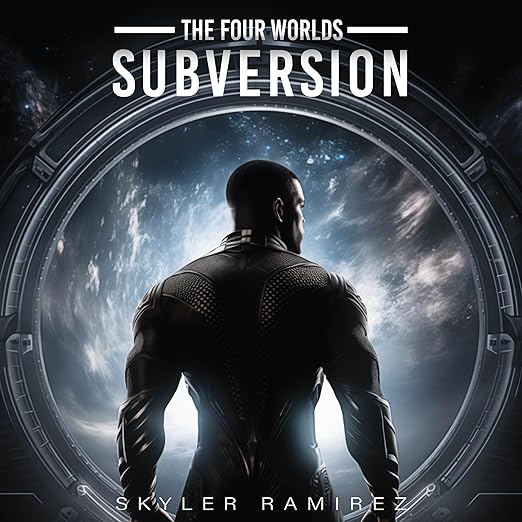
Quick Take
- Narration: Michael Murphy brings consistent energy to a sprawling cast, handling the shifts between Jinny’s desperate captivity and Tyrus’s cold, predatory precision with welcome distinction.
- Themes: governmental deception, free will vs. engineered obedience, unlikely heroism
- Mood: Fast and relentless, with conspiratorial undercurrents
- Verdict: Readers who loved the first volume will find this second entry raises the stakes convincingly, though newcomers should start at the beginning.
I picked up The Four Worlds: Subversion on a rainy Wednesday evening, fully intending to listen for an hour before bed. Three hours later I was still awake, somewhere in the middle of a prison break, unable to find a sensible stopping point. That involuntary commitment is its own kind of recommendation, and it’s the most honest thing I can say about what Skyler Ramirez has built in this second volume of The Four Worlds series.
The setup continues directly from book one: Jinny Ambrosa and Tyrus Tyne have made it to Earth, carrying a warning about the Council’s invasion plans. But the Council is already there, embedded in governments, working through spies and assassins. Before long, Jinny is captured and imprisoned, Tyrus is operating alone in enemy territory, and the very allies they counted on have turned into liabilities. Meanwhile, out in the 47 Colonies, the concept of free will is spreading like a contagion through a system that was built to suppress it, and the Keeper is growing desperate.
Our Take on The Four Worlds: Subversion
What Ramirez does well is maintain genuine narrative momentum across a 21-hour runtime. That is harder than it sounds. Many space opera sequels stumble in the middle volumes because they are essentially throat-clearing between a strong opening and a promised climax. Subversion avoids that trap by giving every major thread real consequences. The Jinny storyline is claustrophobic and tense in ways that feel earned. The Tyrus thread plays to the character’s strengths, and watching someone with his particular skill set navigate a situation where he cannot simply eliminate his way out of trouble is genuinely interesting.
Reviewers have noted that the writing occasionally repeats itself, and I heard that too. There are passages where a situation is explained once, then reinforced, then circled back to in a way that initially feels redundant. But, as one reader observed, the repetition sometimes peels back a new layer of the same moment rather than simply restating it. It is an unusual stylistic choice, and it does not always land, but when it works it creates a strange doubled quality, like looking at the same scene through different glass.
Why Listen to The Four Worlds: Subversion
Michael Murphy handles a large cast with enough vocal differentiation that you rarely lose track of who is speaking during tense scenes. The prison sequences, which could easily become monotonous in audio format, stay distinct because Murphy keeps Jinny’s voice grounded and slightly frayed without sliding into melodrama. His Tyrus is cooler, more metronomic, which suits a character who spent years functioning as an instrument of violence and is now learning to operate on different principles.
The genre blend Ramirez is attempting is genuinely ambitious: space opera scope, military science fiction precision, genetic engineering as a source of moral weight, and a psychological thriller layer that runs underneath everything. Most of the time these elements coexist without canceling each other out. The galactic political intrigue and the intimate question of what free will costs are never far from each other, and that combination gives the series a texture that distinguishes it from more straightforward action-driven science fiction.
What to Watch For in The Four Worlds: Subversion
The pacing is intentionally relentless, and that can work against the book in its quieter character moments. Relationships between Jinny and Tyrus, which carry a great deal of the story’s emotional weight, sometimes feel compressed by the need to move the plot forward. There are scenes where you want the book to slow down and let the connection between these two people breathe, and instead it pivots back to the action.
The typo count is higher than in the first book. Readers who noticed typos in book one should be aware this has become slightly more pronounced here. It does not derail the experience, but it is a genuine roughness in the production. Given how strong the underlying storytelling is, it is a shame that this kind of editorial polish is missing.
A word of caution for anyone thinking of starting here: this is emphatically not a standalone entry. The world, the characters, their histories, and the stakes all assume you have read The Four Worlds volume one. Jumping in at book two would be disorienting in a way that would undermine your experience of what is actually a well-constructed series.
Who Should Listen to The Four Worlds: Subversion
This audiobook will suit you if you are already invested in the series and want more of what made book one work, if you enjoy space opera with a political thriller layer and are willing to accept some narrative roughness in exchange for genuine pace, or if you are interested in stories where free will functions as a source of actual dramatic conflict rather than philosophical decoration. Skip it if you have not read book one, if you need tight editorial polish, or if slow-burn character development is what you seek from science fiction. For fans of the series, book three is apparently already pre-purchased by readers who finished this one, which tells you what you need to know.
Frequently Asked Questions
Do I need to read The Four Worlds book one before listening to Subversion?
Yes, without reservation. Subversion picks up directly from the events of book one, and the characters, factions, and world-building are not re-explained in any meaningful way. Starting here would leave you without the context needed to follow the political conspiracies or care about the central relationship between Jinny and Tyrus.
How does Michael Murphy handle the dual narrative between Jinny’s captivity and Tyrus’s solo operation?
Murphy distinguishes the two threads through vocal tone rather than dramatic shifts. Jinny is rendered with a slightly rougher, more reactive quality that suits the confined prison setting, while Tyrus comes across as cooler and more deliberate. It is a subtle distinction but an effective one over 21 hours.
Is the repetitive writing style in Subversion a problem for the audiobook format?
It is worth knowing about going in. Several reviewers noted repeated passages that re-examine the same event from a slightly different angle. In audio, this can feel like pacing drag in a way that might register less in print. Whether it reads as stylistic depth or structural padding will depend on your tolerance for that approach.
Does Subversion resolve the main conflict, or does it end on a cliffhanger?
Based on the synopsis and reviewer responses, the story is ongoing and clearly points toward a third book. Multiple readers noted pre-purchasing book three immediately after finishing this one, so expect a substantial narrative continuation rather than a closed ending.