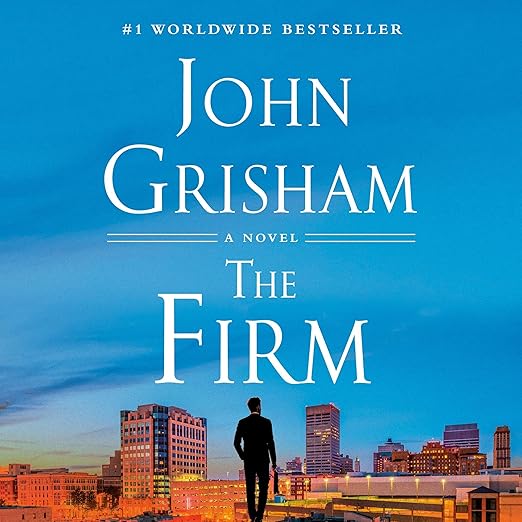
Quick Take
- Narration: Scott Brick is well-matched to Grisham’s procedural tension, measured, clear, and reliable through seventeen hours of legal maneuvering.
- Themes: Institutional corruption, loyalty under duress, the price of ambition
- Mood: Slow-burn and pressurized, the kind of thriller that builds dread through accumulation rather than action
- Verdict: A foundational legal thriller that still delivers on its core premise of a young man trapped between two sets of powerful people who both want something from him.
The Firm was John Grisham’s second novel, published in 1991, and it is the book that turned him into a phenomenon. I came to the audiobook having somehow managed to neither read the novel nor watch the Sydney Pollack film with Tom Cruise, which meant I was able to experience the story without knowing where it was going. What I found was a thriller with a patience that feels almost countercultural now: Grisham takes his time building the trap before he springs it, and Scott Brick’s narration rewards that patience.
Mitch McDeere is top of his Harvard Law class. Bendini, Lambert and Locke of Memphis makes him an offer that is, by any rational measure, extraordinary: a BMW, cleared school loans, a mortgage arranged, a decorator hired. Mitch accepts and moves to Memphis with his wife Abby. The novel spends a substantial portion of its runtime inside the seduction of that offer, inside the slow dawning awareness that something is wrong, and inside the paralysis that comes when Mitch discovers just how thoroughly he is owned before he has realized he was being purchased. When the FBI arrives wanting his cooperation, Mitch is caught between an organization that kills its own lawyers and a federal agency that is not particularly interested in his survival either.
Our Take on The Firm
What Grisham understood, and what still holds up, is that the most effective legal thrillers are not really about legal procedure. They are about leverage. The Firm is a book about a man who discovers that every gift he has been given is actually a chain, and who then has to figure out how to escape using only his intelligence and a willingness to be smarter than the people who think they own him. That premise has a clarity that keeps the story moving even through its more deliberate passages.
Scott Brick is a reliable narrator for this kind of material. He does not dramatize excessively, which suits a story where the dread comes from information and implication rather than from action scenes. His voice has a professional steadiness that matches Mitch McDeere’s character, a young man who is fundamentally calm under pressure and who works through problems methodically. Brick keeps Grisham’s many characters distinct without resorting to caricature, which matters across seventeen hours.
Why Listen to The Firm
Listeners who have watched the film first will find significant differences. Multiple reviewers note that the book and the movie have different endings, and several who knew the film said the book made more sense as a complete narrative. One reviewer who had watched the film many times described the book as finally making the full plot cohere in a way the adaptation did not. If you have the Tom Cruise version in your head, the audiobook is worth your time as a corrective and an expansion.
For listeners who are new to Grisham, this is a reasonable entry point and historically important as the book that established his template. The prose is efficient rather than literary, which makes it well-suited to audio. Grisham does not write sentences you need to read twice, which means the story moves at the pace it intends on first listen.
What to Watch For in The Firm
The slow-burn pacing is a feature of the book, but it does mean the first third moves deliberately. One reviewer called it a slow burn but engaging at the end, and that is an accurate description of the shape of the reading experience. If you are expecting propulsive thriller momentum from the opening chapter, you may need to adjust your expectations. Grisham is setting a stage, and the payoff comes from how fully that stage is constructed.
The novel is also a product of its era in some of its gender dynamics. Abby McDeere is well-drawn but largely reactive, and her role is structured around Mitch’s choices rather than her own. Readers attuned to this will notice it, though it does not undercut the thriller architecture in any material way.
Who Should Listen to The Firm
Legal thriller readers who have somehow not gotten to this one yet will find it well worth the seventeen hours. Listeners who appreciated early Grisham novels like The Pelican Brief or The Client will find this is of a piece with that work. Anyone who came to the story through the film and felt something was missing will get the full version here. Readers who need constant action or who struggle with slow-build narratives may want to look at a later Grisham that hits the ground harder.
Frequently Asked Questions
How different is the audiobook version of The Firm from the Tom Cruise film adaptation?
Substantially different, particularly in the ending. Multiple listeners who knew the film described the book as having a more complete and coherent resolution. The film streamlines and alters the plot significantly.
Is Scott Brick the right narrator for Grisham’s legal thriller style?
He is well-suited to it. Brick’s measured, professional delivery matches the book’s methodical slow-burn pacing. He keeps a large cast of characters distinct without resorting to exaggerated voices.
Does The Firm hold up as a thriller decades after it was published?
The core premise remains effective: a young man trapped between two powerful institutions, using only his intelligence to escape. The period details are present but not obtrusive, and the leverage-based tension is timeless.
Is The Firm a good starting point for someone new to John Grisham?
It is historically the book that established Grisham’s template, so it gives you the clearest sense of what he was building. The efficient prose and clear plot make it accessible. Be prepared for a deliberate first third before the pace accelerates.