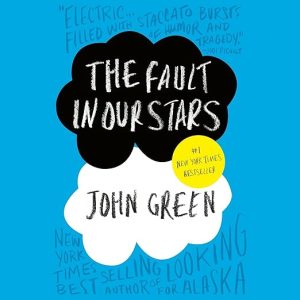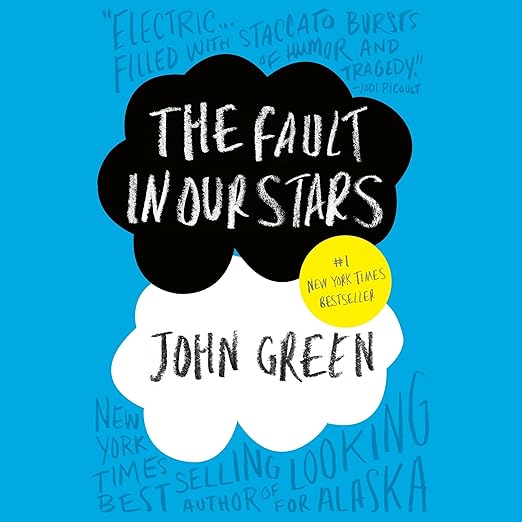
Kate Rudd is the only name in the narrator credit of this seven-hour audiobook, and that matters more than usual for a novel told entirely in the first person by a sixteen-year-old. Hazel has been terminal since her diagnosis, bought a few extra years by a tumor-shrinking treatment, and she meets Augustus Waters at a cancer support group. John Green's novel has been in print long enough that its plot is common property, so the useful question now is what a listener gets from it that a reader does not.
Is The Fault in Our Stars Worth Your Time?
Irreverence is the part people forget. The publisher describes the book as insightful, bold, irreverent and raw, and that third adjective is doing more work than the others. This is a very funny novel about children with cancer, and the comedy is not incidental relief but the actual voice of the thing. Hazel is sardonic about her own prognosis in a way that would be unbearable coming from an adult writer's idea of a dying teenager, and the fact that it lands instead is the whole trick of the book.
One of the sharper notices, filed from Canada, frames Green's real subject as time itself and argues that the novel conveys with unpleasant accuracy what it is like to feel like a ticking time bomb. The same notice points out that the children here are grappling with life-crises most adults manage to postpone. That is the most useful sentence anyone in the pool writes, and it explains the book's staying power: the illness is a delivery mechanism for a much more general problem.
Intensity of response is itself a kind of information about this novel. Alexandra C predicts that any reader with a heart will melt, cry, and both curse and fall in love with John Green, and offers that as a warning rather than a boast. Reading the five notices in sequence, what strikes me is that not one of them is measured. People do not emerge from this novel with a considered opinion. They emerge with an injury and a recommendation.
Anyone approaching it as a straightforward weepie will be surprised for about ninety minutes and then flattened on schedule. The jokes are load-bearing. Take them out and the book becomes the sentimental object its detractors describe; leave them in and the sad parts land because you were not braced. That is a structural achievement rather than a tonal accident, and it is why the sad passages still work on a second pass when you already know what is coming.
The Best Parts of The Fault in Our Stars
The literary bones are better than the phenomenon suggests. Adrienne, whose notice is the most careful here, records that the title comes from Julius Caesar and argues that the source sets the tone precisely. Shakespeare's line puts the fault in ourselves rather than in our stars, and Green spends the novel arguing with that proposition rather than illustrating it. Adrienne rates it, hedged with a quite possibly, as the best standalone novel in a lifetime of reading. Whatever you make of that ranking, the book is doing deliberate literary work beneath a teenage love story, and read aloud, its sentence rhythms come forward in a way the page flattens.
Durability matters next, and it is what persuaded me to revisit the novel at all. Madison Says opens by conceding that claiming a book changed your life is serious business, then makes the claim anyway and settles on the verdict that the damage was repair rather than ruin. Notices like that are usually written in the first flush of a bestseller and look embarrassing a decade later. These have not aged into embarrassment, which for a novel this heavily marketed is genuinely unusual.
Worth noting too: the notices here come from four countries, including one filed from Brazil in Portuguese, whose author reports that the pleasure was reading it in English to practice the language. Green's prose is clear, contemporary and dialogue-heavy, exactly the profile a language learner wants, and hearing the sentences spoken is a better tool for that purpose than the printed page. That is a use case nobody designs for and plenty of people rely on.
Before You Commit to The Fault in Our Stars
This listing stacks editions and the score inherits the confusion. The recording is dated April 2022, while four of the five reviews on this page were filed between 2013 and 2016, when the novel was new and this production did not exist. What sits underneath the buy button is a decade-old conversation about a text, attached to a much newer performance of it. The 4.6 across 163 ratings is a verdict on John Green, not on the version you would be downloading.
Emotional cost is real and the marketing tends to soften it. The subject is teenagers dying with their parents in the room, and several buyers describe being genuinely damaged by the experience. That is the intended effect and most people are glad to have had it. If cancer is currently in your household, however, the novel offers no distance at all, and audio removes the skimming ahead that a print reader instinctively uses for self-protection.
One credited reader carries Hazel, Augustus, both sets of parents and an entire support group across the runtime. That is a heavy casting load for a novel whose defining feature is one very particular teenage voice, and it is the variable this page gives you no information about whatsoever. Sample a scene with three or more people talking rather than a passage of Hazel alone. If the register holds there, it will hold everywhere.
Should You Listen to The Fault in Our Stars?
Take it if you have somehow avoided the book, if you last read it as a teenager and want to see what survives the second pass, or if you want a novel that treats young people as capable of serious thought about mortality. It also serves a listener who simply wants clear, funny contemporary English delivered at a steady pace. Parents of teenagers who have read it will find the return trip worthwhile, if only to understand what their children were reacting to.
Hold off if you are grieving, if you want anything resembling a comfortable listen, or if articulate teenagers in fiction irritate you. Green's characters speak with more polish than most people manage in an argument, which is either the pleasure of this book or the barrier to it, and seven hours will not change your mind either way.
Quick Take
- Read by: A single credit covers a first-person teenager, her boyfriend, four parents and a support group full of children.
- At its heart: Terminal illness, first love, mortality in adolescence, arguing with Shakespeare.
- Vibe: Funny, sharp and eventually devastating.
- Short version: The novel earns its reputation, and hearing it read aloud brings the comedy forward where the page buries it.
How long is The Fault in Our Stars audiobook and how is it paced?
Seven hours and eleven minutes, short for a novel with this profile. The pacing is conversational rather than plot-driven, built on long exchanges between the two leads, which means it moves quickly early and then slows deliberately as the consequences of the diagnosis take over.
Are the reviews on this listing about the 2022 audiobook edition?
Mostly not. Four of the five date from 2013 to 2016, well before this production appeared, so the 4.6 average reflects a decade of opinion about the novel itself. Treat it as a verdict on John Green rather than on the recording you would be buying.