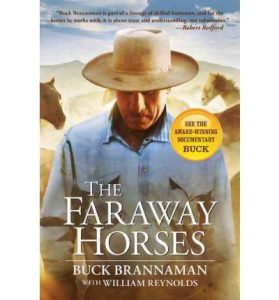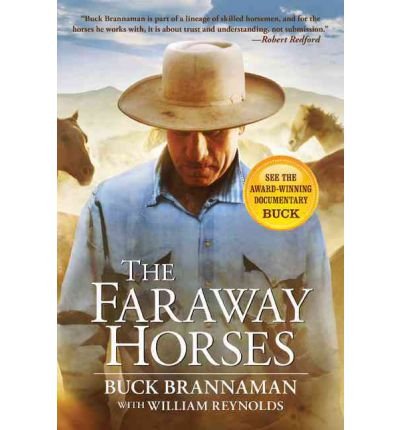
I came to The Faraway Horses sideways, the way you often come to the books that matter most. A friend who trains horses mentioned Buck Brannaman in passing, and I looked him up and spent an afternoon watching footage of him work, the way a horse that arrived kicking and rolling its eyes left the round pen calm, ears forward, following at his shoulder like it had forgotten what panic felt like. Then I found the audiobook and listened to it over the course of a long weekend. By the end I understood something new about patience, not from a self-help framework but from watching, through Brannaman's words, what it actually looks like to earn trust from a creature that has reason not to give it.
Buck Brannaman is the horseman whose approach partly inspired Nicholas Evans's novel The Horse Whisperer, and Robert Redford, who played that character in the 1998 film, later produced a documentary simply called Buck about Brannaman's life and clinics. The Faraway Horses is his own account: a childhood marked by severe abuse at the hands of his father, the intervention of a foster family, and the slow discovery of a gift with horses that would define his entire life. It is also, at its deeper level, a book about how the work you find as a young person can save you, if it demands enough of you and if it teaches you the right things.
Brannaman does not spend a great deal of time on his childhood in terms of page count, but he does not flinch from it either. The abuse was real and sustained, the kind that leaves marks on how a person reads situations, reads bodies, reads the small signals that precede violence. What is striking is the connection Brannaman draws, without overdoing it, between what his childhood taught him about survival and what horses require from a trainer. A horse that has been frightened by humans operates from a specific kind of vigilance. Brannaman understands that vigilance from the inside. His empathy with troubled horses is not sentimental. It is structural. He knows what fear-driven behavior looks like and what changes it.
This is the emotional spine of the book, and John Pruden narrates it with the right kind of restraint. He does not push the pathos of the childhood sections. He reads them with a plainness that respects Brannaman's own no-drama approach to autobiography, and that plainness makes the moments of real feeling, when they come, land harder than they would if the narrator had been signaling their importance all along.
The Best Parts of The Faraway Horses
The book's considerable value for horse people is that Brannaman explains his approach with unusual clarity. He draws on the tradition of Tom Dorrance and Ray Hunt, the horsemen who most shaped his thinking, and he articulates principles that serious trainers spend years absorbing through apprenticeship. The idea is not to dominate a horse but to present yourself as safe, consistent, and worthy of following. The round pen work, the groundwork, the gradual extension of trust that eventually allows a rider to sit on a horse's back and go somewhere together, these are not tricks. They are a relationship, built in small increments, continuously renegotiated.
For listeners who have no experience with horses, this material is still accessible because Brannaman has the instincts of a genuine teacher. He knows how to illustrate abstract principles with concrete scenes, and his stories from his traveling clinics, the difficult horses, the baffled riders who arrive with problems they did not realize were their own, are genuinely compelling. The book runs six hours and seven minutes, which is on the shorter side, and the brevity suits it. There is no padding here.
Before You Commit to The Faraway Horses
The Faraway Horses has accumulated an impressive 4.8 rating across more than 1,100 listeners, which is the kind of score that usually reflects a book that does something real for people rather than simply satisfying genre expectations. What comes back again and again in reader responses is that the book changed how people thought about the relationship between their own histories and the creatures they work with. That is a significant thing for a memoir to accomplish.
Brannaman is not a literary stylist in the conventional sense, but his prose has the directness and specificity of a man who has spent his life paying close attention. He notices things. The way a horse holds its ears. The moment a rider's seat changes and the horse feels it. The particular quality of stillness that means trust rather than submission. Those observations accumulate into something that feels, by the end, like a philosophy of relationship: not just with horses but with any creature, human or animal, that has learned to expect the worst.
Should You Listen to The Faraway Horses?
Listeners who love equestrian memoirs will find this essential. Readers with no horse background who are drawn to memoir, natural history, or books about the psychology of animals will also find plenty here. It is a quiet book with a long reach. The short runtime makes it an accessible commitment. What it asks of you instead of time is a particular quality of attention, the willingness to slow down and follow a man who has made a practice of slowing down himself. That is not always comfortable in an era that rewards speed above almost everything else. But Brannaman has spent a lifetime demonstrating that the things worth having tend to require patience, and The Faraway Horses makes that argument in the most concrete, specific, and human terms possible.