Quick Take
- Narration: Nick Flesher handles the post-apocalyptic setting with straightforward delivery that matches the book’s accessible YA register.
- Themes: Community rebuilding, coming of age under civilizational collapse, the weight of knowledge
- Mood: Hopeful and adventure-driven, low on existential dread
- Verdict: A solid entry in a YA post-apocalyptic series that rewards loyal readers of the End of Everything sequence more than newcomers.
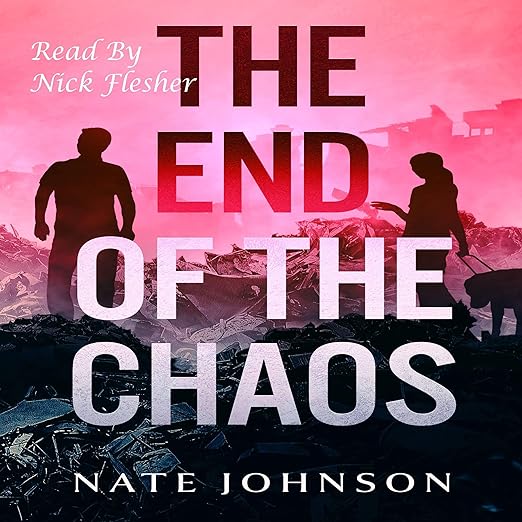
I listened to The End of the Chaos on a morning run, which turned out to be an ideal match: the book moves at a pace that rewards forward momentum rather than pause and reflection. This is the seventh volume in Nate Johnson’s End of Everything series, set thirty-eight years after a virus killed almost everyone on earth. Joshua Tanner, the protagonist, faces a specific and concrete mission: preserve disappearing knowledge and rescue a girl stranded on the other side of the continent. Nick Flesher delivers this with a clean, unshowy performance that keeps the focus on plot.
The premise earns its place in the post-apocalyptic genre by focusing on something that most survival narratives ignore: knowledge erosion. Johnson understands that civilizational collapse is not just about food and shelter but about what happens when the accumulated expertise of modernity disappears alongside its practitioners. Joshua’s mission to save what remains of usable knowledge alongside his cross-continent rescue mission gives the book an intellectual spine that lifts it above standard genre fare. At five hours and forty-seven minutes, the book moves quickly enough that you feel the urgency of what is being lost. Flesher keeps the pace honest rather than artificially rushed, which is the right call for material this emotionally invested in its outcome.
What Thirty-Eight Years of Rebuilding Looks Like
One of the consistent pleasures that readers across the End of Everything series have described is watching communities form and develop across books. The Portland settlement that appears throughout the series has become, for loyal readers, a genuine fictional community with accumulated history. One reviewer who praised the series overall mentioned loving all the stories of people coming together to make a community in Portland across the sequence.
That accumulated attachment is partly what makes book seven a different experience for series veterans versus newcomers. The emotional weight of returning characters and their children and grandchildren landing in book seven is entirely a function of investment built over the previous six volumes. Johnson writes with awareness of this: the reviewer who described the book as containing unexpected twists and growing romantic elements alongside the survival challenges is describing content that rewards long-term series readers in particular. For those readers, this volume delivers.
What Nick Flesher Brings to the YA Apocalypse Register
Flesher calibrates the narration correctly for a protagonist who is young but carries genuine responsibility. He reads Joshua as someone navigating real stakes without losing the forward, propulsive energy that characterizes the character at his best. He does not age Joshua down into a child register or up into adult gravitas. The performance sits exactly where the character lives, which is a more difficult balance to strike than it appears when done well. The cross-continent journey sections in particular benefit from this calibration: the physical danger and the emotional weight of the mission need to coexist, and they do.
The Editorial Issue That Hovers Over the Series
One reviewer offered a pointed observation worth flagging for prospective listeners: they gave the publishing around this author a one-star rating while rating the author’s storytelling highly, specifically citing editorial and grammatical errors that need correcting. This is a recurring note in reader feedback across the End of Everything series, and it is worth taking seriously. Another reviewer noted that these issues have been improving across books, with book seven showing cleaner editing than earlier entries.
In audio format, editing errors in the source text manifest as awkward sentence rhythms or occasional logical discontinuities rather than visible typos. Flesher handles these with professional smoothness where possible, but listeners attuned to prose quality will notice the rough edges. The storytelling engine underneath is strong enough that most readers and most reviewers have decided the flaws are worth tolerating. But transparency requires naming them rather than hoping no one notices.
The Balance of Adventure, Romance, and Survival
The cross-continent journey involves natural disasters and desperate human encounters, with enough variety to keep the forward momentum from feeling monotonous. The romantic element, Joshua’s connection with Amanda, is present throughout but never dominates the plot. Johnson is writing primarily adventure fiction with survival stakes, and the romance is a motivating force rather than the central focus.
One reviewer described the series as YA that they genuinely enjoyed as an adult, citing the characters’ transitions into adulthood and their determination in surviving difficult situations. That balance, grounded protagonists navigating real stakes without the self-conscious grit of adult post-apocalyptic fiction, is the series’s specific appeal. Johnson has found a register that younger readers find accessible and adult readers find refreshingly unironic about the possibility of humans working together and building something worth having.
For Listeners Starting Here Versus Starting at Book One
Start at book one. This series builds emotional continuity across seven volumes, and the Portland community Johnson has developed only resonates fully if you have watched it grow. The plot of The End of the Chaos is self-contained enough that newcomers can follow what happens, but the investment that makes the book satisfying is earned through the series rather than available in a single volume. Series fans will find this a strong continuation. New listeners curious about the End of Everything world should begin with the first book and let the attachment build naturally. Johnson has written a series that rewards patience and sustained engagement, and book seven is the payoff for six books of investment, not a shortcut to the experience the series builds.
Frequently Asked Questions
Can The End of the Chaos be read as a standalone, or is the full series necessary?
The book’s plot is technically followable without the prior six volumes, but the emotional payoff is almost entirely dependent on series investment. New listeners should start from the beginning of the End of Everything sequence.
The reviews mention editorial issues. How noticeable are these in the audio version?
They manifest as occasional awkward sentence rhythms and minor logical discontinuities rather than visible typos. Nick Flesher handles them professionally, but listeners attuned to prose quality will notice. The consensus is that the storytelling is strong enough to outweigh the technical imperfections.
Is this series appropriate for young adult readers specifically, or does it skew older?
It sits comfortably in the YA range. The protagonist is young and the series handles violence and death without graphic intensity. Multiple reviewers noted enjoying it as adults, which suggests it works across age groups without being too dark for younger listeners.
How does the knowledge-preservation theme play out in this specific book versus the series overall?
It is most directly addressed in this volume through Joshua’s mission to preserve disappearing expertise and usable technology. The earlier books focus more on physical survival; book seven elevates the intellectual stakes of civilizational rebuilding as a distinct challenge.