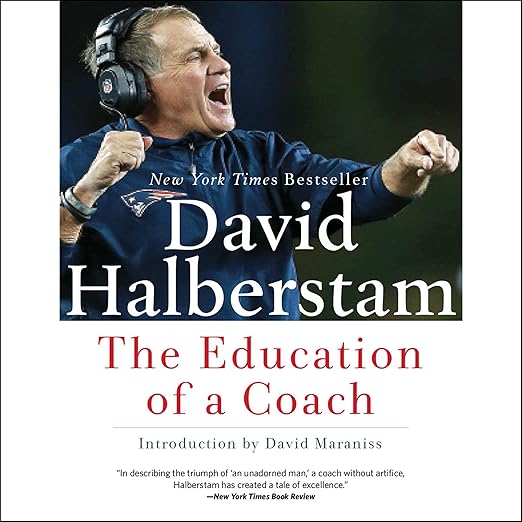
Quick Take
- Narration: Tom Stechshulte delivers Halberstam’s measured, literary journalism with the authority it deserves; his voice suits the book’s contemplative rather than celebratory tone.
- Themes: Leadership development, the inheritance of coaching philosophy, football as an intellectual discipline
- Mood: Thoughtful and unhurried, more portrait than biography
- Verdict: One of the finest sports biographies written in the last twenty years, elevated by Halberstam’s literary intelligence and made more resonant by Belichick’s subsequent career arc.
I was not particularly interested in Bill Belichick when I first encountered this audiobook. I am not a football person in the way that some people are football people, the kind where the sport is a year-round preoccupation and coaches are known quantities. What I am is a reader who respects David Halberstam, and Halberstam’s name on anything, whether it is The Best and the Brightest or The Fifties or this relatively slender book about a coach, is reason enough to pay attention. He died in 2007, two years after this book’s publication, and in hindsight it reads as one of the works of late Halberstam: precise, patient, and working at a length calibrated exactly to what the subject can bear.
The Education of a Coach is not a career retrospective. It is a portrait of how a person becomes who they are. The central argument, rendered through accumulated observation rather than thesis statement, is that Belichick is not primarily the heir of Bill Parcells’ coaching tree, though he worked under Parcells for years. He is the heir of his father, Steve Belichick, a naval academy scout and football analyst who spent decades studying the game at a level of intellectual rigor most coaches never approached. Halberstam does not make this argument quickly. He earns it, and the earning takes most of the audiobook’s nine and a half hours.
Steve Belichick: The Father the Book Discovers
Steve Belichick is the real revelation of this audiobook for listeners who come to it from outside the football world. The elder Belichick was not a head coach and not a famous figure, but he was a student of football in the way that a philosopher is a student of ideas: systematically, across decades, building a framework for understanding the game that his son absorbed through childhood proximity before he consciously understood what he was absorbing. Reviewer Mark Twain on Audible makes the analogy explicit: Bill Belichick is to professional coaching what Paul Brown was to Vince Lombardi, the upstream influence that shaped the downstream figure most people recognize.
This is the kind of biographical insight that requires access, patience, and the literary intelligence to know what to do with it once you have it. Halberstam had all three. He spent time with Belichick and people who knew him at every stage of his career, and the portrait that emerges from those interviews is of a man who is genuinely private not because he has something to hide but because his interiority is his working space, the place where the film study and the historical analogy and the salary cap calculation all happen, in a process that does not benefit from being watched. That quality of inner life, and Halberstam’s skill in rendering it without overexplaining it, is what makes this book more than a sports biography.
Stechshulte and the Pitch of Literary Journalism
Halberstam’s prose has a specific pitch that demands a particular kind of narration: measured, intelligent, slightly formal without being stiff. Stechshulte understands this. He does not impose personality onto Halberstam’s sentences, which have plenty of personality of their own. The result is an audiobook where you are consistently aware of the quality of the writing, which is rare and welcome. Reviewer Richard of Connecticut, writing in 2006, noted that whatever subject Halberstam chose to write about became compelling; that capacity is on full display here, and Stechshulte’s narration serves it rather than competes with it.
At nine hours and thirty-two minutes, this is substantial for what is essentially a single-subject biography, but Halberstam uses the length to develop ideas rather than pad them. The sections tracing Belichick’s early coaching career, his time as a defensive coordinator in New York, and his difficult years as a head coach in Cleveland, all of which preceded the dynasty years in New England, are treated with the same analytical care as the championship seasons. The failure years are in many ways more interesting than the success, because they reveal how Belichick learned from losing in ways that most coaches never do.
Reading This in 2026
There is an unavoidable dimension to re-encountering this book now: Belichick’s departure from New England after the 2023 season, following two decades of extraordinary success, and his subsequent move to the University of North Carolina. The portrait Halberstam drew in 2005, of a man defined by preparation, analysis, and an almost philosophical commitment to team over individual, sits interestingly alongside the public questions about whether Belichick’s methods eventually created friction with his own organization. This book does not answer those later questions, but it provides the most serious account available of who Belichick is at his core. That makes it more relevant in 2026 than it might have seemed in 2015, and the listener who finishes it will have a framework for thinking about the later chapter of his career that most of the commentary never quite manages to provide.
What Halberstam Understood That Most Sportswriters Miss
Halberstam approached sports biography the way he approached everything: as a study in power, character, and the forces that shape a particular kind of excellence. He is not interested in Belichick as an entertainer or a personality; he is interested in Belichick as a study in how intellectual inheritance works, how a child absorbs a parent’s framework for thinking about a problem and then spends a career finding out what that framework can and cannot do. Reviewer Wheelchair Assassin described the book as monstrously enjoyable and interesting, and that combination captures Halberstam at his best: serious without being solemn, rigorous without being dry. For listeners who have never thought about why a football coach might be worth a nine-hour audiobook, this is the book that makes the case.
Frequently Asked Questions
Do you need to know football to appreciate this audiobook, or does it work for non-fans?
It works for non-fans. Halberstam is a literary journalist, not a sports journalist, and his interest is in character, leadership, and how a person becomes who they are. The football context is present throughout but never demands technical familiarity.
How does Tom Stechshulte’s narration handle Halberstam’s literary prose style?
With appropriate care. Halberstam’s sentences have architecture, and Stechshulte respects that architecture rather than flattening it. The narration is measured and intelligent, well-matched to a book that asks the listener to follow an argument as much as a story.
Does the book cover Belichick’s controversial moments, or does it present an entirely favorable portrait?
The book was written in 2005, before Spygate and several later controversies. It is a portrait of Belichick’s intellectual development and coaching philosophy rather than a comprehensive career biography, so later controversies are outside its scope. The portrait is admiring but not uncritical of Belichick’s communication style.
Is this primarily a book about Bill Belichick, or does it spend significant time on his father Steve Belichick?
Both are central to the book’s argument. Halberstam’s thesis is that understanding the son requires understanding the father; the intellectual framework for football analysis that Steve Belichick spent decades developing is the foundation on which Bill built his career.