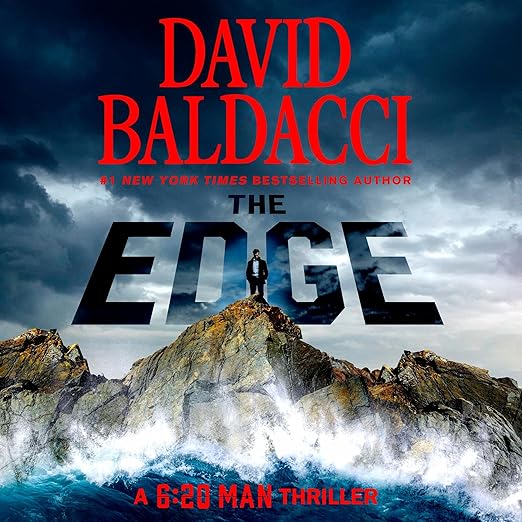
Quick Take
- Narration: Zachary Webber is a reliable fit for Baldacci’s procedural thrillers, handling both the action choreography and the quieter interrogation scenes with equal competence.
- Themes: Small-town secrets and outsider trust, national security and buried intelligence, moral ambiguity in service
- Mood: Taut and atmospheric, with a Maine coastal chill running through it
- Verdict: A well-constructed second entry that improves on the first by embedding Travis Devine in a community rather than a corporation, giving the procedural more human texture.
I was halfway through a late commute when Travis Devine drove into Putnam, Maine for the first time, and the shift in register from the financial conspiracy of the first 6:20 Man book to this particular small coastal town in late autumn felt immediately right. David Baldacci has made a career of understanding what genre readers want from their environments. Putnam, Maine, with its lobstermen, its generations-deep loyalties, and its communal suspicion of anyone who did not grow up there, is one of the better settings he has built in recent years.
The premise of The Edge is efficient: a CIA operative named Jenny Silkwell has been murdered in rural Maine, and her missing devices contain state secrets that could compromise active operatives. The government, in need of someone who can move quickly and read complex social dynamics in an unfamiliar environment, turns to ex-Army Ranger and recently established troubleshooter Travis Devine. His job is to solve the murder, retrieve the data, and do it before the people who want that information find it first.
Our Take on The Edge
What distinguishes this from a generic spy-thriller procedural is the emphasis on the town itself as the primary obstacle. Devine is not working against a clearly defined foreign adversary or a monolithic corporate villain. He is working against a community that has trusted each other their whole lives and that reads his presence as inherently suspicious. Dak, Jenny’s brother who is trying to revitalize Putnam’s economy, Earl the lobsterman who found the body, and Alex, Jenny’s sister with her own complicated history: these are people with layered motives who are neither villains nor reliable allies. Baldacci builds out their individual relationships to Jenny and to each other before allowing the central mystery to resolve, and the result is a thriller that keeps its questions open longer than the setup implies.
Reviewer Pronzini/Muller Supreme described this as one of Baldacci’s finest works, and while that may be somewhat subjective for a writer with such a large catalog, the specific praise for character development, location, and plot management is accurate. The book does not feel like output from a production line. It feels like a writer working at the top of his range in a specific mode.
Why Listen to The Edge
Zachary Webber has become the established voice for Travis Devine, and that continuity matters for a series character. He brings Devine’s analytical reserve to life without making him cold, which is the right instinct for a protagonist whose appeal depends on competence rather than charisma. The Maine setting benefits from Webber’s delivery during the interrogation and conversation scenes, where the silences and hesitations are as meaningful as the dialogue. He handles the thriller mechanics of the action sequences cleanly without pushing the pacing so hard that the atmospheric passages feel interrupted.
At 11 hours and 45 minutes, this is a comfortable two-to-three session listen. The book does not drag, and Baldacci has calibrated the information release well enough that the desire to know what Putnam is hiding keeps the momentum up even in the character-building chapters.
What to Watch For in The Edge
Readers who have not read The 6:20 Man will not be lost, but they will arrive at Travis Devine without the backstory that gives his compromised moral position its full weight. The first book’s financial conspiracy and the personal costs Devine paid are referenced rather than recapped here. The Edge functions as a standalone procedural, but the character depth it builds on is more resonant if you know where Devine started.
The small-town-holds-secrets structure is a familiar one, and some of its beats are predictable at the genre level. Baldacci works within the conventions competently rather than subverting them. If you come to the book hoping for something structurally surprising or formally inventive, that is not what this is. What it is, is a well-made thriller in a well-chosen setting, executed by a writer who has been doing this long enough to know exactly what the machinery requires.
Who Should Listen to The Edge
Existing 6:20 Man series readers should continue here without hesitation: it builds the series’ world and Devine’s character in ways that book one established the need for. General thriller listeners who like their procedurals grounded in real, specific places and who appreciate protagonists with moral complexity rather than invulnerability will find this a strong listen. Listeners looking primarily for non-stop action rather than atmosphere and character-building may want something with a faster baseline tempo. The Edge earns its 4.6 rating from readers who want their thrillers to have some weight.
Frequently Asked Questions
Is The Edge accessible as a standalone, or do I need to read The 6:20 Man first?
It functions as a standalone procedurally, but Travis Devine’s background and moral landscape are more fully established in the first book. The Edge references his previous case without fully recapping it. New readers will follow the mystery without difficulty but will miss some of the character depth that makes Devine interesting.
How does Zachary Webber’s narration compare to his performance in The 6:20 Man?
Reviewers have not noted a meaningful difference in quality between his performances across the series. He has settled into a consistent register for Devine that combines measured authority with occasional vulnerability, and the Maine small-town setting seems to suit his delivery of the more character-driven scenes well.
Does the small-town Maine setting feel authentic, or does it read as a genre backdrop?
Multiple reviewers praised the setting as one of the book’s genuine strengths. Baldacci gives Putnam specific texture through its economy, social dynamics, and communal memory in ways that make it feel particular rather than generic. The tension between Devine as outsider and the town’s interlocking loyalties is the book’s primary dramatic engine.
How does The Edge handle the national security thriller elements versus the more intimate murder mystery?
The two register seamlessly rather than feeling like separate genres spliced together. The missing CIA devices and the state secrets they contain create the urgency, but the investigation is conducted entirely on a human, interpersonal level. Devine is not fighting foreign agents or accessing government databases; he is reading people in a small town, which keeps the thriller grounded and the procedural elements intimate.