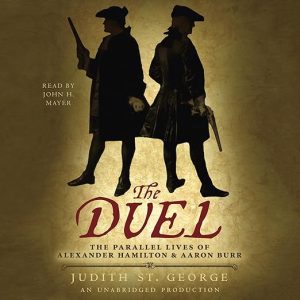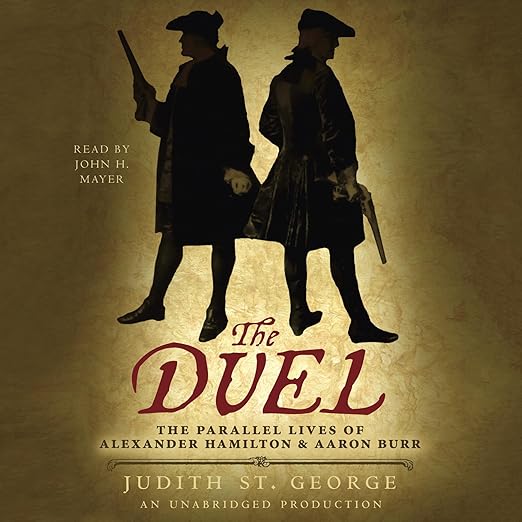
I listened to The Duel on a Sunday afternoon when I was looking for something brief and complete, and Judith St. George's dual biography of Alexander Hamilton and Aaron Burr delivered exactly that: a focused, intelligent examination of two lives that intersected fatally, written with the clarity of someone who knows how to hold a young reader's attention without simplifying the material into something untrue.
At three hours and three minutes, this is one of the shorter audiobooks I have reviewed this year, but St. George uses the runtime efficiently. The alternating-chapters structure moves between Hamilton and Burr with the kind of parallelism that makes both figures legible as individuals before the book brings them into collision. Both men were orphaned young. Both were brilliant students, one at Princeton, one at Columbia. Both served under Washington. Both entered politics. The symmetry is real, documented, and St. George uses it structurally to show how similar circumstances can produce drastically different character outcomes and political trajectories.
How The Duel Holds Up
What the book does exceptionally well is demonstrate that the duel itself was not an aberration but the logical terminus of a long-running competition between two men whose ambitions and senses of honor had been on a collision course for decades. St. George does not dramatize the Weehawken morning sensationally; she earns the event through the accumulation of character detail that precedes it. By the time the pistols are out, you understand both men well enough that the outcome, death for one and political ruin for the other, feels like something that character produced rather than chance inflicted.
Reviewers have consistently noted this book's unusual effectiveness across age ranges. One adult reviewer described being completely riveted. A thirteen-year-old called it not childish but accessible. A sixth-grade teacher described it as providing exactly the right amount of detail to keep students interested without glazing their eyes. That range of response is the mark of nonfiction that is genuinely well-written rather than merely age-appropriate.
The Best Parts of The Duel
John H. Mayer's narration is clean and appropriately paced for the material. He does not perform the history or add theatrical weight to the more dramatic passages; he delivers St. George's prose with the measured confidence of someone who trusts the writing. That restraint is the right call for a book that works through the steady accumulation of parallel biography rather than dramatic peaks. The three-hour runtime also means the narration sustains its energy from start to finish without the mid-stretch fatigue that longer nonfiction audiobooks sometimes develop.
Before You Commit to The Duel
Listeners who have encountered Ron Chernow's Hamilton, or who came to this period through Lin-Manuel Miranda's musical, will find that The Duel takes a more balanced view of Burr than either of those sources. St. George is writing dual biography, not Hamiltonian hagiography, and Burr emerges as a genuinely intelligent and capable man destroyed partly by circumstances and partly by the way his particular brand of ambition expressed itself against Hamilton specifically. Several reviewers came to this book via the musical and described finding Burr considerably more sympathetic here than the stage version allows.
The book's brevity means it cannot go deep on any single aspect of either man's life. This is an introduction to both figures and to the question of how their paths converged so fatally, not a comprehensive account of either career. Readers who want more will find it serves well as a gateway to longer treatments.
Should You Listen to The Duel?
This works for middle-grade listeners, classroom settings, and adults who want a concise, intelligently framed account of the Hamilton-Burr relationship without committing to a longer biography. It is also an effective audio companion for anyone currently working through Chernow's Hamilton or similar material, offering a compressed narrative arc that makes the larger biographies easier to contextualize. Those already deeply versed in early American political history may find the surface treatment frustrating, but as an accessible entry point it is genuinely effective, and Mayer's narration keeps it moving at a pace that suits both younger listeners and adults listening in a single sitting.
Quick Take
- Narration: John H. Mayer delivers a measured, classroom-ready performance that serves the book's middle-grade audience without condescending to adult listeners.
- Themes: Character and ambition, parallel lives diverging, the fragility of legacy
- Mood: Accessible and brisk, with a genuine sense of historical consequence
- Verdict: A precisely calibrated dual biography of Hamilton and Burr that works across age groups, earning its outcome through careful parallel structure.
A Few Questions About The Duel
Is The Duel appropriate for younger listeners, or is it primarily aimed at middle-grade students?
Reviewers consistently note it works across age groups. A thirteen-year-old described it as not childish but accessible, a sixth-grade teacher confirmed it for classroom use, and multiple adults found it fully engaging. The writing is calibrated to be clear rather than simplified, which means it functions as competent nonfiction for any age.
How does the book treat Aaron Burr compared to sources like the Hamilton musical or Chernow's biography?
More evenhandedly than either. St. George is writing dual biography with genuine interest in both figures, and Burr emerges as a capable and intelligent man rather than a simple villain. The structural symmetry of the alternating-chapters format requires that both men receive fair treatment throughout.
At three hours, does the book feel rushed or does it cover the material adequately?
For what it sets out to do, the runtime is appropriate. St. George is not attempting comprehensive biography but a focused examination of how two parallel lives converged fatally. The brevity is structural to the book's purpose, though readers wanting depth on specific periods of either man's life will need to supplement with longer treatments.
Does the book require prior knowledge of the Hamilton-Burr duel or early American history?
No. St. George provides sufficient context for listeners unfamiliar with either figure or the political landscape of the early republic. The alternating-chapters structure is specifically designed to make both men legible from the beginning rather than assuming prior knowledge.