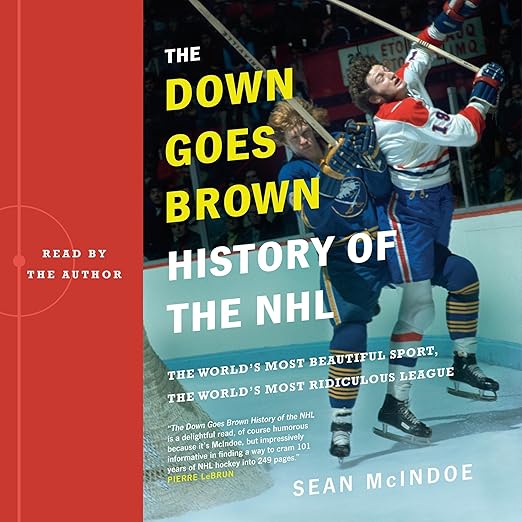
Quick Take
- Narration: Sean McIndoe narrating his own book is essential: his comic timing and deep-fan energy make this work as audio in ways a professional narrator reading hockey satire simply could not.
- Themes: Institutional absurdity in professional sports, the gap between NHL ambition and NHL execution, fan loyalty as irrational devotion
- Mood: Irreverent and affectionate, like listening to the funniest person at hockey trivia night for eight hours
- Verdict: Exactly what it promises, a funny, informed, and genuinely educational history of the NHL’s most memorable failures.
My familiarity with hockey exists on the casual end of the spectrum. I know the basics, I appreciate the sport when I watch it, and I have a mild Toronto Maple Leafs following born entirely from spending time with friends who are deeply invested in their own suffering. So when I picked up The Down Goes Brown History of the NHL, I was not the intended core audience. I mention this because it matters: this is a book that reads differently depending on how much you know going in, and I found it as entertaining as any dedicated fan reviewer, which tells you something about McIndoe’s range.
Sean McIndoe has been writing about hockey online for most of his career, and his blog and subsequent work for The Athletic made him one of the sport’s most recognizable voices precisely because he combines genuine expertise with a willingness to find the NHL’s self-inflicted disasters endlessly funny. This book is the extended print version of that sensibility, applied to the full history of the league.
Our Take on The Down Goes Brown History of the NHL
The framing device of the book is honest and effective: McIndoe is not writing a comprehensive celebratory history. He is writing a warts-and-all account of the NHL’s most spectacular failures, bad decisions, inexplicable rules, and institutional chaos, alongside the genuine moments of skill and drama that make fans stay despite all of that. As a Maple Leafs fan, he is working with extensive personal material for the disaster side of the ledger, and he leans into that with a comedian’s instinct for self-deprecation that keeps the book from feeling like the work of someone who has given up on the game. He is still in love with it. The disasters are funny because they exist inside that love.
The book is, as one reviewer put it, fact-filled rather than merely funny. McIndoe has done the research, and the comedy is built on accurate foundations. When he describes the multiple occasions on which the league president seemed to disappear, or the era when players were wearing what he describes as earmuffs, or the yellow-raincoat era of officiating, these are documented absurdities, not invented ones. That grounding in real history is what makes the humor durable rather than disposable.
Why Listen to The Down Goes Brown History of the NHL
McIndoe narrating his own book is not just a nice-to-have. It is functionally necessary. His comic timing, honed over years of writing punchy online content about hockey disasters, translates directly into audio delivery. He knows exactly where the pauses belong and how much breath to leave before a punchline. A professional narrator reading this text would inevitably lose something, because the humor is written in McIndoe’s specific voice and his narration performs it with that voice intact.
The runtime of just under eight hours is right for the content. McIndoe does not overstay his welcome in any single era or topic. The book moves through the league’s history with the momentum of someone who has too many good stories to linger too long on any one of them. For listeners who already follow McIndoe’s online work, this will feel like an extended and more carefully structured version of what they already enjoy. For newcomers, the book functions as both introduction and orientation to a writer worth following.
What to Watch For in The Down Goes Brown History of the NHL
This is not a book about hockey’s greatest moments. It is explicitly about hockey’s weirdest and most self-defeating ones, which means it is structured around failure rather than triumph. Listeners hoping for extended celebration of Stanley Cup dynasties or the emergence of particular star players will find that material present but not central. McIndoe’s thesis is that the NHL’s history of organizational chaos and improbable decisions is as defining as its athletic achievements, and the book is organized to demonstrate that argument.
The book was published in 2018, which means significant subsequent events, the pandemic season, recent rule changes, various ownership controversies, are not covered. Several reviewers noted they came away wanting more, which is the right problem for a sports history book to create. McIndoe’s online work has continued since publication and covers the intervening years, so readers who find themselves wanting more will have no shortage of additional material to turn to.
Who Should Listen to The Down Goes Brown History of the NHL
Obviously, hockey fans. But McIndoe’s ability to make institutional absurdity legible and funny means this also works for readers who enjoy sports writing as a vehicle for organizational satire, the kind of reader who appreciated Michael Lewis’s Moneyball or Bill Simmons’s The Book of Basketball as much for their portrait of dysfunctional organizations as for their sports content. Casual hockey followers will learn enough to become more informed while being entertained throughout. Avoid this if you need your sports history presented reverently.
Frequently Asked Questions
Does this book require extensive prior knowledge of NHL history to follow, or can casual hockey fans engage with it?
Casual fans can engage with it fully. McIndoe writes for people who love the game rather than for specialists, and he provides enough context for each story that you do not need to already know the details. Several reviewers who are not hockey insiders found it highly accessible.
Is this primarily a comedy book about hockey, or does it have genuine informational depth about NHL history?
Both, and the combination is the point. Multiple reviewers noted that they came away significantly more informed about the league’s history while being entertained throughout. The comedy is built on real documented events rather than on invented or exaggerated material.
How does McIndoe balance being a Maple Leafs fan, one of the league’s most historically suffering franchises, with writing a league-wide history?
He uses his Leafs allegiance as both a source of material and a point of personal credibility. The fact that he is writing from inside a fan experience of sustained disappointment gives him permission to find the league’s disasters funny in a way that a neutral observer could not quite achieve. He takes the brunt of his own best jokes, as the synopsis notes.
Does the audio format work for content that was originally written in McIndoe’s online blog voice?
It works extremely well, partly because McIndoe has the comic timing to deliver his own material effectively, and partly because his writing style was already conversational before it became a book. The transition from column voice to audiobook voice is unusually seamless.