Quick Take
- Narration: James Fouhey captures Nax’s voice well, irreverent, fast-talking, occasionally terrified, and sustains the ensemble energy across eight-plus hours without losing momentum.
- Themes: Wrongful accusation and resistance, found family under fire, identity in crisis
- Mood: Propulsive and funny with real stakes, Firefly energy in YA form
- Verdict: M.K. England’s debut delivers exactly what it promises, Breakfast Club dynamics in space, with LGBTQ+ representation woven in naturally rather than as afterthought.
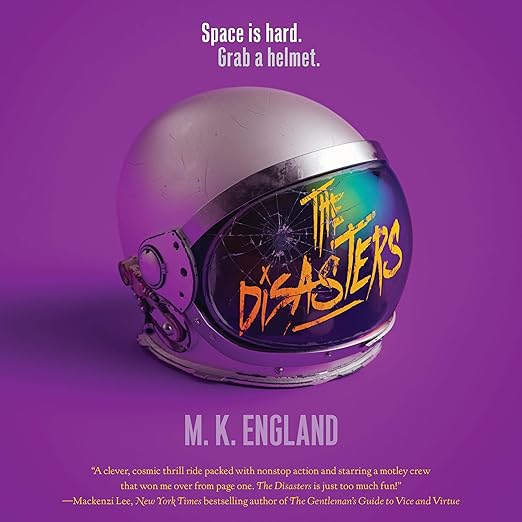
I first heard about The Disasters from a reader who described it as the YA sci-fi she’d been waiting for someone to write for years, queer, diverse, funny, and propulsive without sacrificing character for plot. That’s a crowded brief, but M.K. England delivers on it in a debut that understands its genre pleasures and delivers them efficiently. I listened to most of it on a Saturday afternoon and finished the last two hours that evening with a very real reluctance to stop.
Nax Hall is a hotshot pilot who gets kicked out of Ellis Station Academy in under twenty-four hours. Before he can even process this, a terrorist attack hits the station, and Nax escapes with three other washouts who are now the only witnesses to what happened and the most convenient scapegoats available. They’re on the run in stolen spacecraft, the crime of the century hanging over them, and their plan is to pull off a dangerous heist to spread the truth. The Breakfast Club meets Guardians of the Galaxy is the comparator on record, and it’s accurate.
Our Take on The Disasters
What England gets right from the first chapter is Nax’s voice: self-deprecating, North Carolina-specific, perpetually slightly behind the situation he’s in. One reviewer described Nax as a disaster bisexual, which is accurate and affectionate and exactly the right energy for a protagonist who is genuinely skilled and genuinely terrible at making decisions simultaneously. The LGBTQ+ representation across the main cast is handled with the casual normality that the best contemporary YA gets right, it’s not a storyline, it’s just who these people are.
The ensemble dynamics aboard the Swift Kick are the novel’s strongest sustained element. Nax’s relationship with Malik has a specific sibling energy that reviewers have picked out as a highlight. The romantic thread between Nax and Rion develops without overwhelming the plot. Case, Zee, and Asra each have enough specificity to be recognizable as individuals rather than archetypes. England clearly spent time on these five people before she put them in crisis together.
Why Listen to The Disasters
James Fouhey narrates, and his delivery matches Nax’s first-person voice well: quick, slightly chaotic, genuinely funny. At eight hours and thirty-three minutes, the pacing is tight, England doesn’t spend a lot of time on world-building for its own sake, which is the right call for a high-velocity debut. One reviewer described finding their heart racing with the characters as they tucked and rolled through hallways and soared through space. In audio, that kinetic quality depends heavily on the narrator maintaining momentum, and Fouhey does.
The diversity of the cast, multiple reviewers noted that none of the five main characters are white, is handled through characterization rather than exposition, which means it feels genuinely integrated rather than annotated. England writes a galaxy that is diverse because it would be, not because someone decided to include diversity.
What to Watch For in The Disasters
The Firefly comparison that England has earned is worth unpacking. Like Firefly, The Disasters is interested in a crew of people who shouldn’t work together and demonstrably do, in a universe where the official power structures are corrupt and the people on the run are more trustworthy than the people in authority. England uses the space opera backdrop to comment on institutional failure and the ethics of whistleblowing without becoming didactic about it. The heist to spread the truth has genuine moral stakes beyond plot mechanics.
The ending is deliberately open, England leaves room for a sequel that, as of the current publication record, has not appeared. Some listeners find this frustrating. Others find it freeing. The story reaches a complete emotional arc even without full narrative closure.
Who Should Listen to The Disasters
For YA sci-fi readers who want queer representation integrated naturally rather than highlighted, and who enjoy ensemble dynamics over single-protagonist focus. Fans of Illuminae and Heart of Iron will find the pacing and tone immediately comfortable. Firefly fans will recognize the crew-of-misfits-versus-the-system energy quickly and appreciate how England earns rather than imitates it. Listeners who need dense world-building and hard science fiction will want something different. This is character-and-momentum YA, and it knows exactly what it is.
Frequently Asked Questions
Is The Disasters the first book in a series, or can it be read as a standalone?
England leaves the ending open to a sequel, but the core emotional arc resolves. Most readers treat it as a standalone that could continue, the story doesn’t end on a cliffhanger that requires a follow-up to feel complete.
How prominent is the bisexual representation for Nax, and does it affect the plot?
Nax’s bisexuality is part of who he is rather than a plot point. His romantic attraction to Rion is one emotional thread among several, handled as naturally as anything else about his character. It’s not the story’s focus, but it’s not hidden either.
Does James Fouhey differentiate between the five main characters in the narration?
Fouhey’s primary challenge is maintaining Nax’s voice throughout as this is a first-person narrative, he isn’t switching between full character voices. Within that constraint, the dialogue is differentiated enough through England’s writing that the ensemble reads clearly in audio.
How does The Disasters compare to the Illuminae Files in terms of format and complexity?
The Disasters is significantly more accessible in format, it’s a traditional first-person narrative rather than Illuminae’s found-document approach. The world-building is lighter and the pacing prioritizes character and action over structural experimentation. A good entry point for readers who found Illuminae’s format demanding.