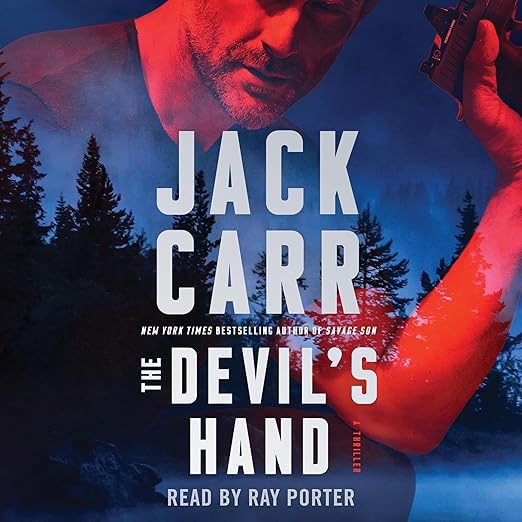
Quick Take
- Narration: Ray Porter is the defining voice of the Terminal List series and that is not accidental, his portrayal of James Reece across four books has been a major reason the series has built the audience it has.
- Themes: Bioterrorism and asymmetric warfare, political corruption and institutional failure, the cost of twenty years of post-9/11 conflict
- Mood: Tense and unrelenting, with geopolitical scope that has widened considerably from the first book
- Verdict: The fourth Terminal List audiobook delivers what established fans expect from Jack Carr, though some reviewers note the series is showing strain at this scale, Ray Porter makes the ride worthwhile regardless.
I was somewhere in the middle of a long drive when I hit the midpoint of The Devil’s Hand, and I found myself running through the internal checklist that fourth installments in action thriller series tend to trigger: Is this still surprising? Is the protagonist still someone I believe in? Is the escalation earning its stakes or just inflating them? The answers, in this case, are mixed, but not in ways that should keep established fans of the Terminal List series away.
Jack Carr’s fourth James Reece novel takes its premise from a twenty-year anniversary: September 11 is two decades past, and the enemy has been patient. A new president. A regional power with ancient grievances. A PhD student with access to a bioweapon. The architecture of the thriller is carefully assembled, and Carr’s background as a former Navy SEAL gives him a specific and credible authority when it comes to tactics, weapons, and the psychology of special operations. One reviewer with over forty years of reading this genre placed it in the top three active series, and that is not a casual assessment from someone who has read widely.
Our Take on The Devil’s Hand
The bioterrorism angle is the book’s most ambitious element and its most chilling. Carr does not treat the scenario as a backdrop, he constructs it with operational specificity, grounding the threat in real-world vulnerabilities that make it feel plausible rather than pulpy. The political dimensions of the story have also expanded significantly since the first book, and reviewers have noted that the series has become explicitly political in ways that some readers embrace and others find intrusive. One reviewer offered a pointed defense: it is a political thriller, and why people are upset about politics in a political thriller is a reasonable question to ask. Fair enough, though the reviewer also acknowledged that the political framing is particular enough that it will genuinely not be neutral territory for all listeners.
Where the book draws legitimate criticism is in the accumulating weight of the series’ ambition. A reviewer who loved the first two books described a feeling that the storytelling had become strained by the fourth entry, a sense that Carr is operating at a scale that pushes credibility even by thriller standards. This is a real pattern in long-running action series, and Carr is not immune to it. The set-pieces remain impressive, the antagonist construction is credible, but the world bends further around James Reece than it could realistically support.
Why Listen to The Devil’s Hand
Ray Porter is the answer, and the answer is unambiguous. He has narrated the entire Terminal List series and his portrayal of James Reece has become so definitive that it is difficult to imagine another voice inhabiting the character. The audiobook format is genuinely the best way to experience this series, and Porter is a significant reason for that. His performance is not decorative, he brings emotional weight to scenes that in print might read as functional, and his command of pacing makes the most intense sequences land harder than they would on the page.
The series also rewards listeners who have followed it from the beginning. The emotional stakes of this installment depend partly on accumulated context, the losses Reece has sustained, the relationships he has built, the particular quality of his commitment to the mission. New listeners can follow the plot, but the character resonance is stronger for those who have invested in the prior books.
What to Watch For in The Devil’s Hand
The bioweapon plot requires patient setup before it becomes kinetic, and the early chapters move through political and strategic context that some listeners may find slower than the action sequences that follow. Carr is thorough in his technical groundwork, which pays off in later tension but demands sustained attention in the first third. The book also carries the political explicitness of the series at its most pronounced, readers who prefer their thrillers politically neutral will find this one challenges that preference more directly than its predecessors.
Who Should Listen to The Devil’s Hand
Listeners who have followed the Terminal List series and want to continue it will find this a worthy installment despite the scale challenges. Military thriller fans who have not yet encountered Carr should start at book one to get the full benefit of Reece’s character arc. Those drawn by the bioterrorism premise specifically will find it handled with more specificity than most genre fiction manages. Political thriller readers who are comfortable with the ideological perspective Carr brings to his plots will find the fourth book particularly ambitious in that direction.
Frequently Asked Questions
Does The Devil’s Hand work as a standalone, or is it essential to have read the previous Terminal List books?
The plot can be followed independently, but significant emotional context, particularly around James Reece’s losses and motivations, derives from the earlier books. Series fans consistently get more from this installment than new readers will. Starting at book one is the recommended approach.
The synopsis mentions political elements, how overtly political is The Devil’s Hand, and does it affect enjoyment if you disagree with Carr’s perspective?
This is the most explicitly political entry in the series so far, and reviewers have noted that the framing is particular rather than neutral. Several readers have left negative reviews specifically about the political content, while others argue that political thrillers are inherently political by definition. Your comfort with Carr’s ideological framing will significantly affect your experience.
Is Ray Porter’s narration of The Devil’s Hand as strong as his earlier performances in the series?
Yes, by all available accounts. Porter has become the defining voice of James Reece across the series, and his performance in the fourth book maintains the same standard. Multiple reviewers cite his narration as a primary reason for preferring the audio format over print for this series.
How does the bioterrorism plot in The Devil’s Hand compare to the more personal revenge narrative of the first book?
The scope is significantly wider. The first Terminal List book was centered on Reece’s personal reckoning with betrayal. By book four, the threat has expanded to a geopolitical scale, a state actor, a bioweapon, a presidential administration. Some reviewers see this expansion as a natural progression; others feel the series has moved away from the intensity that made the first book exceptional.