Quick Take
- Narration: Matt Rendell narrates his own biography with the controlled, almost investigative register of someone who spent years piecing together a story he found genuinely troubling.
- Themes: Sporting genius and self-destruction, the systemic pressure of the doping era, addiction and psychological fragility
- Mood: Elegiac and forensic in equal measure
- Verdict: The most rigorous account of Pantani’s life and death available in audio, demanding but rewarding, particularly for listeners who want complexity rather than legend.
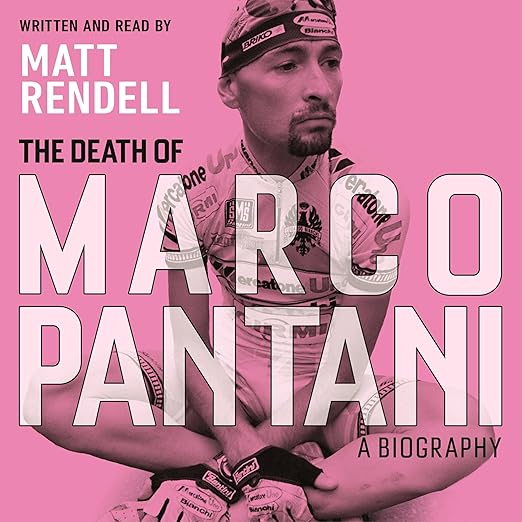
Marco Pantani died on Valentine’s Day 2004, alone in a cheap hotel room in Rimini, from cocaine poisoning. He was thirty-four. In 1998 he had won both the Giro d’Italia and the Tour de France, the only cyclist in a generation considered capable of challenging Lance Armstrong on a bad day. The distance between those two facts is the subject of Matt Rendell’s biography, and it is a distance that resists easy explanation.
I listened to large portions of this on a long train journey through a rainy afternoon, which felt appropriate. This is not an uplifting book. It is a meticulous, grief-tinged inquiry into how a particular kind of sporting genius, extraordinary, fragile, drawn to suffering in ways that both made him great and destroyed him, collided with an era that was equally extraordinary and equally destructive. Rendell had personal encounters with Pantani, access to his psychoanalysts, and interviews with family and friends. He had more material than almost any biographer could hope for, and he uses it with discipline.
Our Take on The Death of Marco Pantani
The book won the National Sporting Club Book of the Year and was shortlisted for the William Hill Sports Book of the Year, distinctions that reflect its quality rather than just its subject’s fame. One reviewer described Rendell’s prose as “sophisticated yet accessible” with comprehensive research “methodically laid out,” which captures the writing’s character accurately. The biography was originally published in 2004 and has been updated for this 2023 audiobook edition to include the 2014 and 2015 investigations into Pantani’s death, which adds forensic weight to a story that already carried considerable institutional complexity. Another reviewer described it as “the best biography of Pantani yet” and praised the way it laid out how professional cycling became consumed with EPO during the 1990s and the pressure that created. A third called it “masterfully-told yet heartbreaking”, a fair summary of the reading experience.
Why Listen to The Death of Marco Pantani
Rendell narrating his own biography is a meaningful choice. His voice carries the controlled emotion of a journalist who spent years inside a story he found genuinely troubling, and that register suits the material, investigative but never cold. At fifteen and a half hours, this is a substantial commitment, but the additional 2014-2015 investigation material in this edition makes it the most complete version of the story available. For listeners who came to cycling through the Pantani era, the bandanna, the pirate nickname, the astonishing 1998 Alpe d’Huez ascent, this is the definitive reckoning with everything that lay beneath the image. Rendell does not let the legend substitute for the person, which is both the book’s most demanding quality and its most valuable one.
What to Watch For in The Death of Marco Pantani
The most substantive criticism in the listener reviews is that Rendell’s analysis of the doping evidence becomes exhaustive at points, crowding out the sense of Pantani as a racer and a person in motion. If you want a book that celebrates the sporting achievement alongside the tragedy, this may feel unbalanced in its forensic emphasis. One reviewer specifically contrasted it unfavorably with books that make you feel like you are “living” the racing, Rendell’s approach is more analytical than immersive. The childhood section is also noted as underexplored given how clearly Pantani’s early psychology shaped his later self-destruction. These are not fatal flaws, but they shape the experience and should be weighed against the book’s exceptional rigor.
Who Should Listen to The Death of Marco Pantani
Essential for serious cycling fans and anyone interested in the EPO era’s human cost beyond the institutional scandal. Less suited to listeners who want a pure racing narrative or a biography that celebrates its subject without interrogating him. The forensic approach rewards patience and genuine curiosity about how systemic pressures interact with individual psychology, and for that audience, this is simply the best thing available.
Frequently Asked Questions
Does the 2023 audiobook edition include the 2014 and 2015 investigations into Pantani’s death, and what do those add?
Yes, the updated edition includes these investigations, which revisited questions about the circumstances of his death and the events surrounding his expulsion from the 1999 Giro d’Italia. They add forensic weight and revisit some conclusions from the original 2004 text in meaningful ways.
How does Rendell handle Pantani’s doping, does he condemn outright or seek context?
Rendell’s approach is methodical rather than moralistic. He lays out the evidence comprehensively and contextualizes Pantani’s doping within the systemic pressures of the EPO era, which one reviewer found exhaustive and another found appropriately rigorous. The book does not simplify.
Is this similar in approach to other cycling biographies like One-Way Ticket by Jonathan Vaughters?
It is more forensic and biographical in focus. Vaughters is writing about an institution and his own role within it; Rendell is attempting a full psychological and investigative account of a single life. Both deal seriously with doping but from very different vantage points.
How long is this audiobook, and is it paced well enough to sustain that length?
The audiobook runs 15 hours and 35 minutes. Reviewers do not broadly flag pacing as a problem, though the doping-evidence sections are noted as dense. The investigative structure gives the longer runtime a sense of building toward conclusions rather than simply accumulating detail.