Quick Take
- Narration: Robert Petkoff brings clarity and authority to the material; his delivery suits the measured, journalistic tone of the adaptation
- Themes: presidential vulnerability, institutional crisis management, the psychology of attempted assassination
- Mood: Urgent and accessible, designed for young listeners but informative for any audience
- Verdict: A compact, well-researched adaptation that covers the 1981 Reagan shooting with enough narrative craft to work as both a history lesson and a genuine story, though it is more primer than deep dive.
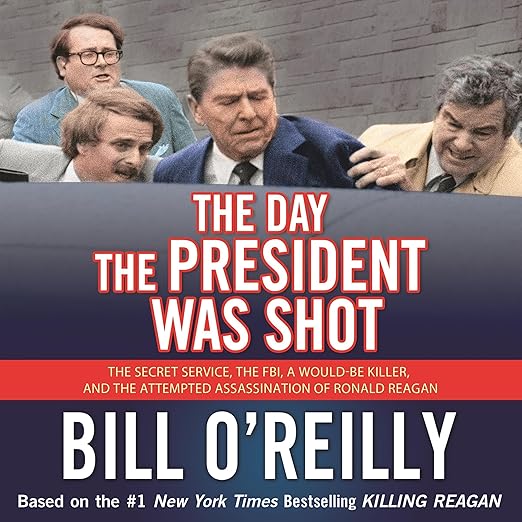
I approached The Day the President Was Shot knowing it was adapted from Bill O’Reilly’s Killing Reagan and knowing it was aimed at younger readers. Both of those facts shape what the book is, and I think it is worth being clear about them upfront rather than pretending this is a comprehensive historical treatment. What it is, instead, is a carefully constructed narrative introduction to a pivotal moment in recent American history, told with enough craft to hold attention beyond the classroom setting for which it carries Common Core connections.
On March 30, 1981, just two months into Ronald Reagan’s presidency, a gunman named John Hinckley Jr. fired six shots outside the Washington Hilton Hotel. Reagan was hit. Press Secretary James Brady was shot in the head. Two law enforcement officers were also wounded. What followed was a compressed drama involving the Secret Service, trauma surgeons at George Washington University Hospital, FBI interrogators, and a president whose resilience in recovery became part of his political mythology. O’Reilly’s adaptation condenses this material into a three-hour audiobook that moves efficiently through the day’s events and their immediate aftermath.
What the Three Hours Actually Cover
The structure front-loads the shooting itself but devotes significant time to both the lead-up and the recovery, which is a defensible choice for a book aimed at readers without prior knowledge of the period. One reviewer noted that only about a third of the book covers the actual day, with the rest given to events leading up to the shooting and its aftermath. For some readers this will feel like the ratio is off; they came for the minutes of chaos and got biography instead. But O’Reilly is more interested in what the assassination attempt revealed about Reagan the man, specifically the personal strength that propelled him back to presidential duties within days, than in the procedural details of the shooting itself.
The FBI’s interrogation of Hinckley is handled with appropriate care for its intended audience. O’Reilly does not sensationalize the shooter’s psychology, which is an important editorial choice for a book with a teen readership. Hinckley’s motivations, rooted in a delusional fixation on the film Taxi Driver, are explained factually rather than exploited for dramatic effect. The medical procedures that saved Reagan’s life are described with enough specificity to feel informative without becoming clinical, another calibration that serves the younger audience well without condescending to adult listeners who pick this up.
Robert Petkoff’s Narration and the YA Register
Petkoff’s delivery is measured and clear, calibrated for listeners who may not be familiar with the political context of the early 1980s. He does not condescend, but he also does not assume knowledge, which is the right balance for this audience. The pacing allows the dramatic sections to land without feeling rushed, and the more documentary passages, the FBI interrogation, the hospital procedures, move efficiently without losing the human stakes that O’Reilly is careful to maintain throughout.
At three hours, this is one of the shorter audiobooks in the genre, and that brevity is appropriate for its intended audience. Young adult readers and classroom listeners will find the runtime accessible in a way that a six or seven-hour treatment would not be. The production quality is consistently strong, with no issues of audibility or inconsistent recording levels that sometimes affect shorter-run audiobook productions. Petkoff’s voice carries authority without the gravity that can make historical narration feel funereal rather than engaging.
The Limits of the Adaptation Format
One reviewer specifically noted that Killing Reagan, the full-length source book, was more comprehensive and more satisfying, which is not surprising. This is an adaptation, and adaptations necessarily compress. The question for potential listeners is whether the compression leaves enough. For listeners using this as an introduction to the subject, the three-hour runtime provides a solid foundation and a coherent narrative. For those who already have background knowledge of the Reagan administration and want genuine analysis or political complexity, this will feel thin in ways that matter.
O’Reilly’s historical accuracy has come under scrutiny in some of his Killing series books, and some critics have noted factual disputes around the Killing Reagan material specifically. For a young adult audience, the book is accurate at the level of major events and narrative arc, but readers with deeper knowledge may notice framing choices that compress or simplify the political context. This is a book for building a foundation, not for testing one.
Classroom Listeners and Curious Adults Who Should Start Here
This audiobook works well for teenagers, middle schoolers with strong reading comprehension, and adult listeners who want a quick narrative refresher on the Reagan assassination attempt without committing to a full-length biography. History teachers who use audiobooks as a classroom supplement will find the Common Core connections meaningful and the three-hour format genuinely practical for a single listening session. Skip it if you have already read Killing Reagan; this is a condensed version of that material rather than a complementary treatment. Also skip it if you require psychological depth on the shooter; the focus is on Reagan and the institutional response, not on Hinckley’s interior life or the broader questions his case raises about mental illness and the American legal system.
Frequently Asked Questions
Is The Day the President Was Shot appropriate for middle school students, or is it strictly high school level?
The Common Core connections suggest middle school and up. The content, an assassination attempt with injuries but no presidential death, is serious but not graphic. The language and explanatory approach are accessible for motivated middle school readers, though the political context may require some teacher scaffolding for younger students.
How accurate is this account compared to other historical treatments of the 1981 shooting?
The major factual elements are accurately presented. Some critics of the Killing Reagan series have disputed interpretive claims about Reagan’s mental state in his second term, but those questions are not central to this shorter adaptation, which focuses on the day of the shooting and the immediate recovery.
Does the audiobook cover James Brady’s long-term condition after the shooting?
The focus is primarily on the day itself and Reagan’s immediate recovery. Brady’s lasting brain damage and his subsequent advocacy for gun control are not covered in depth; this is a book about the assassination attempt rather than a biography of any of its other victims.
At three hours, is this audiobook padded or genuinely efficient?
Genuinely efficient. Reviewers who know the source material note that it is a significant compression of Killing Reagan. For the intended audience, three hours is the appropriate length. There is no padding; if anything, the book could have spent more time on the day itself given its title’s promise.