Before You Press Play
- Narrator: Dan Bittner handles both the lyrical passages about mountain landscapes and the technical sections on snowboard culture with equal confidence, sustaining momentum across twelve hours.
- Subjects: Athletic obsession, the lure of wilderness, counterculture sports identity
- Tone: Propulsive and melancholic, with an avalanche of dread building from the first chapter
- Bottom line: Eric Blehm's biography of Craig Kelly is a portrait of a man who found his purpose in the mountains and, ultimately, could not be separated from them.
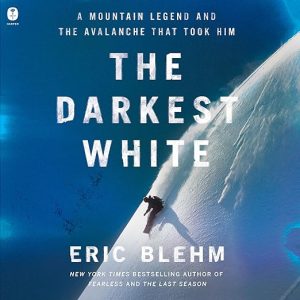
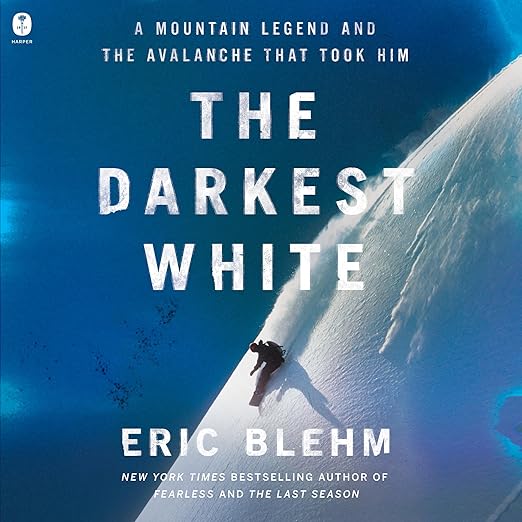
Eric Blehm opens The Darkest White audiobook with the moment everyone who knows Craig Kelly's name already knows is coming: January 20, 2003, the Northern Selkirks, a thunderous crack and a hundred-foot wall of snow. That structural decision, beginning with the tragedy and then stepping back to trace the life, is one that lesser biographers would have buried in a final chapter. Blehm makes it the frame for everything else, and over twelve hours and twenty-seven minutes, Dan Bittner narrates the consequence: a biography that is also a meditation on why someone so attuned to mountains could still die in one.
Blehm is the author of The Last Season and Fearless, both books that examine extraordinary individuals in extreme environments, and his method here is consistent with those earlier works. He is a meticulous researcher with a particular gift for narrative architecture, and Bittner's narration matches that gift. Bittner understands that the weight of January 20, 2003, is best carried by understatement across the twelve hours leading to it, not by telegraphing grief at every mention of backcountry terrain.
What Eric Blehm Delivers
The biography traces Kelly's life from his latchkey childhood through an improbable rise as snowboarding's defining competitive figure. Kelly won four world championships, revolutionized halfpipe technique, helped Burton Snowboards build what would become a billion-dollar industry, and then walked away from competition at 25. The reasoning was not mysterious, though it surprised the industry: he was chasing something that competitions and sponsorship deals and brand appearances could not provide. He wanted the mountains on the mountains' own terms, not as a venue for judged performance.
What Blehm captures is how that restlessness was not a rejection of snowboarding but its purest expression. Kelly had invented ways of moving down a mountain that others were still learning to imitate, and he understood that the next phase of that exploration required removing the scaffolding of competition and commerce. The decision to become a backcountry guide in the Northern Selkirks was, in its own way, as radical as anything he had done in a halfpipe. Jack Carr's endorsement in the front matter describes the book as "not just a terrific story of an amazing life, not just the origin story of an entire sport, but a riveting disaster narrative that builds tension masterfully." That framing is accurate across all three registers.
Reviewer Jennifer L. Vaisman, who had read all of Blehm's previous books, called this one equally impressive in its research and thoughtfulness. Reviewer Lisa M. Kitchin, who had visited Baldface Lodge, one of the lodges Kelly helped define as a backcountry destination, without knowing his story, described the book as filling a gap she had not known existed. That combination, depth for readers who know the subject and genuine discovery for those who do not, is what separates good biography from hagiography.
What Makes The Darkest White Worth Hearing
The audio format works unusually well for this particular book because Blehm's descriptive prose, particularly his accounts of snowboarding in steep backcountry terrain, benefits from being heard rather than read. Listening to an account of deep powder and freeride movement renders the experience more immediate than scanning the same sentences on a page. Bittner's pacing slows perceptibly during these passages, letting the language do its work, and the effect is close to cinematic.
The middle section of the book, which covers the cultural wars inside snowboarding during the 1990s, the corporate money, the rebel identity, the tension between contest culture and backcountry exploration, is where Blehm's skills as a cultural historian are at their sharpest. Kelly becomes a lens through which to see a sport negotiating its own soul. Tony Hawk's endorsement is earned: this is genuinely the story of what happens when athletic innovation meets commercial pressure and the athlete chooses the mountain over the market. Bittner navigates the tonal shifts between cultural analysis and action narrative without losing the listener's orientation.
Where Eric Blehm Loses Some Ground
The avalanche sections near the book's end are handled with sustained restraint. Blehm does not sensationalize the deaths of Kelly and six others at Durrand Glacier. He reconstructs the rescue operation with the kind of specific, reported detail that honors the people involved without transforming their deaths into spectacle. The search teams, their equipment, their communication failures and successes, the physical conditions on the mountain during the rescue, all of this is accounted for with documentary accuracy. The emotional weight comes from the accumulation of detail rather than from narrative editorializing.
The final chapters circle back to the question the book opened with: how does someone who spent his career reading snow end up buried under it? Blehm's answer is not a single explanatory factor. The mountains that drew Kelly out were the same mountains that killed him, and that circularity is the book's final argument about the nature of the relationship between extreme athletes and the environments they inhabit. The wilderness is not a setting. It is a participant.
Who Should Pick Up The Darkest White
Snowboarders and skiers who want to understand the roots of backcountry culture will get the most immediate use from this book, but it reaches considerably further than the sport. Listeners who responded to Jon Krakauer's Into the Wild or Sebastian Junger's The Perfect Storm will recognize the same combination of biographical depth, environmental writing, and disaster narrative. If the snowboard industry's evolution feels like an extended detour from the mountain drama, it is worth knowing that Blehm earns every one of those pages by the time the Selkirks reappear. At twelve hours and twenty-seven minutes, this is a full-length investment that pays off proportionally.
Common Questions
Does The Darkest White audiobook require prior knowledge of snowboarding to follow Craig Kelly's story?
Not at all. Blehm provides the cultural and competitive context throughout, and Dan Bittner's narration handles technical terminology naturally. The book works as a human story first, a sports biography second, and a backcountry disaster narrative third. All three layers are accessible to listeners with no background in the sport.
How does the audiobook handle the avalanche and the deaths of the other six victims at Durrand Glacier?
With care and documentary restraint. Blehm does not center the tragedy on Kelly alone. He reconstructs the rescue operation with specific detail and accounts for the other victims with the same attention he gives the protagonist. The tone is reportorial rather than sensational, and the emotional weight accumulates from accumulated fact rather than from editorial grief.