Quick Take
- Narration: Kimberly M. Wetherell captures Gwen’s Texas-to-Wales transplant energy with warmth, and her Welsh character voices, while not native, are charming enough to serve the cozy atmosphere.
- Themes: The amateur sleuth as outsider, small-town social hierarchies, journalism as a mode of inquiry
- Mood: Warm and lightly suspenseful, the kind of listen that makes a rainy afternoon feel well spent
- Verdict: A promising series debut that introduces a genuinely likable protagonist and a Welsh village setting with real personality, even if the mystery mechanics are familiar.
I have a complicated relationship with cozy mysteries, which is the honest place to start. I find most of them too thin to hold my attention for a full audiobook, their charm wearing off somewhere around the third red herring. So when I tell you that The Curious Case of the Poisoned Professor genuinely kept me listening through all eight hours, I want that to register as a real recommendation rather than a genre courtesy. Lucy Connelly has built something here that works both as puzzle and as character study, which is rarer in the subgenre than it should be.
The setup is appealing in its specificity. Dr. Gwen Griffith is a former managing editor for a Texas newspaper who has been made redundant and takes a position running the journalism department at a university in the small Welsh town of Dillynaidd, a name she has loved since studying there years before. The fish-out-of-water energy is not played for broad comedy but for the more interesting texture of someone who is genuinely competent in her own domain trying to decode a social environment with its own unwritten rules. That is a more nuanced version of the transplant protagonist than the genre usually offers.
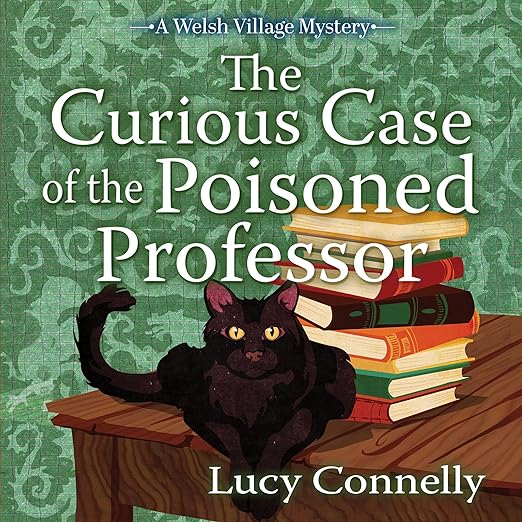
Our Take on The Curious Case of the Poisoned Professor
The victim, Dr. Alice Rice, is established with just enough presence before her death to matter. She was competing with Gwen for the department head position, regarded Gwen with professional hostility, and was found dead on Gwen’s doorstep, which puts the protagonist squarely in the detective’s crosshairs and gives the investigation a personal urgency that the genre needs. Gwen’s journalism background is the clever element here. Connelly has given her protagonist a genuine professional rationale for her investigative instincts, one that goes beyond the standard cozy-mystery convention of the amateur who simply cannot resist meddling.
Kimberly M. Wetherell handles the narration with real warmth. Gwen’s voice reads as smart and slightly wry, which matches the character as written, and Wetherell does not over-perform the Texan accent in a way that would become grating over eight hours. Her Welsh supporting characters are not phonetically precise, but they carry enough regional flavor to keep the setting alive. In a genre where narrators often default to a single slightly generic British register for any UK-set book, that effort reads as genuine care for the material.
Why Listen to The Curious Case of the Poisoned Professor
The supporting cast is where the book earns its most consistent praise. Gwen’s best friend Carolyn, the university dean, is a fully realized character rather than a plot device. The teaching assistant who helps Gwen investigate has his own personality and motivations. Reviewers specifically praised Gwen as “no frills, level-headed, and personable” and “intelligent but approachable,” which is exactly the right combination for a series protagonist. You want someone capable enough to carry the mystery and human enough to stumble.
The Welsh setting is handled with genuine affection rather than as a picturesque backdrop. Connelly, who also writes Scottish Isle mysteries, clearly has an interest in the specific texture of small communities in Celtic landscapes, and Dillynaidd feels like a place with its own social weather rather than a generic cozy-mystery village. Whether or not the Welsh details are strictly accurate is something a Welsh listener would be better placed to judge, but the intention is clearly to create something with local specificity rather than generic charm.
What to Watch For in The Curious Case of the Poisoned Professor
The mystery itself is serviceable rather than ingenious. Several suspects emerge and are developed with enough attention that the solution does not feel arbitrary, but it is unlikely to genuinely surprise experienced cozy mystery listeners. Reviewers consistently praised the setting and characters over the puzzle mechanics, which tells you something about where the book’s real energy is invested. If you approach it as a character-driven procedural set in an appealing location rather than as a puzzle box, you will find it more rewarding than if you come in expecting Agatha Christie-level misdirection.
This is the first in a new series, and Connelly has established enough in this opening volume to make the next entry genuinely appealing. The relationship between Gwen and detective Gareth Jones, initially adversarial, has obvious potential for the series-long slow burn that cozy mystery readers enjoy. The town itself will clearly generate more cases. If the formula in subsequent volumes tightens the mystery mechanics to match the character work, this could develop into a strong long-running series.
Who Should Listen to The Curious Case of the Poisoned Professor
Cozy mystery readers who have enjoyed Sheila Connolly or Paige Shelton, the authors specifically namechecked in the publisher’s positioning, will find this a comfortable fit. Readers interested in Wales as a setting, which is relatively unusual in the genre, will find the location well-utilized. Listeners who want a protagonist with a credible professional background for their investigating, rather than the standard amateur-by-circumstance, will appreciate Gwen’s journalism history. Those looking for a challenging and unpredictable mystery above all else should temper their expectations. Those who listen for character, place, and the satisfaction of a clean resolution will find all three here.
The university setting also does a specific kind of work that smaller village settings cannot. Academic politics, tenure rivalries, departmental hierarchies, and the specific way that colleagues who depend on each other for professional survival can simultaneously despise one another all provide Connelly with a rich source of motivation for her suspects. The faculty-party scene early in the book, where Gwen first encounters the victim and feels the social dynamics of the department, is one of the more carefully observed passages in recent cozy mystery fiction.
Frequently Asked Questions
Is this the first book in a series, and does it set up a continuing storyline?
Yes, it is the first in a new series by Lucy Connelly, who previously wrote the Scottish Isle mysteries. The main mystery is fully resolved within this volume, but the book establishes an ongoing dynamic between Gwen and detective Gareth Jones, and the setting of Dillynaidd is clearly designed for future stories. It stands alone comfortably while setting up something larger.
How does Gwen’s journalism background shape the investigation compared to a typical cozy mystery amateur?
It gives her a more credible rationale for her investigative instincts. Rather than simply being a curious civilian who cannot resist meddling, Gwen approaches the case with the habits of a managing editor: sourcing information, evaluating credibility, and treating witness accounts as stories to be verified. It is a more professional framing than the genre usually provides.
Does the Welsh setting feel authentic or is it purely decorative?
The town of Dillynaidd is built with genuine specificity in terms of social texture, university politics, and local dynamics. Connelly has experience writing small-community Celtic settings from her Scottish Isle series, and the effort shows. The Welsh detail is charming rather than technically deep, and the setting functions as more than picturesque backdrop.
Is Kimberly M. Wetherell’s narration effective with the Welsh character voices?
She brings warmth and personality to all the voices without overclaiming phonetic authenticity in the Welsh accents. Gwen’s Texas voice is handled with restraint, which matters across eight hours, and the supporting Welsh characters carry enough regional flavor to keep the setting alive without tipping into caricature.