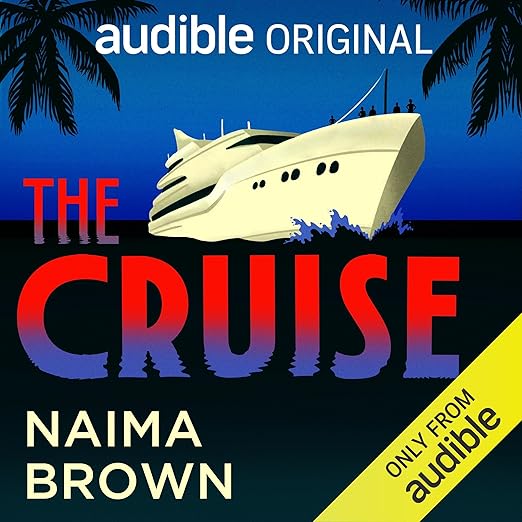
Bailey Collins is running the production board for a reality TV season when her past boards the yacht beside her, and Naima Brown's debut novel The Cruise opens with one of the more unsettling premises in recent crime fiction: a survivor who has spent a decade building distance from her abuser suddenly finds herself professionally responsible for him. This audiobook features a full cast of sixteen narrators including Catherine Van-Davies, Mitchell Bourke, Genevieve Hegney, Lola Bond, Chika Ikogwe, Andrea Solonge, Ayeesha Ash, Chloe Tobin, Alpha Sylla, Nic English, and others, a production scope that matches the story's own ensemble architecture and makes The Cruise one of the more immersive thriller audiobooks in recent memory.
Bailey Produces the Show She's Sabotaging
Brown's structural gambit is clever. Bailey works as senior producer for a reality television show called The Cruise, which means she controls casting, logistics, and the shape of the narrative on camera. When Eli Murphy, the man who assaulted her in high school, applies to be a contestant, she has the professional authority to do something with that. She brings in five members of The Squad, the survivor solidarity network she has belonged to for years, as female contestants, embedding a coordinated operation inside the mechanics of a TV production. The show-within-the-story device serves Brown well: the reality TV format creates a natural tension between performance and reality, between what the cameras see and what is actually happening below deck. Bailey's dual role as producer and co-conspirator generates dramatic irony that the best scenes exploit fully and without sentiment.
The Squad itself is well-differentiated. Brown gives each member a distinct history with Eli or with the justice system's failures more broadly, and the multi-narrator cast makes this differentiation audible in a way that a single narrator could not achieve. With sixteen voices in rotation, the listener gets an unusually precise sense of ensemble, each character sounds like herself rather than like a single performer's interpretation of her. The trade-off is the usual one with full-cast productions: some voices are more compelling than others, and transitions between perspectives can briefly disorient until the listener has learned who belongs to which voice. By the halfway point this is no longer an issue. The ensemble settles into a pattern and the production's intelligence becomes fully apparent.
Catherine Van-Davies Anchors Sixteen Distinct Voices
The 4.5 rating across nearly 1,900 reviews suggests that Brown's formula lands consistently with listeners who arrive for the revenge premise and stay for the character work. The audiobook runs 8 hours and 43 minutes, a runtime that fits the single-location thriller model well: long enough to develop the ensemble fully, tight enough to maintain the propulsion that a luxury yacht setting demands. Brown does not sentimentalize Bailey's trauma or the Squad's solidarity. The injury is real, the response is strategic, and the novel holds both truths without collapsing one into the other or offering easy catharsis before the situation earns it.
The full-cast production is particularly well-suited to a story about a TV show because it mimics the sensory experience of watching ensemble television with sound alone. The villain characters are performed with specific, calibrated menace, Eli Murphy is not cartoonish; he is the recognizable kind of charming and confident that makes the story's premise so urgent and so plausible. Catherine Van-Davies leads the cast as Bailey and carries the emotional through-line with precision. Her performance anchors sixteen voices without overwhelming them, and the moments where Bailey has to perform normalcy for the cameras while managing the Squad's operation underneath are the audiobook's most technically demanding and most successful passages.
Revenge Plotted Through Real Production Logic
Brown's novel builds its tension through accumulation rather than sudden revelation. Individual scenes of Eli interacting with the contestants while Bailey manages the production board are the audiobook's strongest sequences, the gap between what the cameras capture and what Bailey knows creates a sustained dramatic pressure that the multi-voice format amplifies considerably. The Squad members each have a moment where their specific relationship to the situation comes into focus, and these moments distribute the emotional weight in a way that prevents any single character's arc from dominating. Listeners who expect a traditional thriller with a single twist and clean resolution should recalibrate: this is more procedural in structure, focused on how the Squad executes a plan across a contained timeframe. The satisfaction is not surprise but precision, and the audiobook earns it.
Brown also handles a structural challenge that most debut thriller authors stumble on: the mechanics of the revenge plan have to be believable within the specific context of reality television production. She has done that work. The production logic holds, which is essential for a story whose entire premise depends on Bailey's professional authority being real and functional. When the plan moves, it moves in ways that make sense given what we know about how reality TV actually operates, and that credibility is what gives the audiobook's third act its weight.
Give the Ensemble Cast an Hour to Click
This audiobook works particularly well for listeners who appreciate crime fiction that takes its protagonist's interiority seriously alongside its plot mechanics, and for readers who responded to ensemble-driven thrillers with strong social stakes. The revenge premise and survivor solidarity themes will resonate with listeners who have followed the broader cultural conversation around institutional accountability and the justice system's limitations. Listeners who prefer a single strong narrator over ensemble casts should be aware that the sixteen-voice production is a defining feature, not incidental, the story is architecturally built for it. Anyone who bounces off the first cast transition should give it another hour before deciding; the ensemble pays off once you have your bearings in the world of the show.
Is The Cruise audiobook a full-cast production?
Yes. Sixteen narrators are listed, with Catherine Van-Davies leading as Bailey Collins. The full cast is a defining feature of the production and is architecturally matched to a story that follows a large ensemble aboard a reality TV show.
How explicit is the content in The Cruise audiobook?
The audiobook focuses on psychological tension and strategic maneuvering rather than graphic violence. The subject matter is serious, but Brown's execution is measured and does not dwell on gratuitous content.