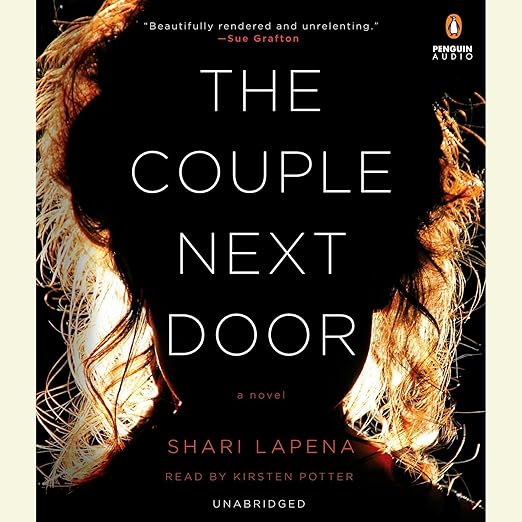
Quick Take
- Narration: Kirsten Potter navigates the shifting suspicion and paranoia of a domestic thriller with controlled, measured delivery that keeps the tension from tipping into melodrama.
- Themes: Secrets between spouses, parental guilt and shame, the performance of the perfect marriage
- Mood: Tense and claustrophobic, with escalating revelations
- Verdict: Shari Lapena’s debut delivers what psychological thriller readers come for: a plot that keeps surprising, even when you think you have it figured out.
I came to The Couple Next Door late, the way you sometimes find a book that has been sitting on your list for years and wonder why you waited. I was on a short flight, the kind where you want something that will occupy you completely, and Shari Lapena’s debut did exactly that. I was a third of the way through before we reached cruising altitude, and I finished it that evening in the hotel room. Kirsten Potter’s narration had a lot to do with that. She found the panic underneath the prose and kept it at exactly the right simmer, never quite boiling over, which is the right register for a book that depends on you not knowing who to trust.
Anne and Marco Conti appear to have it all: the home, the relationship, the beautiful baby Cora. They leave Cora home one evening to attend a dinner party next door, checking every thirty minutes, and come home to find her gone. Everything that follows is the unraveling of what actually happened, told from multiple perspectives as Detective Rasbach closes in on the gaps between what the Contis are saying and what they know.
A Title That Misdirects on Purpose
One of the more interesting choices Lapena makes is in the title itself. The Couple Next Door points you toward the neighbors, toward adjacency, toward someone else’s story spilling into the Contis’ lives. That framing is a deliberate feint. The real story is about what the Contis have been hiding from each other, and the neighbors exist to catalyze the unraveling rather than to drive it. One reviewer described the title as a bit of a red herring, and she is right, though calling it a misdirection is more accurate than calling it deceptive. Lapena is doing something specific with the geography of domestic suspense, and it rewards attention.
The book is consistently praised for its plot twists, and several reviewers noted they thought they had the answer and were wrong, repeatedly. That is a real achievement in a genre where experienced readers arrive with finely tuned pattern recognition. Lapena layers revelation on revelation in a way that feels earned rather than arbitrary, though a few readers flagged that the mechanics of the final twist require some suspension of disbelief. That is not unusual for psychological thrillers, and the book delivers enough genuine surprise to justify any small implausibility.
Anne and Marco: A Marriage Built on Mutual Concealment
The most interesting structural choice in The Couple Next Door is that both Anne and Marco are hiding things from each other and from the reader simultaneously. Lapena does not allow you to fully trust either perspective, which creates a particular kind of dramatic irony: you feel the weight of what each character is not saying, even before you know what it is. The domestic thriller genre has produced many unreliable wives, but Lapena distributes the unreliability more evenly between the spouses, which freshens a formula that can calcify into predictability.
One review captured this well: the Contis have always appeared so perfect to outsiders, but the inside of their marriage is a different story entirely. This gap between public presentation and private reality is the engine of the book. Potter’s narration handles the shifting of perspective between Anne and Marco with enough differentiation that you always know whose point of view you are in, which matters when both of them are concealing information that the other does not know they are concealing.
Kirsten Potter and the Architecture of Domestic Suspense
Domestic suspense as a genre rewards narrators who can sustain anxiety without becoming shrill, and Potter does this effectively across the book’s eight hours and forty minutes. Her pacing is deliberate in the investigation scenes, slightly faster in the revelatory ones, and she has a way of letting silence do work that translates well in audio. When Detective Rasbach interviews the Contis and clearly knows they are lying, Potter communicates the detective’s patience and the Contis’ barely contained fear without editorial comment. The restraint is the performance.
This is Lapena’s debut, and the structural confidence is notable for a first novel. Lisa Jewell’s blurb calls her intensely bingeable, and that is the right word for the experience. The book does not dawdle. At under nine hours, it is tight enough that the momentum rarely flags, and the plot mechanics are sufficiently propulsive that even the occasional credulity-stretching moment does not break the spell. Freida McFadden’s endorsement calling her addictive is earned for exactly this kind of relentless forward motion.
Who This Thriller Is Built For
Fans of psychological domestic suspense who enjoy multiple layers of deception and a plot that keeps repositioning itself will find The Couple Next Door a satisfying listen. It is frequently recommended as a starting point for Lapena’s work, and anyone drawn to her pacing and plot construction will want to continue with her subsequent novels.
Readers who need their psychological thrillers to be deeply character-driven rather than plot-driven may find Anne and Marco function more as instruments of the plot than as fully realized people. That is a legitimate critique of the genre as much as of this specific book. The Contis are drawn with enough specificity to ground the tension, but the novel’s energy is primarily structural. For the right reader, that is precisely the point, and Lapena executes on that structural level with the confidence of someone who knows exactly what kind of book she was writing.
Frequently Asked Questions
Is The Couple Next Door predictable for experienced psychological thriller readers?
Multiple reviewers expected to see it coming and were surprised anyway. Lapena layers multiple reveals rather than relying on a single twist, which makes the book harder to call in advance than many entries in the genre. One reviewer thought she had the answer and was repeatedly wrong.
How does Kirsten Potter handle the shifting perspectives between Anne and Marco?
Potter differentiates the two characters through subtle tonal shifts rather than dramatic voice changes, which fits the material. The Contis are both surface-level composed people concealing panic, and Potter captures that veneer of control with the anxiety underneath it without overdoing either register.
Is this a standalone novel or the beginning of a series?
It is a standalone novel. The plot resolves completely within this audiobook, and there is no continuation of the Conti storyline. Lapena has written other psychological thrillers with different characters that would appeal to readers who enjoy this book’s style and pacing.
The baby’s disappearance is the inciting event. Is this book difficult to listen to as a parent?
Several reviews mention the emotional intensity of the premise, particularly for parents. The book does not dwell gratuitously on the baby’s situation but the stakes are clearly felt throughout. The focus is more on the couple’s secrets and the investigation than on graphic depiction of harm, but listeners with sensitivity to child-in-danger premises should be aware of the central scenario.