Quick Take
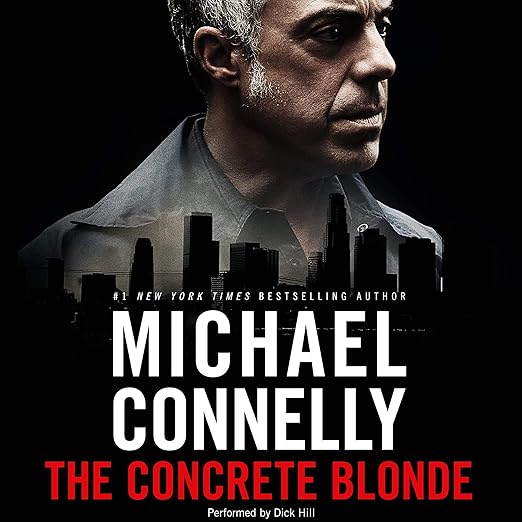
- Narration: Dick Hill is definitive. His performance here is the standard against which subsequent Bosch audiobooks are measured.
- Themes: Institutional accountability, the danger of certainty, justice complicated by bureaucracy
- Mood: Noir-dark and procedurally taut, with a courtroom intensity that rivals the street-level investigation
- Verdict: The novel where Michael Connelly fully arrived as a crime writer, with a narration that makes it essential listening for the genre.
I came to The Concrete Blonde out of sequence, having read later Bosch novels first, and reading earlier Connelly with later Connelly in your head is an instructive experience. You can see what he was building toward, which makes the moments where he gets it exactly right feel like discoveries even in retrospect. Book 3 is where he gets it exactly right for the first time in the series.
The structure of The Concrete Blonde is more ambitious than what Connelly had attempted in The Black Echo or The Black Ice. Those novels operated as conventional procedurals with a strong protagonist. This one runs two tracks simultaneously: a civil trial in which the Dollmaker’s widow is suing Harry Bosch and the LAPD for wrongful death, claiming Harry killed an innocent man, and an active murder investigation when a new victim is found bearing the Dollmaker’s signature. The trial forces Harry to defend the worst day of his professional life in public, in real time, while also trying to prove that the killer he thought he had stopped is still operating. The structural ambition is considerable, and Connelly delivers on it.
Our Take on The Concrete Blonde
The civil trial is not decoration. Connelly uses it as a mechanism for exposing Harry’s character under sustained external examination, which is a more rigorous characterization tool than the internal monologue that procedural fiction typically relies on. In a courtroom, Harry cannot simply think his way to self-understanding. He has to answer questions under oath, and what he reveals and what he defends tells us who he actually is. The Harry Bosch of Book 3 is younger, more volatile, and more personally invested in his certainties than the Bosch of later novels. Reading this after the later books, you can see the long arc of what that certainty will cost him.
The Dollmaker’s methodology is rendered with enough specificity to be genuinely disturbing without tipping into gratuitous detail. Connelly is more interested in the procedural question, was Harry right, is the killer actually dead, what does certainty do to an investigation, than in the horror of the crimes themselves. That prioritization is what makes the novel a work of serious crime fiction rather than entertainment that uses violence as a delivery mechanism.
Why Listen to The Concrete Blonde
Dick Hill’s narration has been described as definitive by readers who have followed the series through multiple versions and narrators, and that consensus is accurate. Hill found in Harry Bosch a register that has become, for many listeners, the voice of Los Angeles crime fiction itself: worn down but not defeated, precise in its observations, with a moral urgency that operates beneath the surface of procedural efficiency. At just over fourteen hours, this is a substantial listening investment. It repays it fully.
Reviewers note that The Concrete Blonde and The Last Coyote, Book 4, function almost as a single extended work, with this novel raising questions about Harry’s past that the following book finally answers. Anyone planning to listen to this should plan to continue immediately. The narrative momentum between the two books is designed to be continuous rather than episodic.
What to Watch For in The Concrete Blonde
The love interest subplot is handled more prominently here than in earlier Bosch novels, and reviewers note that the ending gives her a more substantive role than the series has previously managed. This is the book where Connelly’s secondary characters begin to be more than functional. The supporting detectives and police figures who populate the Hollywood Division are more developed here than in previous entries, which makes the institutional pressure on Harry feel genuinely social rather than merely atmospheric.
The twist in the investigation is visible to attentive listeners before the reveal. Connelly’s cluing is fair but not invisible, and genre veterans who parse clues carefully will likely see the shape of the resolution before Harry does. That foreknowledge does not diminish the experience because the novel’s real interest is in what Harry does with the information once he has it, not simply the surprise of the reveal itself.
Who Should Listen to The Concrete Blonde
Anyone working through the Harry Bosch series in order has already made this decision. Readers who started later in the series and are filling in the early gaps will find this the most rewarding of the first three books. Fans of literary crime fiction who want procedural accuracy combined with genuine character depth should know that Book 3 is where Connelly’s ambition and his craft first operate at full capacity together. And anyone who wants to understand why Dick Hill became the voice of an entire crime fiction universe should start here and listen forward.
Frequently Asked Questions
Should The Concrete Blonde be read alongside The Last Coyote, or does it stand fully alone?
It stands alone as a complete case, but multiple reviewers describe the two books as functioning as a single extended story. Reading them back to back is strongly recommended. Questions raised here about Harry’s past receive their full answer in The Last Coyote.
How does Dick Hill’s narration compare to other Bosch audiobook narrators?
Hill is widely regarded as definitive. His voice for Harry Bosch has become the standard against which other interpretations are measured. Listeners who have heard Hill’s version tend to find other narrators a difficult adjustment.
Are the civil trial and the active murder investigation given roughly equal weight in the narrative?
They are balanced deliberately. The trial provides the external pressure on Harry’s reputation and professional standing, while the investigation provides the forward momentum. Neither is allowed to overwhelm the other, and the two tracks converge meaningfully in the final section.
How does The Concrete Blonde fit for a new reader who has not read the earlier Bosch books?
Connelly provides enough context for the Dollmaker case and Harry’s background that the novel is comprehensible without prior knowledge. But certain emotional dimensions of the trial, particularly Harry’s relationship to his own certainty about the killing, are richer with the context of the first two books behind you.