Quick Take
- Narration: Katie Koster handles the dual POV structure cleanly, giving Elise and Claire sufficiently distinct registers without over-differentiating in ways that would feel theatrical.
- Themes: the burden of knowledge you cannot act on, trust in systems designed to control you, sapphic slow-burn romance in a paranormal setting
- Mood: Teen paranormal with sharpened stakes, more YA thriller than YA romance despite the marketing
- Verdict: A confident, readable YA paranormal that earns its central relationship while maintaining enough plot momentum to satisfy readers who are in it for more than the romance.
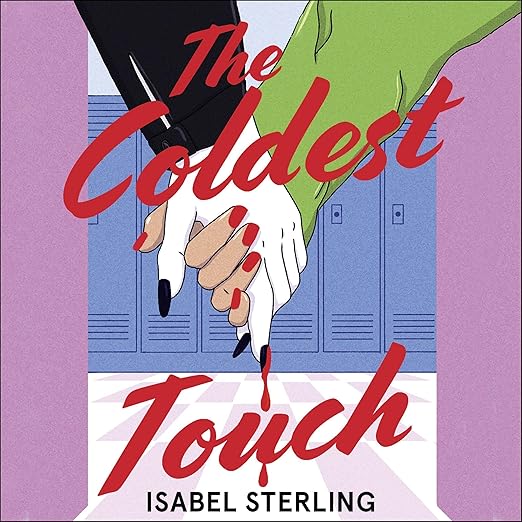
I picked up The Coldest Touch on a Sunday afternoon, planning to listen for an hour while doing something else. I put the other thing down after twenty minutes. The premise, a girl who sees how people will die the moment she touches them, is not new to the genre, but Isabel Sterling does something specific with it that elevated this beyond what I was expecting. The death-sight isn’t a superpower Elise hasn’t learned to use yet. It’s a curse she experienced in the worst possible way when she foresaw her brother’s death and couldn’t prevent it. That distinction changes everything about how she approaches it and how the story positions her relationship with the Veil when they arrive offering answers.
The Coldest Touch, published in December 2021 and narrated by Katie Koster, is Sterling’s follow-up to These Witches Don’t Burn. It stands alone as a story, you don’t need the earlier book, and it takes the author’s interest in paranormal YA with sapphic leads into vampire territory. Claire, the vampire sent to recruit Elise, is an older, more institutional creature navigating the same fundamental conflict that drives a lot of the best YA paranormal: she operates within a system that may not have the protagonists’ best interests at heart, and neither character can be entirely sure whose side she’s actually on.
Our Take on The Coldest Touch
The dual POV structure, alternating chapter by chapter between Elise and Claire, is the novel’s strongest structural choice. It creates genuine dramatic irony, we see Claire’s internal conflict between her mission and her growing feelings well before Elise can, while keeping both characters from becoming transparent to each other or to the reader. Reviewer BeautyBookCorner describes the result as giving “Buffy the Vampire meets Twilight vibes with the high school setting, strategizing and training, and hunting of a murderer.” That’s apt, though Sterling’s world-building is denser than either of those comparisons suggests, and she establishes the Veil’s rules and internal politics with more care than most YA paranormal bothers to.
The world-building, specifically around the concept of shepherding and what vampires are actually for in this mythology, is one of the more original elements here. It’s not the standard vampire lore with new branding, there’s a coherent supernatural ecology that gives the Veil’s existence a purpose beyond the usual secret society template. Sterling does this without over-explaining, which is the harder trick to pull off. Reviewer Fins1997 notes that the story doesn’t concentrate too much on the vampire mechanics, and that restraint is exactly right for the pace the book is trying to maintain.
Why Listen to The Coldest Touch
Katie Koster’s narration handles the tonal range the book requires without overcorrecting in either direction. The investigation sequences, Elise and Claire trying to prevent the teacher’s murder after Elise foresees it, have enough tension that a flat delivery would kill them, and the quieter scenes where the two leads navigate their growing attachment to each other need a different register entirely. Koster moves between these without making the shifts feel abrupt. The dual-perspective structure could easily sound like one character narrated in two slightly different voices; it doesn’t.
The book also moves at a pace that rewards audio listening. At just under twelve hours, it’s long enough to develop real character investment but short enough that it doesn’t overstay. The pacing is consistent, there are no significant stretches where the investigation stalls while the romance takes over, which is a real risk in the genre and one Sterling mostly avoids. The teacher’s imminent murder creates urgency that keeps the central plot present even during the more character-focused scenes.
What to Watch For in The Coldest Touch
Reviewer Angie provides a useful heads-up: the book contains blood, death, violence, and murder, as well as mentions of homophobia. These are handled without gratuitousness but they are present, and listeners who are sensitive to those elements should be prepared. The violence is genre-appropriate and the homophobia appears as a background social reality rather than a primary plot element, but the content warning is warranted.
The central mystery, who is killing people and why, and how it connects to Elise’s brother’s death, is well-constructed but not particularly surprising if you have spent significant time in YA paranormal fiction. The genre’s conventions create certain expectations around who the villain will turn out to be, and Sterling operates within those conventions rather than subverting them. That’s not a failure, but it does mean the twists that reviewer Lydia B. describes as completely unexpected may feel more familiar to genre-experienced listeners.
Who Should Listen to The Coldest Touch
Ideal for YA listeners who want paranormal fiction where the sapphic romance is central and respected without the book becoming entirely about it. The investigation plot is functional and the world-building is solid enough to satisfy readers who need more than a romance to stay engaged. Sterling has carved out a specific niche, paranormal YA with fully realized LGBTQ leads where the supernatural mechanics serve the story rather than dressing it up, and The Coldest Touch is her clearest execution of that approach. Listeners who bounced off Twilight due to its passivity in the female lead will find Elise a notably different protagonist: she pursues information, makes decisions, and drives the plot in ways that feel active rather than reactive.
Frequently Asked Questions
Do you need to have read These Witches Don’t Burn before starting The Coldest Touch?
No. The Coldest Touch is set in a different location with entirely different characters and a separate supernatural mythology. It shares an author and a general approach to paranormal YA with sapphic leads, but it functions as a standalone novel. You can start here without any context from the earlier book.
How explicit is the romantic content between Elise and Claire?
The romance is slow-burn and YA-appropriate, emotionally intense rather than physically explicit. The focus is on the tension of trust and attraction under circumstances where both characters have reasons not to trust each other, and the payoff is emotional rather than explicit. Reviewer Jill Kelley describes it as “the perfect sapphic vampire story” which suggests it delivers on the romantic premise within the conventions of the genre.
Is Elise’s death-sight power used as a consistent plot mechanic, or does it become convenient when the story needs it?
It’s handled with reasonable consistency. The power requires skin-to-skin touch and produces visions of death rather than giving information Elise can always act on. The restriction of what the ability can and cannot do is maintained throughout, which keeps it from becoming a plot-solving device that generates whatever revelation the story needs at a given moment.
Is there a second book in this series, and does The Coldest Touch end at a good stopping point?
Reviewer Lydia B. expresses hope for a Book 2, which suggests the ending leaves room for continuation rather than closing everything. The immediate narrative has a satisfying resolution for the mystery driving the plot, but there are character and world-building threads that feel designed to extend. The ending is complete enough to read as a standalone but open enough to support a sequel if one exists.