Quick Take
- Narration: Gerard Doyle brings a period-appropriate solemnity to Sean Duffy’s world, though this edition’s audio is matched to the Spanish translation.
- Themes: Political violence, identity at the margins, the burden of conscience in a divided society
- Mood: Tense, literary, and deeply atmospheric
- Verdict: Adrian McKinty’s debut Duffy novel is one of the finest pieces of Belfast noir written in English, though listeners should be aware this particular edition is the Spanish-language translation.
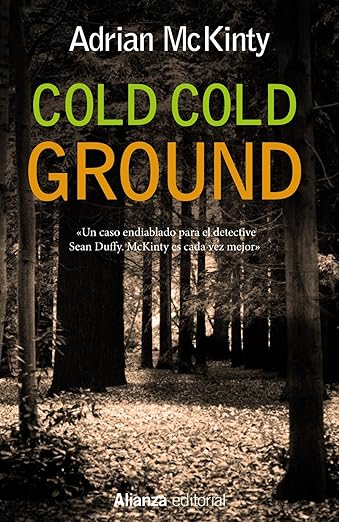
There is a version of Adrian McKinty’s Sean Duffy series that exists almost invisibly in the English-speaking world, passed between readers via word of mouth and enthusiastic recommendations from crime fiction fans who believe it belongs in the same conversation as Tana French’s Dublin Murder Squad. The Cold, Cold Ground is the first in that series, and it is genuinely exceptional. It is also, in this particular Audible edition, a book you need to approach with care: the physical book listed here is the Spanish-language translation published by Alianza Editorial, with a synopsis and reviews predominantly in Spanish. The audiobook edition narrated by Gerard Doyle is the English-language version. If you are an English-speaking listener using this as a guide, Doyle’s audiobook is the one to seek out.
Gerard Doyle has narrated all of McKinty’s Duffy novels, and that continuity matters. His Northern Irish cadences are authentic and never feel like affectation, which is crucial for a series so deeply embedded in the specifics of Belfast’s geography and social texture. Doyle’s Duffy is educated, sardonic, and slightly exhausted in the way that a Catholic police officer in the Royal Ulster Constabulary in 1981 would logically be exhausted, which is to say permanently and for reasons both political and personal.
Our Take on The Cold, Cold Ground
Belfast, 1981. A body with an amputated hand appears during the height of the Troubles, during the hunger strikes, when the entire city is already saturated with violence. The case is assigned to Detective Sean Duffy because it is expected to go nowhere: the victim is gay, linked to the IRA, and it is assumed no one will push too hard. Then a second body appears, and the similarities are difficult to ignore. McKinty’s genius in this first novel is that he refuses to separate the serial killer plot from the political context. The Troubles are not background noise; they are the architecture within which the story takes place. The fact that Duffy is Catholic in a Protestant-dominated institution, and that both his colleagues and the communities he investigates have reasons to distrust him, is not incidental to the plot. It is the plot.
Why Listen to The Cold, Cold Ground
One reviewer describes McKinty as a writer who puts you inside Belfast and doesn’t let you leave, and that is the most precise summary of what makes this series extraordinary. The historical and atmospheric specificity is literary rather than merely decorative. Duffy’s taste in music, his vinyl collection, his strange domestic habits, his educated voice against the background of systematic brutality, all of it is rendered with the kind of precision that makes a fictional world feel inhabited. The second body’s connection to the IRA complicates the case in ways that force Duffy into a dangerous middle space between communities that have every reason to want him gone. That middle space is where McKinty does his best work, and the audiobook format, with Doyle’s steady, knowing delivery, makes the claustrophobia of it genuinely felt.
What to Watch For in The Cold, Cold Ground
This is an adult crime novel with substantial violence and a historical context that rewards some background knowledge of the Northern Ireland Troubles. Listeners completely unfamiliar with the political landscape of 1981 Belfast may benefit from a brief orientation before starting. The series spans six novels covering the 1980s, each anchored to a specific year and real historical events. This first installment establishes Duffy’s character, his methods, and his milieu with enough depth that subsequent books pay compound interest on that investment. One reviewer noted that only two books in the series had been translated into Spanish, which speaks to a real gap in how widely distributed this series has been outside English-language markets.
Who Should Listen to The Cold, Cold Ground
Listeners who enjoy literary crime fiction with genuine historical weight, comparable in ambition to the work of Stuart Neville or the early Declan Hughes novels, will find this essential. The series has a strong following among readers who prioritize atmosphere, character, and prose over pure procedural mechanics. Listeners looking for lighter crime fiction or for stories set in more contemporary contexts should look elsewhere. The violence is integral to the subject matter and not gratuitous, but it is present. If the combination of Troubles-era Belfast politics and a complex Catholic detective navigating an impossible position interests you, start here and plan to continue.
Frequently Asked Questions
Is this edition of The Cold, Cold Ground in English or Spanish?
The physical book listed is the Spanish-language translation by Alianza Editorial. The audiobook narrated by Gerard Doyle available on Audible is the English-language version. Listeners seeking the English audiobook should confirm the edition before purchasing.
Does the Duffy series need to be listened to in order?
The books function individually as mysteries, but Duffy’s character arc develops significantly across the six novels. Starting with The Cold, Cold Ground is strongly recommended both because it establishes the world and because the emotional payoff of later installments depends on time spent with Duffy here.
How central is the 1981 hunger strike context to the story?
Very central. McKinty sets the case against the backdrop of the IRA hunger strikes and the daily violence of the Troubles, and those political realities shape the investigation at every turn. This is not a crime novel that uses historical setting as wallpaper.
How does Gerard Doyle’s narration compare to other Belfast-set crime audiobooks?
Doyle is widely considered exceptional for this series. His Northern Irish accent is authentic, his Duffy is precisely calibrated, and his consistency across all six novels gives the series an audio identity that rewards long-term listening.