Quick Take
- Narration: Shelton narrating his own making-of memoir is a genuine pleasure, the timing of a man who spent decades in the writers’ room coming through in every anecdote.
- Themes: Minor-league baseball and the romance of the game, the guerrilla economics of independent filmmaking, creative conviction against institutional doubt
- Mood: Wry, affectionate, and occasionally frustrated in ways that are entirely warranted
- Verdict: A book for anyone who loves Bull Durham, or for anyone who loves the specific kind of story about a creative work that almost did not exist but somehow became iconic.
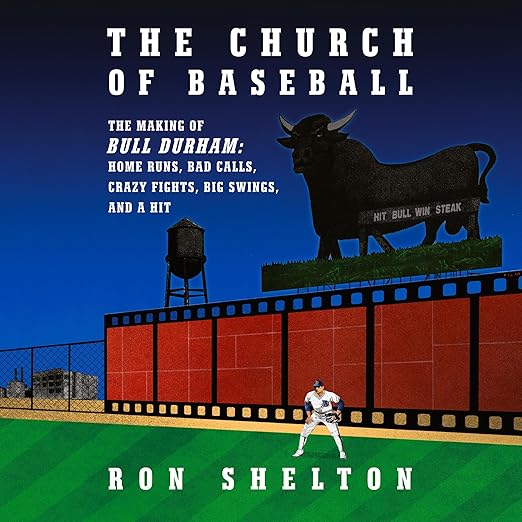
I watched Bull Durham for the first time in a college seminar on American sports mythology. I have watched it probably seven times since. There is something about the film’s understanding of minor-league baseball as a way of life, as a kind of sustained apprenticeship in hope and disappointment, that never loses its resonance. So when I encountered The Church of Baseball, Ron Shelton’s account of how the film was made, I came to it as someone with strong prior feelings about the material it was trying to describe. I am happy to report that Shelton’s book honors the film rather than diminishing it.
The structural arc of the book is essentially two interwoven narratives. The first is Shelton’s own baseball life: six years in the Baltimore Orioles’ minor league system, never quite reaching the majors, learning the culture of the bushes from the inside in ways that would eventually become the texture of the screenplay. The second is the film’s tortured production history, from the pitch that no one wanted to finance, through the casting debates, the rewriting on set, the compressed shooting schedule, and the still-contested reception at the studio level. Shelton has the writer-director’s characteristic mixture of precision about craft and contempt for institutional interference, and both qualities serve the book well.
Six Years in the Bushes as Foundation
The most valuable chapters in The Church of Baseball are the early ones, where Shelton describes what the minor leagues actually felt like from the inside. The rituals, the economics, the specific degradations of bus travel and per diem, the way players manage the cognitive dissonance of believing they will make it while watching the evidence accumulate to the contrary. This material, because it is lived rather than imagined, has a specificity that no amount of research could manufacture.
And it explains why Bull Durham works in the way it does: Shelton was not romanticizing something he had studied from the outside. He was reporting something he had inhabited, and the romance in the film is earned precisely because he also knows the disappointments thoroughly. Annie’s famous monologue about the church of baseball is not a lyrical flight but a precise articulation of what the game actually is for the people who devote their lives to it, and Shelton can write it because he lived the devotion.
Kevin Costner, Susan Sarandon, and the Casting That Almost Did Not Happen
Shelton’s account of the casting process is both entertaining and illuminating about how studios think about risk in ways that bear no relationship to creative quality. Kevin Costner, at the time of production, was not yet the star he would shortly become. Susan Sarandon was considered a has-been, a characterization that the subsequent decades have made difficult to take seriously. The fact that the film was eventually made the way it was made, with the cast it has, required a specific chain of events and advocates that Shelton reconstructs with evident gratitude and equally evident frustration at how unnecessary the resistance was.
One reviewer noted that Shelton’s restraint in dealing with studio executives who contributed nothing and took credit for everything was admirable. The restraint is relative: there is plenty of barely contained irritation on the page, and it is consistently more interesting than diplomatic softening would be. Shelton is not a man who has learned to love the studio system. He has learned to work within it long enough to make the films he wanted to make, and the distinction is audible in every chapter that deals with the institutional machinery.
The Self-Narration and Its Gifts
Shelton narrating his own text is an asset on multiple levels. His timing is that of a man who has been telling stories to rooms of people for forty years, and the self-deprecating anecdotes about directorial mistakes, scenes that did not work the way he planned them, footage that had to be abandoned, land with appropriate weight rather than being smoothed into a success narrative. The humor is dry and specific, built on the same instinct for detail that makes the baseball material so convincing.
At eight hours and twelve minutes, the book runs perhaps twenty minutes longer than it needs to. One reviewer noted that the final chapters, dealing with distribution and reception and the film’s gradual ascent to canonical status, lose some of the earlier grace. It is a genuine structural issue, and the back half is somewhat less compelling than the production chapters. But what is there is considerably more generous and specific than the average Hollywood memoir offers, and for anyone who has ever loved a film enough to want to know exactly how it got made, this is the right book.
Between Baseball and Cinema
Listeners who have already seen Bull Durham will likely find themselves revisiting it after finishing this book, which is a reliable indicator that the making-of account has done its job: not replacing the experience of the film but deepening it, adding the texture of what was required to get it made and what it cost the people involved. That is a harder thing for a book to accomplish than it sounds, and The Church of Baseball manages it consistently.
The book’s most interesting argument is implicit rather than stated: that making a film and playing minor league baseball require the same combination of technical excellence, institutional tolerance, and sustained willingness to operate without guarantees. Shelton spent six years becoming expert at something that did not reward him with the outcome he wanted, and then spent the next phase of his career becoming expert at something else, and the discipline of one fed the other in ways the book traces without quite announcing. The Church of Baseball is, among other things, a very good argument for the productive value of failure that does not resolve easily into lesson-learned.
Frequently Asked Questions
Do I need to have seen Bull Durham to enjoy The Church of Baseball?
Not strictly, but the book will be considerably more rewarding if you have. Shelton assumes a reader who knows the film and discusses specific scenes and dialogue in detail. Watching the film before listening to the book is strongly recommended.
How much of the book covers the actual filmmaking process versus Shelton’s baseball career?
Roughly half and half, though the balance shifts as the book progresses. The first third is primarily baseball memoir; the middle section covers preproduction and filming; the final chapters deal with postproduction and release. The baseball material is essential context for understanding why the film succeeds.
Is Shelton’s narration accessible to listeners unfamiliar with his other films?
Yes. The book uses Bull Durham as its primary subject, with references to Shelton’s other sports films including Tin Cup and White Men Can’t Jump serving as secondary context. The narration does not assume familiarity with his full filmography.
Is this primarily a baseball book or a filmmaking book?
Both, with neither subordinated to the other. Shelton treats baseball and filmmaking as related disciplines, both requiring sustained investment in a process whose outcome is never guaranteed. Readers who come purely for the baseball or purely for the industry mechanics will find half of what they came for and be surprised by how much the other half adds.