Quick Take
- Narration: Jenna Lamia captures Kyra’s youth, intelligence, and growing desperation without ever making her feel like a victim rather than a protagonist.
- Themes: Religious coercion, the cost of obedience, a young woman’s right to choose her own life
- Mood: Tense and suffocating, with flashes of tenderness that make the danger feel more acute
- Verdict: A YA novel that treats its difficult subject matter with genuine craft, made more immediate and urgent by Lamia’s committed performance.
I was halfway through a long afternoon walk when I started listening to The Chosen One, and by the time I got home I was sitting on the front step, coat still on, unable to go inside until I knew what happened to Kyra. That kind of compulsive listening does not happen unless the narrator and the material have locked together in a particular way. Jenna Lamia’s performance is the reason this book works as well as it does in audio.
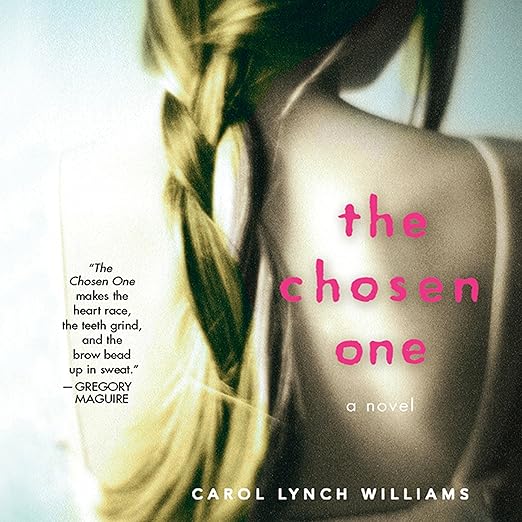
Published in 2009 through Macmillan Audio, Carol Lynch Williams’ novel is told in the first person by Kyra, a thirteen-year-old girl growing up in an isolated polygamous community. The book opens in a present tense that creates an almost claustrophobic immediacy: we are inside Kyra’s consciousness, feeling the walls of her world before we fully understand their extent. When the Prophet decrees that Kyra must marry her sixty-year-old uncle, a man who already has six wives, the story shifts from coming-of-age tension to something more urgent and frightening.
Our Take on The Chosen One
Williams walks a line here that is genuinely difficult. She needs Kyra’s world to feel coherent from the inside, to make comprehensible why a girl who is clearly intelligent and questioning would have stayed this long, would still love her family this much, would still feel the pull of a community she knows is wrong. Getting that balance right requires a kind of anthropological empathy for people whose choices and beliefs differ fundamentally from the reader’s own. Williams has it, and it gives the novel a moral complexity that lesser treatments of this subject often lack.
The Mobile Library on Wheels, which Kyra visits secretly to read books the community forbids, is one of the novel’s most effective devices. It is not just a symbol of the wider world; it is a practical lifeline, and the librarian who runs it is one of the book’s most quietly significant secondary characters. Books as contraband, as evidence of a different way of living, as something worth risking punishment to access: this is a theme that resonates beyond the specific setting.
Why Listen to The Chosen One
Lamia’s narration is the primary argument for the audiobook over the print edition. She voices Kyra with a quality of earnest, frightened intelligence that makes every scene feel immediate. The community’s internal logic, its rhythms of speech and worship and family life, comes through in the way Lamia delivers the dialogue of Kyra’s mother and sisters, who are both loved and complicit in a system that is destroying Kyra. The voice never tips into caricature, which is crucial.
The novel is short, under three hundred pages in print and just over five hours in audio, but it does not feel thin. Williams compresses the story effectively, and the pacing in the final third, as Kyra faces the consequences of her choices, is handled with real skill. One reviewer described it as a book that “will stay with you long after you’ve read it,” and I think that is accurate precisely because Williams does not simplify the ending into easy resolution.
What to Watch For in The Chosen One
This is a YA novel, but the content is genuinely dark. The decree that Kyra must marry her elderly uncle is depicted without euphemism, and the violence that threatens those who resist the community is made explicit and frightening. Younger or more sensitive listeners should approach with parental guidance or awareness of the content level.
The novel also situates its community vaguely, somewhere near the Arizona-Utah border, and does not name any specific religious group. Williams is writing about a pattern of coercive control rather than targeting a particular denomination, and that choice feels correct: it prevents the book from becoming a polemic while also making the scenario feel more, not less, threatening in its generalizability.
Who Should Listen to The Chosen One
Readers fourteen and older who are interested in YA fiction that engages seriously with questions of autonomy, religious authority, and the cost of compliance will find this one of the genre’s more committed treatments of those themes. Jenna Lamia’s narration makes the audiobook the format to choose. Adults who enjoy YA fiction will find it compelling; this is not a book that condescends to its audience. Skip it if content involving child marriage and religious coercion is too difficult; the novel does not soften either.
Frequently Asked Questions
Is The Chosen One based on a real community or specific religious group?
Williams does not name a specific group or location. The community is depicted as a polygamous sect in the American Southwest, but the novel is a work of fiction that draws on patterns of coercive control rather than representing any particular denomination.
Is this appropriate for the middle-grade age group, or is it strictly older YA?
The content is best suited to readers thirteen and older. The subject matter, including a forced marriage decree for a thirteen-year-old and community violence, is serious and not appropriate for younger middle-grade readers.
Does Jenna Lamia differentiate between the many secondary characters in Kyra’s large family?
Lamia handles the ensemble well given the constraints. Kyra’s mother and the older sister she is closest to are distinctly voiced. Some of the twenty-plus siblings are less individualized, but that is a feature of the novel’s structure as much as the narration.
How does The Chosen One handle the ending? Does it resolve cleanly or leave things open?
The ending is not tidy, and that is part of its strength. Williams does not deliver a simple escape narrative; the consequences of Kyra’s choices are real and include significant loss. It is honest rather than comfortable.