Quick Take
- Narration: Christine Lakin’s performance is genuinely strong, praised by multiple listeners for clean audio, excellent character differentiation, and pacing that amplifies the novel’s suspense.
- Themes: Secrets among strangers, unreliable memory, marriage under pressure
- Mood: Tense and contained, the claustrophobia of a luxury space that has become a trap
- Verdict: A well-executed Audible Original thriller that uses its exclusive format well, with Lakin’s narration as a consistent asset throughout.
I put this one on at eleven o’clock on a weeknight planning to listen for twenty minutes before sleep. Two hours later I was still going, having long since given up on sleeping before finding out what Nina actually knew. That is not a comment on the book’s intellectual depth, but it is a comment on its craftsmanship: Avery Bishop has built a thriller that manages its reveals well enough to override the reasonable instinct to stop and rest.
The setup is efficient. Nina and Michael Carr are newlyweds on a minimoon at The Chateau, an exclusive Catskill Mountains resort. A young woman’s body is found near the lake. Nina finds herself at the center of a police investigation. The synopsis compresses the plot accurately but cannot convey the book’s primary mechanism, which is the way Nina’s memories of the other guests and the events preceding the murder become increasingly unreliable as the investigation presses on. What she thinks she saw, what she is being told she saw, and what she can actually verify become progressively harder to disentangle.
Our Take on The Chateau
Bishop is working firmly within the psychological thriller tradition, and the Catskills resort setting does considerable atmospheric work. The isolation of a high-end hotel where guests cannot easily leave, combined with the social pressure of being questioned alongside strangers who are all concealing something, generates the particular claustrophobic tension the genre requires. Reviewer LKB noted that the back and forth timelines kept them hooked until the eye-opening conclusion, which indicates Bishop is using structural movement between past and present as a reveal mechanism rather than mere stylistic variation. When those timelines converge, the effect is designed to recontextualize what you thought you understood.
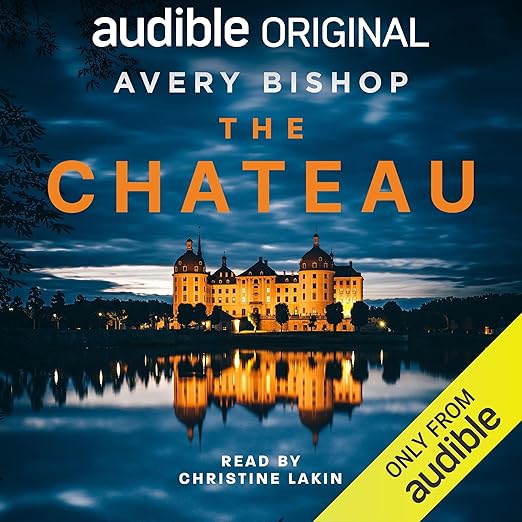
This is an Audible Original, meaning it was released exclusively through Audible before any print edition. That context matters because Audible Originals are specifically designed for the audio format, and Bishop has made structural choices that work particularly well in that medium. The interrogation scenes, where Nina is questioned by detectives who believe she holds relevant information, have a quality in audio that print cannot quite replicate: you hear the pauses, the deflections, the moments where Nina’s answer does not quite match what was asked.
Why Listen to The Chateau
Christine Lakin’s narration is genuinely exceptional here, which several reviewers flagged independently. One noted the absence of distracting audio artifacts, which sounds like low praise but is actually a meaningful technical achievement across a seven-and-a-half-hour recording. More substantially, reviewer Debbie Mastalski observed that Lakin’s narration adds to the tension throughout, which is the correct way to describe what a skilled thriller narrator does: they do not merely read the suspense, they generate it. Lakin’s character differentiation is clean, her pacing through the interrogation scenes is precise, and her handling of Nina’s unreliable narration is well judged.
The book moves quickly. At seven hours and thirty-two minutes it does not overstay, and the plot’s forward momentum is maintained throughout. One reviewer who gave it four stars rather than five noted it was twisty without quite pinning down where it fell short, which suggests the ambiguities are more structural than substantive.
What to Watch For in The Chateau
As an Audible Original released in August 2025, the review count is relatively small at eleven, and the range from two to five stars includes one reviewer who objected to the presence of a same-sex couple in the guest roster rather than to anything about the book’s craft. That review should be disregarded as irrelevant to the audiobook’s quality. The meaningful critical feedback is light, which for a thriller of this type generally means the mechanics worked as intended. The genre conventions are present throughout, including the unreliable narrator, the back-and-forth timeline, and the web of concealed secrets among a small group of people. Readers who have fatigued on those conventions may find this one familiar in structure even if the specific mystery is satisfying.
Who Should Listen to The Chateau
This is for listeners who want a propulsive, professionally executed psychological thriller with a narrator who actively contributes to the listening experience rather than merely accompanying it. Fans of domestic suspense in enclosed settings and anyone who appreciates Audible Originals that feel purpose-built for the audio format will find The Chateau a reliable choice. Skip it if thriller conventions feel overworked to you at this point, or if you prefer your suspense fiction to be more psychologically layered than plot-driven.
Frequently Asked Questions
Is The Chateau available in print, or is it exclusively an Audible Original?
Based on the metadata, it was released as an Audible Original in August 2025. Audible Originals are sometimes made available in print after their exclusive window, but at the time of this review it appears to be audio-exclusive.
Does Christine Lakin’s narration handle multiple characters convincingly, or does the large guest roster create confusion?
Multiple reviewers specifically praised Lakin’s character differentiation as one of the audiobook’s strengths. She maintains distinct voices across the ensemble of resort guests without confusion, which is essential for a mystery where the other guests are all potential suspects.
How does the back-and-forth timeline structure work in audio compared to print?
The structure works effectively in audio because Lakin’s delivery of the timeline shifts is clear and signals the movement without requiring visual chapter breaks. The interrogation-present and memory-past alternation builds tension specifically suited to listening.
Is the ending of The Chateau genuinely surprising, or does it telegraph its conclusion too early?
Based on reviewer responses, the conclusion surprised most listeners, with the eye-opening finish mentioned by multiple readers. Bishop appears to have successfully obscured the solution through the unreliable memory mechanism.