Quick Take
- Narration: Leila Buck brings a measured, intimate quality to Amra’s teenage voice that honors both the horror and the resilience at the heart of this memoir.
- Themes: War and survival, ethnic hatred and genocide, the anchoring power of animals, education as escape
- Mood: Harrowing and deeply human, emotionally demanding but never exploitative
- Verdict: One of the more important YA memoirs in recent years, documenting the Bosnian War siege of Bihac through the eyes of a teenager who survived it.
There are books I approach with a certain careful preparation, and The Cat I Never Named was one of them. I knew going in that it dealt with the Bosnian War, with genocide, with a teenager navigating starvation and ethnic violence in a city under siege. I listened to the opening chapters on a Sunday evening, expecting to need distance. What I didn’t expect was to be so completely absorbed by the specific texture of Amra’s world, the school friendships interrupted, the food calculations, the way ordinary life and extraordinary terror coexist until coexistence becomes impossible, that I listened through to dawn without planning to.
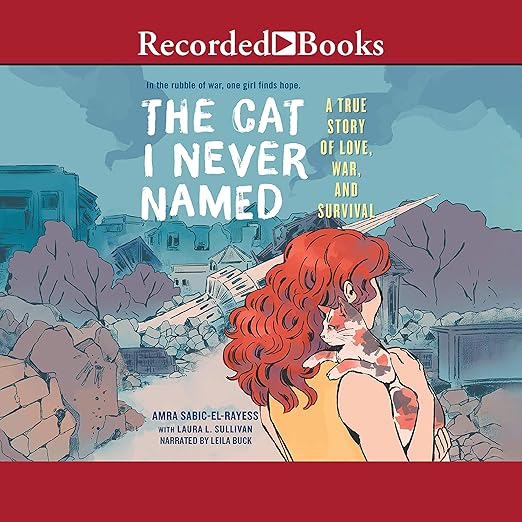
Amra Sabic-El-Rayess was sixteen years old when the Serbian army surrounded Bihac in 1992. What had been a multicultural city of Muslims, Croats, and Serbs became, almost overnight, a place where centuries of buried hatred surfaced in organized brutality. The memoir does not spare the reader from what that looked like. But it also doesn’t allow the horror to flatten the humanity. Amra’s family, her friendships, the new boy she notices, the stray cat they name Maci who becomes a kind of guardian spirit for the household, these details insist on the fullness of life even as the circumstances of war systematically strip it away.
Our Take on The Cat I Never Named
The book’s most remarkable quality is its dual fidelity: to the specific young person Amra was during the siege and to the larger historical and political context that made the siege possible. These two registers don’t fight each other, a teenager worrying about the attentions of a boy while also calculating food rations is not a contradiction but a truth about how human beings actually experience catastrophe. One reviewer who lived through the same siege described the book’s accuracy with specificity: it captures how quickly friends turned into enemies, how centuries of hatred against the Muslim population led to the worst genocide on the European continent since WWII.
The role of education is woven through the memoir as something close to a lifeline. As an educator, one reviewer was especially moved by how education functioned as a tool to help Amra escape her circumstances, and the book makes this concrete rather than abstract. The determination to learn, to maintain the structure that school provides, to hold onto some sense of a future, is one of the through-lines that makes this book something more than a survival narrative. It’s also a portrait of what education means when everything else is being taken away.
Why Listen to The Cat I Never Named
Leila Buck’s narration is a genuine asset. This is a first-person teenage memoir set in a very specific cultural and historical context, and Buck navigates the dual challenge of rendering both the adolescent interiority of Amra’s voice and the gravity of what she is describing. The performance is intimate and measured, there is no performed anguish, no melodramatic reaching for effect. The restraint is exactly right for material this serious. At just over 12 hours, the audiobook has room for the kind of immersive storytelling that transforms a historical account into something felt rather than merely understood.
The title itself, the cat that Amra’s family shelters but never names, because naming creates attachment and attachment creates vulnerability, except that the attachment happens anyway, is a quiet piece of thematic precision that Buck’s narration carries well. The cat Maci is not a sentimental device. It’s a structural element of the memoir, present at key moments, and the decision about naming resonates differently as the siege wears on.
What to Watch For in The Cat I Never Named
This is demanding listening. The descriptions of starvation, ethnic cleansing, and the psychological impact of prolonged siege warfare are handled with honesty and care, but they are not softened. One reviewer described reading the book in a single day despite not being someone who typically enjoys reading, that’s a measure of how compelling the narrative is, but also an indication of how much emotional weight it carries. Listeners who are sensitive to depictions of violence against civilians, including children, should know that the book does not avert its gaze.
The memoir is also, importantly, a YA title, it is written for teenage readers, though it has clearly found a substantial adult audience. This means the writing is accessible and direct in a way that suits audio, and it also means the perspective is consistently that of a teenager navigating events that no teenager should have to navigate. Some adult readers find that the YA framing makes the horror more rather than less affecting, because it refuses the distancing that more explicitly adult historical narratives sometimes provide.
Who Should Listen to The Cat I Never Named
This is appropriate for listeners aged 14 and up, and particularly for anyone with an interest in the Bosnian War, the 1990s genocide in the former Yugoslavia, or the broader question of how ordinary communities become capable of extraordinary violence. Several reviewers who had personal connections to Bihac and the siege described the book’s accuracy and emotional truth as remarkable. For educators looking for a memoir that connects the specific experience of war to larger questions about prejudice, education, and human dignity, this is one of the strongest available in the YA category. If the subject matter is too close or too heavy for your current listening season, it will wait, but it rewards the encounter.
Frequently Asked Questions
Is The Cat I Never Named appropriate for younger teen listeners, or is the content too graphic?
The book is designated YA and was written with teenage readers in mind. The violence and deprivation described are real and not sanitized, but Amra’s perspective keeps the focus on survival, relationships, and resilience rather than on graphic detail for its own sake. Most educators recommend it for readers 14 and up, with parental awareness for younger teens who are sensitive to depictions of war and ethnic violence.
How much does the cat Maci actually appear in the book? Is it primarily an animal story or a war memoir?
This is primarily a war memoir and coming-of-age survival story. Maci appears throughout and functions as a genuine emotional anchor for the family, but the book is not a pet narrative. The title refers to something more metaphorical, the decision not to name something as a form of self-protection, and the way that protective distance fails in the face of genuine connection.
Does Leila Buck’s narration capture the cultural specificity of a Bosnian Muslim teenager in the 1990s?
Buck’s narration is intimate and respectful of the material rather than attempting to perform a specific ethnic accent or cultural marker. The cultural specificity comes through the writing itself, the family dynamics, the food, the community relationships, the particular texture of Bihac as a city, and Buck’s performance allows that specificity to surface without imposing anything on top of it.
Is there any resolution or sense of what happened to Amra after the events described?
Yes. Without going into detail, the memoir does account for Amra’s life after the siege and her journey toward the educational opportunities she fought to reach during it. The framing of the narrative, written by the adult Amra looking back, means the reader knows she survived, but the memoir is careful about how it handles that temporal distance. The resolution is meaningful without being triumphalist about what it cost.