Quick Take
- Narration: Mark Smeby delivers a clear, accessible read pitched at the young adult register the student edition targets.
- Themes: Christian apologetics, responding to doubt, faith and intellectual inquiry
- Mood: Earnest and investigative, structured like a courtroom brief
- Verdict: A well-executed gateway apologetics audiobook for teenagers and young adults wrestling with questions about Christianity, limited for readers seeking philosophical depth.
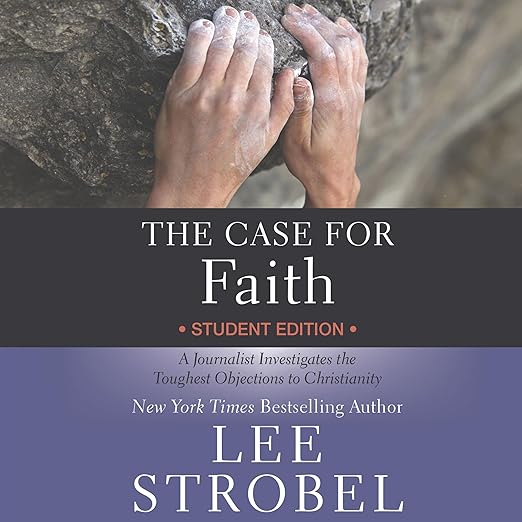
At just over two hours, The Case for Faith Student Edition is built for the attention span of a teenager who has just heard something at school, or at a dinner table, that made them genuinely uncertain about what they believe. That is an honest and specific target audience, and Lee Strobel, who built his reputation on translating skeptical inquiry into accessible faith arguments, generally knows how to write for it.
I should acknowledge my own position clearly: I am not the target listener for this book. My interest in it is partly as a communications object, how does a journalist-turned-apologist condense some of the hardest theological problems into a format a sixteen-year-old can engage? And partly as a genuine curiosity about whether Strobel’s journalistic framing still holds up in a cultural moment when the objections to Christianity are both more numerous and more sophisticated than they were when the original Case for Faith was published in 2000.
Our Take on The Case for Faith Student Edition
Strobel structures the book as an investigation into eight major objections to Christianity: the existence of suffering, the credibility of miracles, the reality of hell, questions about those who have never heard of Jesus, and others in similar territory. He interviews scholars across these areas and presents the exchanges in a question-and-answer format that mirrors his journalism background. The approach makes difficult material accessible without entirely stripping it of substance, which is a genuine achievement in a 140-minute audiobook.
Reviewer E. Johnson noted this is a revised student edition of the original and works well alongside Strobel’s Case for Christ. That sequencing is accurate, the two books address adjacent objections and complement each other. Reviewer Zane D. LaPlant described it as essential preparation for believers who need to articulate answers to challenges they will encounter from skeptics, which reflects the apologetics mission clearly.
Why Listen to the Student Edition If You Are an Adult
Strobel’s investigative framing is both the book’s greatest strength and its most significant limitation. The interview format creates the impression of weighing both sides of each question, and it makes the material feel like a genuine inquiry rather than a predetermined defense. But the scholars Strobel consults are uniformly sympathetic to Christian conclusions, which means the interrogation is never as adversarial as the journalistic frame implies. Reviewer Richard A. Hayward, who gave it four stars, wished he had purchased the full adult edition for the additional content, a note worth heeding for anyone wanting more depth.
What to Watch For in the Apologetics Format
The student edition is specifically adapted to be shorter and more accessible than the original adult version. That compression means some of the theological arguments are presented in their most digestible form, which is appropriate for the audience but should not be mistaken for comprehensive engagement with the objections. Reviewer Choose To Be Golden noted the book increased their faith and knowledge in ways they did not anticipate, which suggests the material works even for readers approaching from inside faith, not just from skeptical doubt. Mark Smeby’s narration is clearly pitched at the young adult register: unhurried, friendly, and careful with terminology that might be unfamiliar to a listener without church background.
Who Should Listen to The Case for Faith Student Edition
This is designed for Christian teenagers and young adults encountering skeptical arguments, from peers, from school, from social media, and wanting to understand how thoughtful Christians respond to them. It also works for adult listeners new to apologetics who want an accessible entry point before reading longer works by Alvin Plantinga or N.T. Wright. It is not the right pick for readers who want genuine philosophical debate, sustained engagement with atheist arguments in their strongest forms, or academic theology. Strobel is a communicator, not a philosopher, and this book is best appreciated for what it is rather than what it is not. Within those parameters, it does its job cleanly.
Frequently Asked Questions
How does the student edition differ from the original Case for Faith for adults?
The student edition is shorter, adapted in language and format for teenage readers, and includes infographics and charts in the print version (which do not translate to audio). Some arguments are condensed compared to the adult edition. Reviewer Richard A. Hayward specifically noted wishing he had bought the adult edition for the extra content, suggesting adult listeners seeking full depth should consider the unabridged version.
Does this audiobook require prior religious knowledge, or can skeptics follow along?
Strobel explicitly targets both believers with doubts and non-believers curious about Christianity. The book does not assume deep theological knowledge and explains its terms. That said, the argumentative framework assumes Christianity is the tradition worth defending, so purely secular listeners may find the premise narrower than the investigative framing implies.
Is the two-hour runtime enough to meaningfully address questions like the problem of evil?
Strobel covers eight major objections in that runtime, which means each receives a compressed treatment. The arguments are useful as starting points and conversation starters rather than definitive resolutions. Listeners who want sustained philosophical engagement with the problem of evil specifically should look to longer-form resources afterward.
Can this audiobook be used in a youth group or classroom setting?
Yes, Strobel explicitly mentions this application in the book’s description, and it is well-suited to discussion-based settings. Each of the eight objections functions as a self-contained topic that could anchor a session. The interview format also makes it easier to pause and discuss than a more narrative-driven audiobook.