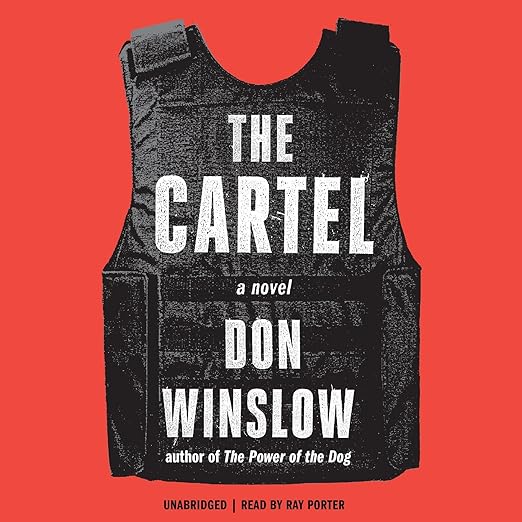
Quick Take
- Narration: Ray Porter is superb here, his controlled intensity matches Winslow’s journalistic precision, and he manages a vast cast of characters across 23+ hours without losing a single voice.
- Themes: The war on drugs and its human cost, obsession and moral compromise, systemic corruption from Mexico to Washington
- Mood: Relentless and devastating, with the texture of lived reportage
- Verdict: The Cartel is Don Winslow operating at the peak of his powers, a novel that feels like it was written by someone who could not look away from what he was documenting.
I came to The Cartel late, having already read The Power of the Dog and spent several weeks afterward trying to shake its residue. I waited months before starting the sequel, partly because I knew what Winslow was capable of and wasn’t sure I was ready for another 23 hours of that particular darkness. When I finally started it on a long trip, I listened for six hours on the first day. That tells you most of what you need to know.
This is Book 2 of Winslow’s Power of the Dog trilogy, and while the publisher says you don’t need the first book, I’d push back gently on that. The relationship between DEA agent Art Keller and cartel boss Adan Barrera, the blood feud at the center of both novels, carries weight that is significantly greater if you have already watched it form in the first volume.
Our Take on The Cartel
The Cartel picks up in 2004, with Barrera out of prison and determined to rebuild El Federacion from the ground up. Keller, who sacrificed everything to put him away, cannot accept a world in which that sacrifice goes unrewarded. What follows is a decade-long odyssey that spans Mexico, the corridors of American political power, and the streets of Berlin and Barcelona. Winslow has always written crime fiction with the moral weight of literary fiction, and this volume doubles down on that ambition.
What distinguishes The Cartel from almost everything else in the genre is its documentary commitment. Winslow incorporates actual events, the splintering of the Sinaloa cartel, the emergence of the Zetas, the infamous Iguala bus attack in which forty-three students were murdered, into a narrative that handles them with the care those events deserve. One reviewer called it journalistic in its immediacy, and that is exactly right. Reading Winslow, you sometimes forget which parts are fiction.
Why Listen to The Cartel
Ray Porter’s narration is the main reason to choose audio for this series, and I say that as someone who thinks Winslow’s prose is strong enough to carry itself on the page. Porter understands the rhythms of Winslow’s sentences, the short declarative blows that land like news bulletins, and the longer passages that build into something almost elegiac. He also manages a cast that runs into the dozens across 23-plus hours, keeping Mexican cartel figures, American agents, journalists, and politicians all distinct from one another. It is a technically demanding performance and Porter makes it sound effortless.
At 4.5 stars, the audience response reflects readers who came to the series with high expectations and found them met. Multiple reviewers describe the book as unputdownable, and one simply wrote: Don Winslow doing what he does best.
What to Watch For in The Cartel
The violence in this book is extreme and unflinching. Winslow does not sanitize the reality of the drug war, and several passages, particularly those involving the Zetas’ methods, are genuinely harrowing. This is not gratuitous; it is purposeful. But listeners who are sensitive to detailed depictions of torture and mass killing should be forewarned. This is a book about a war, and Winslow treats it as one.
The scope can also be disorienting in the early hours. Winslow juggles multiple storylines, Keller’s covert operations, a journalist covering the cartels, the internal power struggles within El Federacion, and the early chapters move quickly between them. The payoff arrives, but the first few hours require active listening to establish the geography of the narrative.
Who Should Listen to The Cartel
Listeners who have already read or listened to The Power of the Dog should begin this immediately. Those new to the series should start with Book 1 rather than jumping in here, not because The Cartel is inaccessible, but because the emotional stakes are built across both volumes. This is essential listening for readers of literary crime fiction, fans of Cormac McCarthy’s No Country for Old Men, or anyone who wants to understand the mechanics and human cost of the American drug war as it played out in the first decade of the 2000s.
Frequently Asked Questions
Is it necessary to read The Power of the Dog before The Cartel?
The publisher markets it as standalone, but the emotional weight of Art Keller and Adan Barrera’s feud is significantly richer with the first book’s context. If you’re investing 23 hours, starting at the beginning of the trilogy is the stronger choice.
How does Ray Porter handle the large cast of Mexican and American characters in audio?
Porter is widely considered one of the best narrators working in crime fiction, and his performance here justifies that reputation. He maintains distinct vocal identities for a cast that spans dozens of named characters across multiple countries.
Does The Cartel incorporate real historical events from the Mexican drug war?
Yes, extensively. Winslow incorporates fictionalized versions of documented events including cartel territorial wars, political corruption, and the Iguala disappearances. Reviewers consistently note the book reads like fictionalized journalism.
How graphic is the violence in The Cartel compared to typical crime fiction?
Significantly more graphic than most genre fiction. Winslow does not pull back from the realities of cartel violence. Several passages are genuinely disturbing. This is intentional and purposeful, but sensitive listeners should be prepared.