Quick Take
- Narration: Jonathan Marosz handles the dense, atmospheric prose with clarity, delivering Preston and Child’s descriptive passages without letting the detail slow the momentum.
- Themes: Scientific obsession, historical evil recurring in the present, the cost of knowledge
- Mood: Gothic and atmospheric, with a propulsive investigation backbone
- Verdict: Widely considered one of the strongest entries in the Pendergast series, this is Preston and Child working at their most ambitious, with a central mystery that sustains genuine dread across seventeen hours.
I started The Cabinet of Curiosities on a Saturday evening intending to listen for an hour before making dinner. Four hours later I was eating cold cereal at my kitchen counter with my headphones in, unwilling to stop while Pendergast navigated an ancient tunnel beneath New York City and the full scale of what was found there began to emerge. Preston and Child have a gift for the grand, operatic gesture in crime fiction, and The Cabinet of Curiosities is one of their most sustained demonstrations of it.
The third entry in the Aloysius Pendergast series, following Relic and Reliquary, The Cabinet of Curiosities does something ambitious with its premise: it roots a contemporary serial killer investigation in a historical atrocity, specifically thirty-six murders committed in a New York charnel house more than a century before the novel opens. When the bodies are discovered during construction work and identical killings begin in the present, the connection between past and present becomes the engine of the investigation. NPR named it one of the hundred best thrillers ever written, which is the kind of endorsement that makes a list-maker cautious, but in this case it holds up.
Our Take on The Cabinet of Curiosities
What distinguishes The Cabinet of Curiosities from much of the Pendergast series is the quality of its dual timeline construction. The nineteenth-century sections, depicting the New York of the 1880s and the world of the charnel house’s original occupant, are rendered with enough historical specificity to feel genuinely inhabited rather than decorative. One review singled out the geographical and cultural material about nineteenth-century Manhattan as rivetingly terrific and factually accurate, which reflects the research investment Preston and Child made in that dimension of the novel.
The central concept, a serum designed to extend life through what amounts to a form of ritualistic murder, sounds pulpy in summary but is handled with enough pseudo-scientific plausibility to function as genuine dread rather than camp. The character of Pendergast benefits from the historical mystery dimension, which gives him intellectual material proportionate to his extravagant analytical gifts. One reviewer called this the crown jewel of the Pendergast series, and while readers who have followed the full run of the books identify later installments where the formula runs down, this entry shows the collaborative partnership at its peak.
Why Listen to The Cabinet of Curiosities
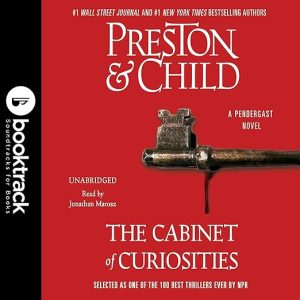
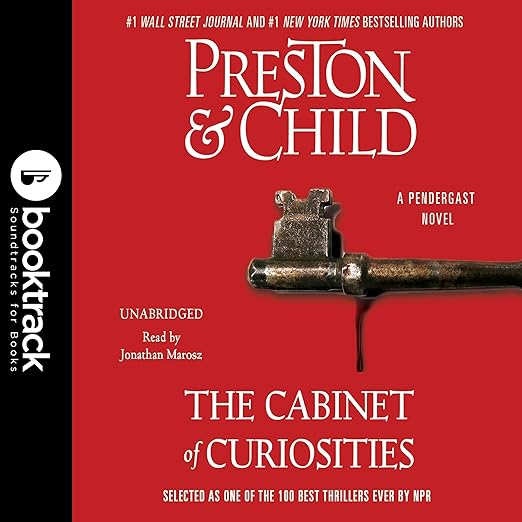
Jonathan Marosz handles the novel’s considerable length, seventeen hours and four minutes, with consistent energy and pacing precision. The book alternates between dense descriptive passages and rapid investigation sequences, and Marosz calibrates his delivery accordingly, giving the historical sections a slightly more formal cadence while keeping the present-day plot moving at full speed. The Booktrack format available on this edition adds complementary music alongside the narration, though the standard narration stands fully on its own for listeners who prefer undistracted delivery.
At seventeen hours, this is a significant commitment, but Preston and Child’s plotting discipline ensures the runtime earns itself. There is very little slack here; the historical material and the present-day investigation inform each other across the full length, and the payoff is proportionate to the investment required.
What to Watch For in The Cabinet of Curiosities
Readers who have followed the Pendergast series from Relic will recognize the formula: eccentric, almost supernaturally capable FBI agent, gruesome historical crime with scientific ambition at its center, supporting cast that includes both allies and institutional obstacles. The formula is executed well here, but listeners new to Pendergast should know that the character operates according to conventions established in the earlier books and will feel somewhat opaque without that context.
The pseudo-scientific premise, while handled with seriousness, requires a suspension of disbelief that not all thriller readers will willingly extend. If you prefer your crime fiction to stay within the boundaries of forensic realism, the novel’s central mechanism may test your patience. For readers who enjoy the speculative dimension that Preston and Child routinely bring to their crimes, this element is a strength rather than a liability.
Who Should Listen to The Cabinet of Curiosities
The Cabinet of Curiosities rewards listeners who have already engaged with the Pendergast series, ideally having at least listened to Relic and Reliquary first. It also works as an entry point for readers drawn specifically to the historical-mystery dimension, since the nineteenth-century material is substantial enough to constitute a major attraction in its own right. Fans of Kate Quinn’s historical investigation novels or Caleb Carr’s The Alienist will find familiar pleasures in the period texture and the intersection of science and crime. Listeners who want fast-moving, lower-density crime fiction may find seventeen hours of Preston and Child’s atmospheric style more demanding than they prefer.
Frequently Asked Questions
Should I read Relic and Reliquary before listening to The Cabinet of Curiosities, or can I start here?
While The Cabinet of Curiosities can be followed as a standalone investigation, Pendergast as a character carries significant backstory from the earlier novels that shapes how he is presented here. Starting from Relic provides the fullest understanding of who he is and why the supporting cast responds to him as they do. Most Pendergast fans consider the first three books a natural unit.
What is the Booktrack format mentioned in the listing, and should I choose it over standard narration?
The Booktrack edition adds complementary background music synchronized to the narration. The music is designed to sit beneath the spoken content rather than compete with it. Whether this enhances or distracts from the experience is a personal preference question. The standard narration contains the complete story and is the more widely recommended format.
How graphic is the novel’s depiction of the murders, both historical and contemporary?
Preston and Child work in the tradition of Gothic-inflected thriller writing where the horror of their crimes is conveyed through atmosphere and implication as much as explicit description. The mutilations are described in enough detail to establish the nature of the evil without extending into gratuitous territory. Readers with sensitivity to body horror should be prepared for some confronting material.
Is The Cabinet of Curiosities representative of the Pendergast series as a whole, or is it a high point the later books do not sustain?
Critical consensus and reader reviews generally identify this as one of the strongest entries in the series. Later books introduce elements that divide the existing fan base, particularly around the Pendergast family mythology. This third entry represents the partnership at its most focused and the formula at its most effective.