Quick Take
- Narration: Elizabeth Evans delivers a crisp, emotionally calibrated performance that matches the novel’s high-stakes pacing and its protagonist’s fierce interior voice.
- Themes: elemental magic and power, political intrigue and loyalty, coming-of-age under impossible pressure
- Mood: Propulsive and lush, with a persistent undercurrent of danger
- Verdict: A confident debut that builds an intricate magical world without losing sight of the human drama at its center.
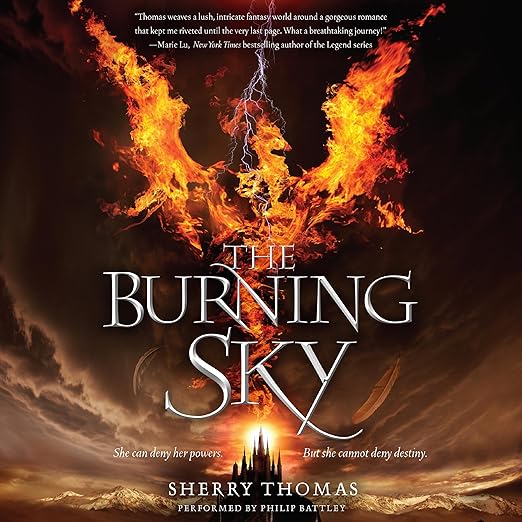
I started listening to The Burning Sky on a long train journey, fully expecting to fall asleep somewhere around the third chapter. Instead I arrived at my destination two stops too late, having completely missed my exit because I was too absorbed in Iolanthe Seabourne’s increasingly complicated situation to pay attention to anything as mundane as a train platform. That kind of listening experience is what I chase with every new fantasy audiobook, and Sherry Thomas delivers it here with considerable skill and genuine narrative intelligence. Her background as a romance novelist gives her an instinct for the precise emotional beat that most pure fantasy writers take chapters to locate, and that precision shows up throughout this debut in the way character decisions feel both surprising and retroactively inevitable once the reasoning becomes clear.
The novel opens on a seemingly ordinary day that very quickly stops being ordinary. Iolanthe, a young elemental mage with unusual power over lightning, finds herself entangled with a prince in disguise who insists her life is in danger and that she must trust him immediately and without explanation. It is the sort of premise that could easily collapse under the weight of its own convenience, but Thomas earns each turn of the plot through the sheer quality of her characters’ internal lives. These are people who think carefully about their circumstances, who question what they are told, and whose decisions carry genuine weight throughout the narrative. The world’s political stakes are established clearly enough that readers understand why the wrong choice could be catastrophic, not just personally but cosmically.
A World That Earns Its Complexity
The world of The Burning Sky is structured around elemental magic and a political order built on the suppression of those who wield it with genuine power. Thomas has constructed her mythology with the kind of layered consistency that rewards careful listening rather than passive absorption. There are rules here, and the magic system has real internal logic that shapes the story rather than simply serving as a plot convenience when the narrative needs a spectacular escape. The empire’s bureaucratic machinery of control feels genuinely oppressive, and the personal stakes for Iolanthe are established from early in the narrative with enough clarity that listeners understand why going along with Titus is not simply naive compliance but a calculated survival decision. What elevates the worldbuilding beyond mere backdrop is how inseparable it is from the characters’ motivations and from the particular kinds of fear that organize their choices throughout the book.
What Titus Brings to the Story
The dual perspective structure, alternating between Iolanthe and the prince Titus, is where many fantasy novels stumble into the trap of making one viewpoint clearly superior to the other. Thomas avoids this by giving Titus secrets that fundamentally reframe what listeners think they understand about the novel’s central relationship, and his chapters carry a different texture than Iolanthe’s, more guarded, more strategically calculating. His voice as rendered by Elizabeth Evans has a controlled quality that makes his rare moments of genuine feeling land with unexpected and disproportionate force. The slow build of trust between these two protagonists, each of whom has excellent reasons to be deeply suspicious of the other, forms the emotional spine of the audiobook and it holds without requiring either character to become unrecognizably self-sacrificing to sustain it.
Elizabeth Evans and the Demands of a Dual-POV Fantasy
Elizabeth Evans handles the narration with a deftness that this particular material requires. Moving between two protagonists, a large cast of secondary characters, and multiple registers of emotional intensity is genuinely difficult professional work, and Evans makes it sound effortless across the full length of the audiobook. She finds distinct voices for each character without resorting to caricature that would undermine the novel’s emotional seriousness, and her pacing through the novel’s action sequences is particularly effective, tight and propulsive without feeling rushed to the point of incoherence. Her rendering of Iolanthe’s sharp, slightly sardonic inner voice is especially well-judged and gives the character a distinctive presence that makes the chapters from her perspective feel like dispatches from a specific and irreplaceable mind rather than generic fantasy-hero narration.
Who Should Listen and Who Should Think Twice
If you come to fantasy audiobooks primarily for immersive world-building delivered through genuinely compelling characters whose internal lives are as detailed as their external circumstances, this is an excellent choice. Thomas is a romance novelist by background and it shows in the best possible way: her character dynamics are precise, her emotional beats are earned rather than assumed, and she understands the value of restraint in letting scenes develop at the pace the material actually needs. Listeners who prefer fantasy that privileges plot mechanics over character psychology may find the pacing of the early chapters slower than they want. Those who want a complete story in a single volume should also know this is book one of a trilogy, and it ends at a point that strongly invites the next installment rather than providing full resolution. For listeners willing to commit to the full journey, the foundation built here is a genuinely strong one. Thomas has proven with this debut that commercial fantasy and genuine literary craft are not incompatible ambitions, and the three-book structure allows her the space to develop both storylines and the relationship between them with the patience that the material deserves and rewards. The craft is evident on every page.
Frequently Asked Questions
Is The Burning Sky appropriate for adult listeners or is it primarily aimed at a younger audience?
The novel sits firmly in the young adult space but reads with enough sophistication to engage adult fantasy listeners comfortably. The emotional themes, the political stakes, and the quality of the prose all work for readers beyond the target demographic.
How does Elizabeth Evans handle the two main perspectives in her narration?
Evans distinguishes Iolanthe and Titus clearly through vocal texture and emotional register without making the distinction feel artificial. Both perspectives feel inhabited rather than performed.
Does the magic system in The Burning Sky require extensive background knowledge to follow?
No. Thomas introduces the elemental magic system gradually and with enough clarity that listeners unfamiliar with the series can follow along without confusion. The internal logic becomes clearer as the story progresses.
Does the audiobook end on a cliffhanger?
It ends at a narrative resting point that concludes the central arc of this volume while leaving significant threads open for the sequel. Whether you call it a cliffhanger depends on your tolerance for unresolved series threads.