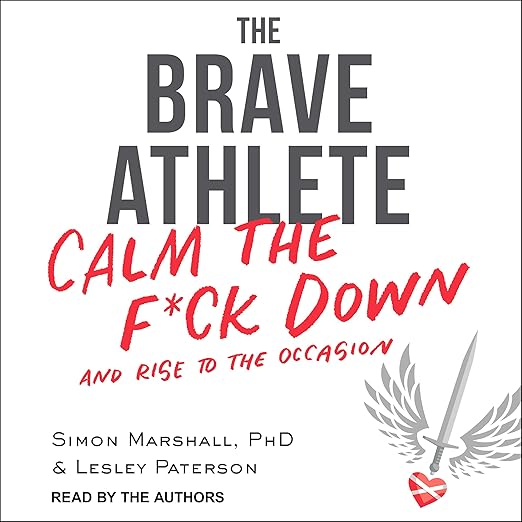
Quick Take
- Narration: Simon Marshall narrates his own book and brings genuine warmth and self-deprecating humor that a hired voice couldn’t replicate – this is one of those rare cases where author narration is the right call.
- Themes: sport psychology, cognitive behavioral tools for athletes, managing fear and self-doubt
- Mood: Practical and irreverent, like getting advice from a smart friend who happens to have a PhD
- Verdict: For any athlete who has ever bailed on a workout, choked in a race, or spent the night before an event in quiet dread, this is the most useful nine hours you’ll spend with headphones in.
I picked this one up on a recommendation from a friend who races triathlons, and I’ll be honest: I was skeptical. Sport psychology books tend to fall into two camps – the overly academic, full of jargon that keeps readers at arm’s length from the actual tools, or the motivational fluff that sounds good in the moment and evaporates by the next training session. The Brave Athlete is neither of those things.
Dr. Simon Marshall and Lesley Paterson have written something that is, above all, practical. The book is organized around thirteen specific mental problems that athletes face – not vague concepts like ‘confidence’ or ‘focus,’ but named, recognizable situations: you get crazy nervous before a race, you quit when it gets hard, you make dumb mistakes under pressure, you care too much about what other athletes think of you. Each problem gets its own chapter with a diagnosis and a set of concrete exercises. That structure alone puts this ahead of most books in the genre.
Our Take on The Brave Athlete
The central framework is the three-brain model: the Chimp brain, ancient and emotional; the Professor brain, rational and language-based; and the Computer brain, which stores habits and runs them automatically. Marshall borrows this from Steve Peters’ work, but where Peters’ original book felt clinical, The Brave Athlete applies the model to sport-specific situations with enough humor and honesty that it never feels like a lecture. The Chimp brain doesn’t make you a bad athlete – it makes you human. The goal isn’t to silence it but to stop letting it run the show at the wrong moments.
What makes this land in audio is Marshall’s own narration. He is funny in the way that only someone who has watched elite athletes fall apart in predictable ways can be funny – with affection rather than condescension. His British delivery adds a useful dryness to passages that could otherwise tip into self-help earnestness. Lesley Paterson’s presence as co-author is felt in the examples, which are grounded in the real experience of a three-time world champion triathlete rather than constructed case studies.
Why Listen to The Brave Athlete
The reviewer community around this book is notably diverse. Triathletes, marathon runners, cyclists, and even people outside sport entirely – one reviewer was a reserve firefighter who found the breathing and arousal regulation chapters applicable to structural fire work – have found something useful here. That breadth is not a sign that the book is vague. It’s a sign that the underlying psychology is real. Fear is fear whether you’re on a starting line or walking into a burning building. The tools Marshall offers are behavioral and cognitive, not motivational platitudes, and behavioral tools transfer.
At just under ten hours, this is one of the more accessible audiobooks in the sports nonfiction space. It doesn’t demand that you read every chapter sequentially – the problem-based structure means you can skip to the chapters most relevant to where you are right now and return to the others later.
What to Watch For in The Brave Athlete
If you have already read widely in this space – if you’ve worked through Steve Peters, Carol Dweck, and Michael Gervais – some of the conceptual ground will feel familiar. The three-brain model is not new. What is new here is the sport-specific application and the tone, which is consistently irreverent without undermining the seriousness of the underlying research. Listeners who want a purely clinical presentation may find Marshall’s humor distracting, though I’d argue that’s the point – this is a book designed to make the work feel less frightening, not more.
The book is aimed squarely at endurance athletes, and the examples skew toward triathlon and cycling. This isn’t a limitation for most readers, but if you’re a team sport athlete looking for material on collective psychology and group dynamics under pressure, you’ll find less here than you might want.
Who Should Listen to The Brave Athlete
Essential for any endurance athlete who has ever let their head sabotage their legs – which is most of them, at some point. Useful for coaches looking for vocabulary and frameworks to share with athletes who resist traditional mental training approaches. Less suited to complete beginners who haven’t yet developed the self-awareness to recognize which of the thirteen problems apply to them, though it’s worth starting anyway. The section on body image and the relationship between self-criticism and performance is particularly valuable for athletes at all levels.
Frequently Asked Questions
Do I need to be an elite athlete for this book to be useful?
No, and several reviewers make this point explicitly. The mental challenges Marshall and Paterson address – pre-race anxiety, quitting under pressure, fear of failure – affect athletes at every level. If anything, recreational athletes often experience these problems more acutely because they lack the structured mental training support that professionals receive.
How does Marshall’s self-narration affect the listening experience?
Positively. His delivery is warm, dry, and self-aware, and the humor in the text comes across more naturally than it would with a hired narrator reading someone else’s jokes. At under ten hours, the pacing never drags. This is one of the cleaner examples of an author-narrated nonfiction audiobook working exactly as it should.
Is the three-brain Chimp/Professor/Computer model scientifically rigorous?
It’s a simplification, as Marshall himself acknowledges. The model is drawn from Steve Peters’ work and from cognitive behavioral science, and while it doesn’t map precisely onto neuroscience, it functions as a useful working framework for behavior change. Marshall is careful not to overclaim – he’s offering a practical tool, not a neuroscience textbook.
Can the techniques in this book be applied outside of sport?
Yes. Multiple reviewers have noted applications in parenting, workplace performance, and high-stress professional environments. The chapters on managing arousal, handling criticism, and reframing failure are broadly applicable. Marshall focuses on sport because that’s his clinical background, but the underlying cognitive and behavioral tools are not sport-specific.