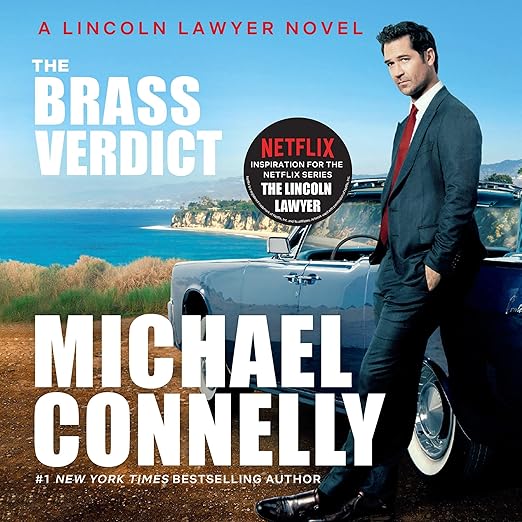
Quick Take
- Narration: Peter Giles delivers Haller’s perspective with the appropriate Los Angeles legal-world cool; the dual-protagonist structure is handled without confusion, though Bosch readers may feel his chapters lack the interiority of his own series.
- Themes: Legal ethics and moral compromise, the uneasy alliance between defense and prosecution, LA as a system that produces and conceals crime
- Mood: Taut and procedural, with the distinctive Connelly quality of feeling simultaneously fast and meticulous
- Verdict: An intelligent legal thriller that rewards readers of both the Bosch and Lincoln Lawyer series, and works as a standalone for listeners new to either.
I finished The Brass Verdict on a Tuesday commute, which felt appropriate: Connelly is fundamentally a city writer, and there is something right about absorbing his Los Angeles fiction while moving through traffic. The book had been in my queue since I wrapped the first Lincoln Lawyer novel, and I was curious how Connelly would handle the collision of his two most fully realized characters in the same narrative space.
This is the second book in the Lincoln Lawyer series and the first to place Mickey Haller alongside Harry Bosch in a sustained way. The premise is clean and believable: a Hollywood defense attorney is murdered, Haller inherits his case load including the defense of a prominent studio executive accused of killing his wife and her lover, and Bosch is assigned to find the killer. The two protagonists are forced into an uneasy collaboration where each is using the other and both know it.
Our Take on The Brass Verdict
Connelly is at the height of his powers here, and the dual-protagonist architecture is the most formally interesting choice he makes. Haller is the first-person narrator of the Lincoln Lawyer series, and Connelly keeps that perspective intact while routing Bosch through Haller’s perception rather than his own inner voice. One reviewer identified this as a brave gambit: Bosch placed in a supporting role, seen from the outside, allows readers who know him intimately to experience the gap between how he presents and what they know of his interior. The calculation works. Seeing Bosch without access to his thoughts makes him more unsettling and more interesting, which is not a result every author could engineer.
The central case, the defense of Walter Elliott, is constructed with the procedural precision Connelly’s readers expect. The courtroom sequences have real texture, the detective work that runs parallel to the legal proceedings is tightly plotted, and the convergence of the two storylines in the final act earns the tension built over the previous chapters. One reviewer noted that the ending contained good twists; another found that it sometimes drags but that the endings are always worth it. Both are accurate assessments of how Connelly structures his middles.
Why Listen to The Brass Verdict
Peter Giles has been the voice of the Lincoln Lawyer series and handles Haller’s particular combination of cynicism and professionalism with a cool that suits the character. The Los Angeles legal world in Connelly’s fiction has its own rhythmic texture: the traffic, the studio lots, the distances between courtrooms and crime scenes, the way money and law intersect in Hollywood that differs from anywhere else. Giles captures that atmosphere without overplaying it, and the result is an audiobook that feels like the right medium for this material. Reading Connelly is one thing; hearing his LA rendered in audio is another.
The book also works as a re-entry point for readers who have lost track of either character. Haller’s two years of wrong turns before the novel begins are addressed efficiently without demanding that listeners have followed his backstory in detail. And Bosch’s presence, even filtered through Haller’s perception, provides enough of his characteristic obsessiveness and moral seriousness to satisfy series readers without requiring deep familiarity with his own novels.
What to Watch For in The Brass Verdict
The book is not without its structural compromises. The middle section, as multiple reviewers have noted, has passages that move more slowly than the setup and resolution, and listeners who are accustomed to Bosch’s internal monologue will find the experience of seeing him from the outside slightly disorienting. That disorientation is part of the novel’s design, but it means the book rewards patience in a way that pure plot-driven thrillers do not always ask for.
The connection to the Netflix Lincoln Lawyer series may also shape expectations in ways that work against the novel. Television has conditioned audiences to a slightly more compressed version of Connelly’s plotting, and the audiobook’s eleven hours require acceptance of a slower, more layered pace than television adaptation allows.
Who Should Listen to The Brass Verdict
This is most immediately satisfying for readers who have spent time with either the Bosch series or the Lincoln Lawyer series and want to see what happens when the two protagonists share narrative space. It also works well as a standalone legal thriller for listeners new to Connelly who want an introduction that is more formally ambitious than a single-protagonist procedural. Listeners who want predominantly courtroom drama will find the balance tilted somewhat toward investigation; those who want a pure detective novel will find the legal proceedings take up more space than expected. The book is doing both, which is what makes it worth the eleven hours.
Frequently Asked Questions
Do I need to have read the first Lincoln Lawyer novel before The Brass Verdict?
Not strictly, but the setup for Haller’s two-year absence from legal work and his return is handled more richly if you know the first book. The novel functions as a standalone, but series context adds dimension to his character arc.
Is The Brass Verdict more of a legal thriller or a detective novel?
It is genuinely both, which is its main formal distinction. Haller’s preparation and trial of the Elliott case provides the legal thriller spine, while Bosch’s parallel investigation into the murdered attorney provides the detective procedural. The two plotlines converge in the final act.
Does the narration change to reflect Bosch’s perspective when he is a point-of-view character?
Bosch is not a point-of-view character in the strict sense; the novel is narrated in Haller’s first person, and Bosch is seen from the outside throughout. This is a deliberate structural choice by Connelly, not a limitation of the audio production.
Is this audiobook a good entry point for listeners new to Michael Connelly’s work?
It is a solid entry point. The premise is self-contained, the characters are introduced with enough context for new readers, and Connelly’s prose and plotting are in good form throughout. Existing fans of either series will get more from the character collision, but the novel does not require prior investment.