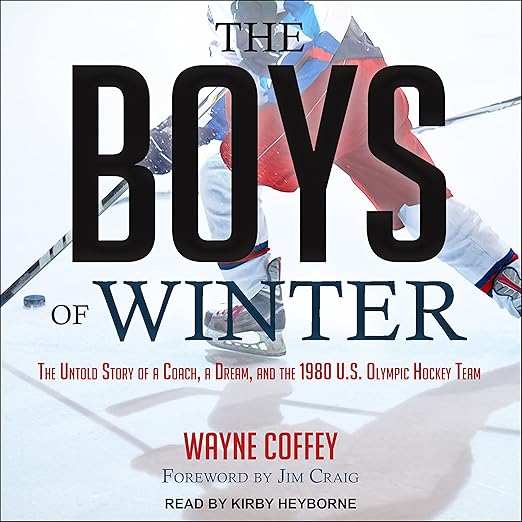
Quick Take
- Narration: Kirby Heyborne delivers a warm, measured performance that handles the biographical interstitials and game-day tension with equal skill.
- Themes: Cold War sport, collective identity, the mythology of the underdog
- Mood: Nostalgic and emotionally generous, with bursts of real athletic tension
- Verdict: A finely crafted account of the 1980 Miracle on Ice that earns its emotional weight by insisting on the particularity of real lives over the shorthand of legend.
I was not alive for the 1980 Lake Placid Olympics, and I came to this story with the particular disadvantage of knowing the ending. Everyone does. The phrase Miracle on Ice has embedded itself so thoroughly into American cultural memory that it has become its own shorthand, a synonym for improbable triumph that you can invoke without reference to hockey at all. What Wayne Coffey does in The Boys of Winter is something more difficult than telling a story: he dismantles a legend carefully enough that the real event underneath becomes more extraordinary than the myth above it.
I finished this one on a Sunday afternoon when I had nowhere to be, listening on a long walk through a neighborhood I barely know. I remember stopping at a corner when Coffey described a particular moment in the Soviet game and realizing that my heart rate had actually increased. The fact that I knew what happened did not insulate me from the tension he builds. That is the mark of genuinely good sports writing.
The Structural Gamble That Pays Off
Coffey makes a structurally bold choice. He tells the story of the US team’s semifinal victory over the Soviet Union, the game itself, in three periods, and into each period he weaves the individual biographical histories of the players on the ice. So a goal scored in the second period becomes an occasion to trace the childhood, the minor-league disappointments, and the particular set of circumstances that brought a specific man to that specific moment on the ice.
One reviewer called this a format that could have failed but largely succeeds, which is an honest assessment. It does occasionally create pacing problems, particularly in the later periods where the game’s tension wants to accelerate and the biographical material demands that it slow down. But the payoff is considerable. By the time the game ends, you know these players not as symbols of national triumph but as specific human beings with specific histories, which is what Coffey wants. The victory means something different when you understand what each man carried onto the ice.
The format also allows Coffey to manage the expectations of a reader who already knows the outcome. Because the biographical material is doing substantial narrative work, the book does not depend entirely on manufactured suspense about a result everyone knows. The drama shifts from what happens to why it happened and to whom, which is where Coffey’s reporting is strongest.
The Soviets and the Interview Access That Changes Everything
The element of Coffey’s reporting that distinguishes this book from other accounts of the same events is his access to the Soviet players. Several reviewers singled this out, and rightly so. The Soviet team in 1980 was one of the great athletic organizations in the history of sport, and the American narrative of the Miracle tends to flatten them into an abstraction, a monolithic opponent whose defeat was principally ideological. Coffey refuses this.
His interviews with Soviet players humanize them in ways that, paradoxically, make the American victory more impressive rather than less. When you understand what the Soviets were and what they represented, you understand more fully what the US team walked out of that arena having done. The sections on the Soviet players’ own experience of the game, their own preparation and expectations, are among the best parts of the book and the element least likely to be found elsewhere in the considerable literature on this event.
Kirby Heyborne and the Weight of a Known Story
Heyborne is one of the more versatile narrators working in audiobooks, and he calibrates his performance well to Coffey’s material. The biographical sections, which require him to inhabit different emotional registers as he moves between different players’ histories, are handled with the kind of quiet specificity that distinguishes a professional who has read the whole text from one who is performing sentence by sentence.
The game-day sections present a different challenge: narrating something the listener already knows the outcome of while sustaining genuine tension. Heyborne solves this primarily through pace, knowing when to slow and let the tension pool and when to let the prose accelerate. One reviewer noted that the book contains a lot of hockey knowledge that might skate over the heads of non-fans, and Heyborne does not editorialize on the technical material, which is the right call. The sport writing is precise, and non-expert listeners can follow the emotional architecture even when the tactical details blur.
Who Should Listen and Who Should Know Going In
Listeners who are hockey fans will get more from the tactical sections than casual sports readers, but the book is not inaccessible to people who came to it because of the broader cultural story. If you watched the 2004 film about the team and want the richer, more complicated version, this delivers that. Coffey’s portrait of coach Herb Brooks is nuanced rather than flattering: he documents the psychological pressure Brooks applied to players alongside his coaching genius, and the book is honest about the internal tensions that shaped the team’s dynamic.
The reviewer who met Ken Morrow in person and tested Coffey’s portrayal against that direct experience found it confirmed, which is meaningful testimony. Readers expecting hagiography should know that what they get instead is something more valuable: a journalist’s account of extraordinary people doing extraordinary things under circumstances that make both the ordinary and the extraordinary legible.
Frequently Asked Questions
How much hockey knowledge do I need to enjoy The Boys of Winter?
The book is written for a general sports audience, not exclusively for hockey insiders. The game-day sections include technical references that dedicated fans will appreciate more fully, but the biographical and emotional architecture of the book is completely accessible to casual readers. Several reviewers without deep hockey backgrounds found it highly rewarding.
Does the book cover the gold medal game against Finland, or only the Soviet semifinal?
The book’s primary focus is the semifinal game against the Soviet Union, which is the game that became mythologized as the Miracle on Ice. The gold medal victory over Finland is covered, but the Soviet game is the structural and emotional center of the narrative.
How does Coffey portray coach Herb Brooks, given that Kurt Russell’s portrayal in the film became iconic?
Coffey’s portrait is more complicated than the film version. He acknowledges Brooks’s coaching genius and his strategic vision, but he also documents the psychological pressure he applied to players and the tensions this created within the team. Players’ own accounts of the experience are varied, and Coffey does not resolve that complexity into a simpler heroic portrait.
Why does Coffey structure the book around the three periods of the Soviet game rather than telling the story chronologically?
The three-period structure allows Coffey to weave individual player biographies into the game narrative so that each goal and turning point is anchored to a specific human story. It is a structural risk, and it occasionally slows the pacing, but it transforms the game from a national symbol into a collection of particular human triumphs, which is the book’s central ambition.