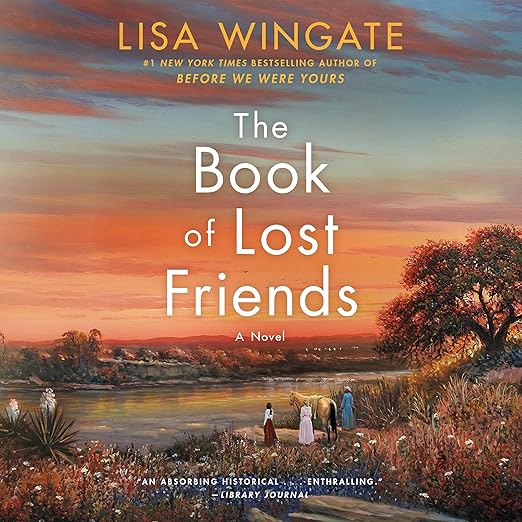
Quick Take
- Narration: Sophie Amoss handles the dual timeline with care, her voice modulates appropriately between 1875 Louisiana and 1987, giving Hannie’s passages a particular emotional weight.
- Themes: Reconstruction-era search for family, inherited history in the American South, teaching as a form of witness
- Mood: Quietly devastating and ultimately hopeful, the kind of historical fiction that stays with you past the last chapter
- Verdict: Wingate at her most purposeful, grounded in documented history and told with enough narrative pull to make 15 hours disappear.
I came to The Book of Lost Friends after a long run of contemporary thrillers, and it landed differently than I expected. Lisa Wingate’s historical fiction tends toward the warm and redemptive, and this novel is no exception, but it earns that warmth through specificity. The “Lost Friends” advertisements she draws from were real: notices placed in Southern newspapers by formerly enslaved people searching for family members sold away before emancipation. Wingate builds her story around that documented record, and the weight of it is felt throughout.
The novel alternates between two Louisiana storylines: Hannie Gossett’s journey westward in 1875, searching for her scattered family in the chaotic aftermath of Reconstruction, and Benedetta Silva’s arrival in 1987 at a struggling rural school near the same stretch of river. The connection between the two timelines is not forced, Wingate is patient about letting it emerge, and when it does, the payoff is genuine rather than contrived.
Our Take on The Book of Lost Friends
What distinguishes this from comparable dual-timeline historical fiction is the way the 1875 narrative refuses to be background texture for the modern story. Hannie, Lavinia, and Juneau Jane are not symbols or archetypes, they are specific people making specific decisions under specific pressure. The road to Texas they travel together is populated by vigilantes and displaced soldiers still fighting a war that ended a decade before, and Wingate renders that landscape without romanticizing it. Reviewer Browner noted the “fraught process of attempting to reconcile the past while looking to the future” as central to both timelines, which is exactly right, the 1875 women and the 1987 teacher are all, in different ways, trying to make something out of inherited damage.
The Benedetta storyline in 1987 is slower to establish its stakes, but Wingate is deliberate about it. Benny arrives in Augustine, Louisiana expecting to pay off student debt with a subsidized teaching position and instead finds herself in a community suspicious of outsiders and a school where poverty has swallowed any possibility of conventional engagement. Her decision to center her curriculum around ancestral research, letting students find their own connections to the history embedded in the land around them, is where the two timelines finally merge, and it is handled with genuine delicacy.
Why Listen to The Book of Lost Friends
Sophie Amoss’s narration is well suited to the material. She does not grandstand. Historical fiction of this kind can tempt narrators into an elevated, theatrical register that keeps listeners at arm’s length, but Amoss stays close to the characters. Her rendering of Hannie’s voice carries an interiority that the written page can sometimes struggle to convey, you feel the exhaustion and determination simultaneously, which is exactly what the character requires. Reviewer C. Stastny Books praised the book’s layered approach to the Gossett family history, noting how the tangled bloodlines of slaveholders and enslaved people sharing a surname were handled with honesty and care. Amoss gives those complexities room to breathe.
At 15 hours, the listening experience rewards sustained attention. This is not a book you should put on as background audio. The relationships between characters build incrementally, and the 1875 passages especially gain texture from being listened to with full attention rather than half-listened to on a commute.
What to Watch For in The Book of Lost Friends
Wingate’s prose is accessible and warm, which is both a strength and a limitation. A few reviewers noted the book is classified under mystery, but it is more accurately historical fiction with narrative tension, if you arrive expecting plot twists and criminal investigation, you may be surprised by how interior and relationship-focused the story actually is. The suspense operates differently: it is the suspense of whether Hannie will find her family, whether Benny will reach her students, whether history will finally be acknowledged rather than buried. Those stakes are real but they require patience.
Readers who found Wingate’s earlier novel Before We Were Yours emotionally effective will recognize the structure and sensibility here. This is companion reading rather than a departure.
Who Should Listen to The Book of Lost Friends
Listeners who respond to dual-timeline historical fiction anchored in documented history, particularly American history of the Reconstruction period, will find this rewarding. It is also excellent for book clubs given the depth of discussion it opens up about inheritance, erasure, and the persistence of the past. Skip it if you are looking for propulsive genre fiction; the pace here is deliberate and the emotional payoff is cumulative rather than immediate.
Frequently Asked Questions
Is The Book of Lost Friends based on real historical documents?
Yes. Wingate drew directly from actual ‘Lost Friends’ advertisements that appeared in Southern newspapers after the Civil War, placed by freed enslaved people searching for family members who had been sold away. The historical grounding is one of the novel’s distinguishing qualities.
Do you need to have read Before We Were Yours before listening to The Book of Lost Friends?
No, The Book of Lost Friends stands alone. Fans of Before We Were Yours will recognize Wingate’s dual-timeline approach and emotional sensibility, but the books share no characters or storylines.
How does Sophie Amoss handle the shift between the 1875 and 1987 timelines?
With restraint and precision. She modulates her register between the two periods without overcorrecting into caricature, giving each narrator her own emotional interior. Hannie’s passages in particular benefit from Amoss’s grounded, unhurried delivery.
Is this categorized as mystery but actually something else?
Yes, The Book of Lost Friends is historical fiction with narrative tension rather than a mystery in the genre sense. There is no crime investigation. The suspense centers on whether Hannie will find her family and whether the past will be acknowledged in the present. Readers expecting a thriller structure may be surprised.