Quick Take
- Narration: Meghan Kelly brings a controlled, slightly guarded quality to Kate’s first-person voice that suits a protagonist who is deliberately concealing things from both other characters and the listener.
- Themes: Secrets and self-preservation, small-town community pressure, grief as moral cover
- Mood: Slow-building and atmospherically unsettled
- Verdict: A thriller that earns its suspense through setting and character concealment more than plot velocity, best suited to listeners who like their crime fiction character-driven and morally gray.
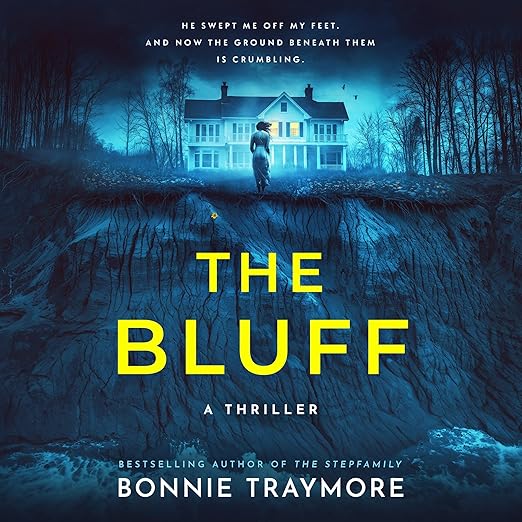
I came to The Bluff on a grey Wednesday afternoon when I was between two larger books and wanted something that would make efficient use of seven and a half hours. Bonnie Traymore’s novel had sat on my list for a while, largely because the setup intrigued me more than the average domestic thriller premise: a woman stuck in a small lakefront town whose house is literally sliding off the eroding bluff into Lake Michigan, right at the moment a murder puts her at the center of suspicion. The literal and figurative ground giving way simultaneously is too good an image to waste, and Traymore does not waste it.
Kate moved to Crest Lake from Manhattan six years before the novel begins, following Ryan Breslow, a charming photographer she was probably moving too fast with by her own admission. Ryan is now dead, a car accident still under investigation, and Kate is isolated, financially trapped by a house that no one will buy because it is inching toward the lake, and increasingly at odds with the neighbors on the shoreline committee whose disputes about how to address the erosion have reached the point of genuine hostility. When one of her opponents on that committee is murdered on the night of a contentious vote, Kate becomes the obvious suspect. She is also concealing something, and the novel’s tension derives almost entirely from managing the distance between what the reader suspects about Kate and what Kate is willing to reveal.
The Crumbling Bluff as Character
Traymore’s best decision was to treat the eroding shoreline not as backdrop but as structural metaphor and active plot element. The ground literally cannot hold: properties that were valuable when purchased are now sliding. The community argument about solutions maps onto the character tensions in ways that feel organic rather than forced. Kate’s urgency about getting the erosion fixed is financial in origin, but it is also psychological: she needs to leave this place, and she cannot leave until the house sells, and the house will not sell until the bluff stops crumbling.
That layering gives the procedural material about committee votes and property values a weight that it would not otherwise carry. The shoreline dispute, which could easily read as an excuse for characters to argue in rooms, becomes genuinely tense because Traymore has invested it with the full weight of Kate’s financial desperation and the community’s accumulated resentments. The setting is doing active narrative work throughout.
The Kate Problem
The most searching review in the batch addresses the central risk of the book’s design: Kate is not a sympathetic protagonist in the conventional sense. One reader called her amoral, shallow, and manipulative, and found her secrets less surprising than the novel seemed to expect. This is a real structural tension in domestic thrillers that use unreliable or morally compromised first-person narrators: the reader is positioned to discover who this person really is, but if the revelation feels thin or if the character never becomes genuinely compelling, the mechanism fails.
Traymore’s Kate is more interesting than that reading suggests, but the criticism has a foundation. Her secrets are logical given who she is established to be, which means astute readers may arrive at them before the novel intends. Whether that constitutes a flaw or simply a faster read depends on your relationship with the genre. For listeners who find morally ambiguous protagonists more interesting than likeable ones, Kate works. For those who need someone to root for, she will test patience.
Meghan Kelly and the Controlled Narrator
Kelly’s narration is well-calibrated for this material. Kate is a woman performing normalcy while concealing anxiety, and Kelly’s delivery carries a consistent quality of mild suppression, the voice of someone choosing words carefully, that serves the unreliable narrator convention without becoming mannered. She does not overperform the unreliability with obvious tells, which is the right choice: the book needs you to believe Kate’s surface presentation for long enough that the gradual erosion of it registers.
The community scenes, where multiple characters with competing interests talk past each other at the committee meetings, are handled with enough vocal differentiation to follow without a scorecard. At seven hours and thirty-three minutes, the listen is comfortable, and the pacing of Traymore’s reveals keeps the listener invested even through the slower middle section.
What the Climax Delivers
Listeners who come to The Bluff through Traymore’s other work will find this consistent with her approach: she is primarily interested in the interior of her characters, in the gap between what people present and what they carry, and the external plot events exist to pressure that interior into revealing itself. Whether that is enough for any given listener depends entirely on what you want from a thriller. As a study of a particular kind of self-protective woman in a particular kind of pressure situation, this is a sharply observed piece of work that uses its Lake Michigan setting to good effect and never overexplains what it is doing.
The final act is described by multiple reviewers as shocking and explosive. My own reading was that it is well-constructed rather than jaw-dropping: the pieces Traymore has assembled make sense in retrospect, and the resolution honors the promises the setup makes without requiring the reader to accept anything implausible. For a domestic thriller, that is the appropriate standard. The book is not trying to overturn the genre. It is trying to execute it with craft and specificity, and on those terms it largely succeeds. Listeners who want their thrillers to move faster and hit harder may find it too deliberate. Listeners who appreciate atmosphere and the slow revelation of character will find more here than the premise initially suggests.
Frequently Asked Questions
Is The Bluff better suited to listeners who like psychological character studies or plot-driven page-turners?
It sits closer to the character-study end of the domestic thriller spectrum. The plot is present and functional, but Traymore’s investment is primarily in Kate’s concealment and the slow revelation of who she actually is. Listeners who need high plot velocity may find the pacing deliberate.
Does the Lake Michigan setting add meaningfully to the atmosphere, or is it interchangeable with any small-town setting?
The setting is integral. The erosion of the bluff is both plot mechanism and metaphor, and the specificity of the lakefront community, its property values, its committee politics, its insularity toward newcomers, is part of what makes Traymore’s world feel inhabited rather than generic.
How does Meghan Kelly handle the first-person unreliable narrator in audio?
With appropriate restraint. Kelly’s delivery of Kate’s voice carries a quality of controlled disclosure that suits a narrator who is systematically withholding information. She does not overperform the unreliability with obvious tells, which is the right choice.
Are the plot twists in The Bluff genuinely surprising, or are they telegraphed early?
Reader responses vary significantly here. Some found the final reveals genuinely shocking; others, including readers with experience in the psychological thriller genre, found the secrets less surprising than anticipated. The book’s real strength is atmospheric tension rather than twist mechanics.