Quick Take
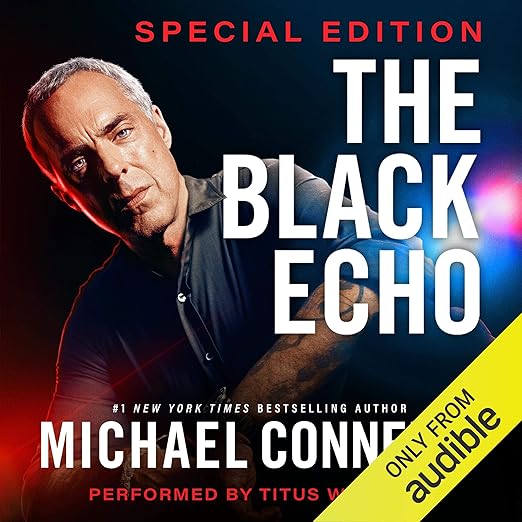
- Narration: Titus Welliver is the definitive voice for Harry Bosch, he played the character on Amazon Prime for seven seasons, and that embodiment gives the narration a lived-in authority no outside casting choice could replicate.
- Themes: Vietnam trauma surfacing in civilian detective work, institutional corruption versus individual justice, the ethics of vengeance versus law
- Mood: Terse and atmospheric, with the Los Angeles grit and tunnel-rat claustrophobia that defined Connelly’s early work
- Verdict: The best possible way to start the Harry Bosch series, Welliver’s performance turns an already excellent debut novel into something that feels definitive, and the bonus interview adds genuine behind-the-scenes texture.
I discovered Harry Bosch through the television series rather than the books, which is, I suspect, increasingly common for newer readers of Connelly’s work. The show ran for seven seasons on Amazon Prime, with Titus Welliver making the character so completely his own that I was curious whether the audiobook would feel like a translation or a homecoming. It is a homecoming. Welliver reading the first Bosch novel is not an actor performing a character; it is a person inhabiting a world they have lived in for years, and the difference is audible from the first paragraph.
The Black Echo is Connelly’s debut novel, published in 1992 and winner of the Edgar Award for Best First Novel. LAPD homicide detective Hieronymus “Harry” Bosch has recently been demoted to Hollywood Division following a shooting scandal, and he is already in the kind of institutional trouble that will define his career. When a body turns up in a drainpipe at Mulholland Dam, the case is initially unremarkable, except that Bosch recognizes the victim as a fellow Vietnam tunnel rat, a man who fought beside him in the underground warfare that left Bosch with the kind of trauma that does not negotiate with civilian life. What follows is simultaneously a conventional Los Angeles crime investigation and a reckoning with a war that never entirely ended for the men who fought it underground.
Our Take on The Black Echo Special Edition
What Connelly understood from his first novel, which is not obvious, because debut novels almost never get this right, is that the best crime fiction is not primarily about the crime. It is about the detective. Harry Bosch is not a detective because he enjoys puzzle-solving. He is a detective because working homicide is the only way he has found to impose order on a universe that demonstrated, in the tunnels of Vietnam, that order was not guaranteed. The victims he investigates are the ones who cannot speak for themselves, and for Bosch that is personal in a way the procedural format usually avoids addressing directly.
The plot architecture is solid: the drainpipe body leads to a bank robbery investigation that leads to a criminal conspiracy with deep roots, and the third act moves into literal tunnels beneath Los Angeles in a sequence that directly echoes the Vietnam trauma at the novel’s heart. The parallel between the tunnels of Vietnam and the tunnels beneath the city is not subtle, but Connelly earns it, the book has spent its full length establishing why that geography holds such dread for Bosch specifically, so when it pays off, the resonance is felt rather than merely noted.
Why Listen to The Black Echo Special Edition
Titus Welliver’s narration is the primary argument for this specific edition over earlier audiobook versions of the novel. He brings the character an economy and weight that Connelly wrote but that requires the right instrument to realize, Bosch is not a verbose character, and much of his emotional state is conveyed through what he does not say. Welliver understands that register at a level that comes from seven years of playing the man on screen. The internal monologue passages, where Bosch is processing his Vietnam memories or navigating his distrust of his own department, are particularly well-handled, quiet, precise, never sentimentalized.
The bonus interview with Connelly and Welliver is included in the special edition and runs to a meaningful length rather than a promotional add-on. The two discuss the origins of the character, the choices Connelly made in the debut that established Bosch’s psychology, and what Welliver brought to the role over his long tenure on the show. For listeners who came to the books through the series, it is a valuable companion piece. For those approaching Connelly for the first time, it works as a persuasive argument for why the series that follows is worth continuing.
What to Watch For in The Black Echo Special Edition
One reviewer who came to the novel after watching the Amazon Prime series noted that the book covers ground the first season incorporates, which means some of the narrative’s surprises will be less surprising for viewers. That is a real consideration. The show adapted this novel significantly, and if you have watched season one carefully, you have encountered versions of several major plot beats. The novel offers depth and context that the adaptation cannot provide, but the pure surprise of the story’s mechanics may be partly spent.
Some readers have also noted that the book’s early 1990s Los Angeles texture, the institutional attitudes, some of the dialogue conventions, can feel dated in specific passages. Connelly’s prose has evolved considerably across thirty-plus years of Bosch novels, and the debut is not as fluid as the mature work. That is a reasonable observation about a first novel, and it does not meaningfully diminish what the book achieves.
Who Should Listen to The Black Echo Special Edition
For anyone beginning the Harry Bosch series, this special edition is the right starting point precisely because of Welliver’s involvement, it sets the sonic template for a character you will spend significant time with, and Connelly’s debut is strong enough that it holds up as the canonical first chapter. Existing fans of the television series who have not read the source material will find the novel offers backstory and psychological depth the show could only gesture at. Readers new to crime fiction who want a serious, psychologically grounded police procedural, one that uses Los Angeles as a real city rather than a backdrop, will find Connelly’s debut has not aged as poorly as many of its contemporaries. The bonus interview makes this edition worth seeking over alternatives.
Frequently Asked Questions
Is this special edition significantly different from other audiobook versions of The Black Echo?
Yes, in two meaningful ways: Titus Welliver narrates rather than a generic casting choice, bringing seven seasons of playing Harry Bosch on screen to the performance; and the edition includes an exclusive bonus interview with Connelly and Welliver discussing the character’s origins, the novel’s choices, and what the show brought to the role.
How much does prior knowledge of the Amazon Prime Bosch series affect the experience of listening to this novel?
Season one of the show draws directly from the plot of The Black Echo, so viewers who watched it closely will recognize versions of key narrative beats. The novel provides much more psychological context and the Los Angeles atmosphere is richer, but the pure suspense of the plot mechanics will be partially familiar to longtime series viewers.
Does The Black Echo function well as a standalone, or is it primarily the setup for a long series?
It functions as a complete, self-contained crime novel. The Bosch series now runs to over twenty books, but the first novel resolves its case and its central emotional question without leaving cliffhangers. Listeners who want to stop here can; those who continue will find the character develops substantially across the series.
Is Harry Bosch’s Vietnam tunnel-rat backstory essential context for the plot, or is it primarily character color?
It is structurally essential, not just character color. The specific Vietnam experience, tunnel warfare, the underground claustrophobia, the trust required between men in confined lethal spaces, directly parallels and eventually converges with the criminal investigation. The novel earns its psychological depth by making the war’s legacy plot-relevant rather than merely atmospheric.